For more than six decades, Barbara Jakobson stood as a monumental and transformative force within the vibrant ecosystem of the New York art world. Serving concurrently as an influential collector, a fierce and dedicated patron, and a longtime trustee of the Museum of Modern Art (MoMA), Jakobson helped shape the city’s cultural landscape while cultivating a distinct personal footprint. Beyond her institutional influence, she possessed a sharp, discerning curatorial eye and a truly singular sense of style. That refined aesthetic was perhaps nowhere more evident than in her longtime home on Manhattan’s Upper East Side—a five
-story residence that doubled as her own deeply personal, ever-evolving private gallery from the mid-1960s until her death.
Jakobson viewed her living space not merely as domestic quarters, but as an active canvas for her life and passions. “I see the house as a vessel for an ongoing autobiographical exercise,” Jakobson explained in a 2021 interview with Curbed. “I keep the transformation as proof of life.” That living chronicle, forged through decades of artistic curation and intimate gatherings with creative luminaries, is now being passed to a new chapter. Following her death last year, the historic property was brought to the real estate market in April 2026 with an initial asking price of $9.8 million. After receiving a price reduction of over $800,000, the residence is currently listed at $8.99 million. The prominent listing is held by Leslie Hirsch, Edward Joseph, Howard Morrel, and Benjamin Anderson of Christie’s International Real Estate New York.
Situated along East 74th Street in the highly desirable Lenox Hill neighborhood of Manhattan, the impressive five-story townhouse carries a rich architectural and cultural lineage that predates Jakobson’s long tenure. The structure was originally built in 1910 before undergoing a significant expansion in 1956 directed by architect John Kingsland. The 20-foot-wide abode also boasts a storied cinematic history. Before Jakobson acquired the property, it served as the home of renowned filmmaker Elia Kazan during a pivotal era in his career. While residing within the East 74th Street walls, Kazan directed cinematic masterpieces such as East of Eden, released in 1955, and Splendor in the Grass, which debuted in 1961. During this golden era of Hollywood production on the East Coast, the townhouse frequently welcomed an array of legendary silver-screen icons, with stars such as James Dean, Natalie Wood, and Marlon Brando reportedly visiting the premises.
A native New Yorker deeply attuned to the city’s creative pulse, Jakobson purchased the pad in 1965 and proceeded to anchor her life there for nearly six decades. Throughout those 60 years, the residence functioned as a vital salon for New York’s avant-garde and established creative sets alike. Artists who defined the contemporary canon—including figures such as Jasper Johns, Andy Warhol, Cy Twombly, and Robert Rauschenberg—were frequent guests, mingling within rooms that showcased some of the era’s most important works of art.
Locally nicknamed “the Squirrel House” in charming reference to the whimsical bronze squirrel sculptures that guard the property’s entrance, the residence successfully marries playful eccentricity with timeless refinement. Bold red lacquered front doors open to reveal approximately 6,000 square feet of stylish, meticulously maintained interiors. Within this expansive footprint are a total of eight bedrooms and six full bathrooms, thoughtfully distributed across the building’s multiple levels to accommodate both intimate daily living and large-scale entertaining.
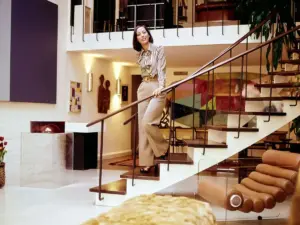
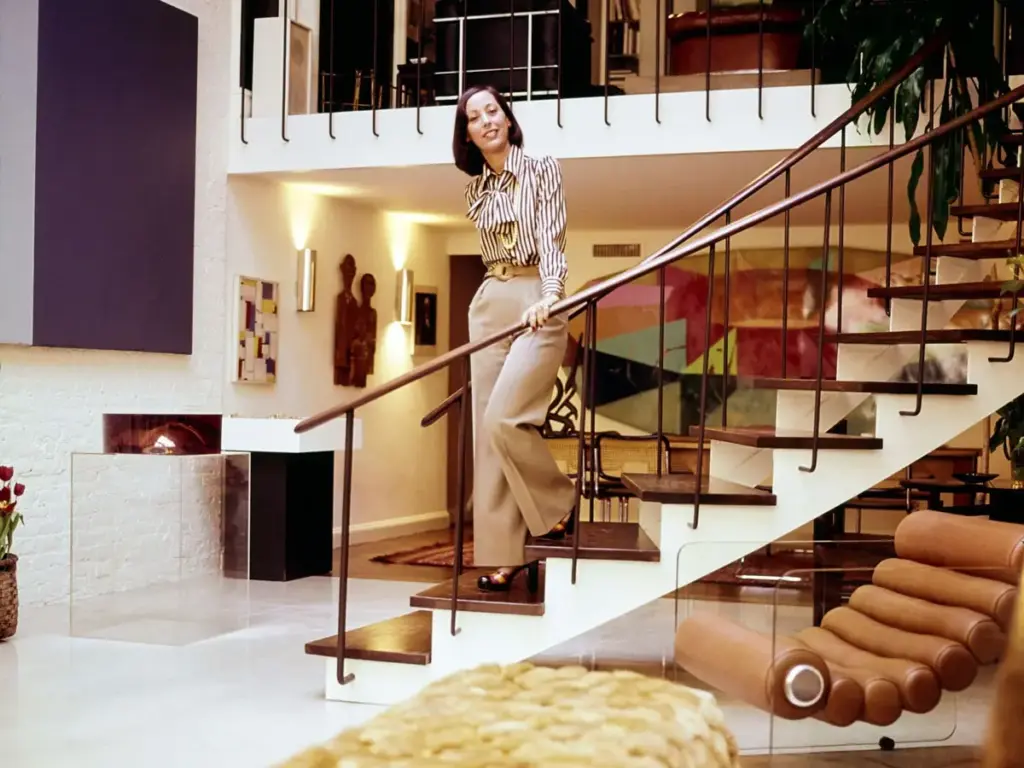
Upon entering the building, visitors are greeted by a grand entry hall defined by striking triple arches and custom wallpaper designed by acclaimed artist Peter Halley. This welcoming transition space flows naturally into the parlor floor, which encompasses a formal living room, a dedicated gallery space, and a sophisticated salon anchored by a functional wood-burning fireplace. A signature architectural feature of the home is its sweeping staircase—the very steps upon which Jakobson was famously photographed for the pages of Vogue magazine. This dramatic staircase spirals downward to a spectacular double-height great room. Though it has since moved on to other collections, the lasting spatial impact of Frank Stella’s monumental 1971 painting Felsztyn III remains tangible here, as its faint outline can still be discerned on the wall where it once hung before being sold in 2005 at a Christie’s auction featuring selections from Jakobson’s legendary collection. From this impressive entertaining volume, glass doors open directly outward to a private, lushly enclosed 350-square-foot garden, offering a quiet green sanctuary in the heart of Manhattan.
The upper floors of the townhouse are dedicated to private quarters and restful retreats. The guest accommodations are thoughtfully spread across the intermediate levels, featuring two distinct junior suites complete with private dressing rooms and well-appointed en-suite bathrooms. Meanwhile, the primary suite commands the entire top floor of the residence. This expansive owner’s domain functions as a light-filled private lounge designed for reading, quiet relaxation, and the contemplative appreciation of art, providing a fitting crown to a home that spent six decades at the intersection of New York’s cultural history.