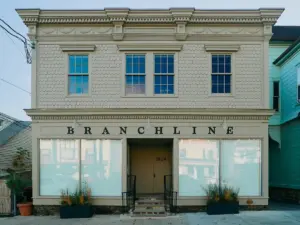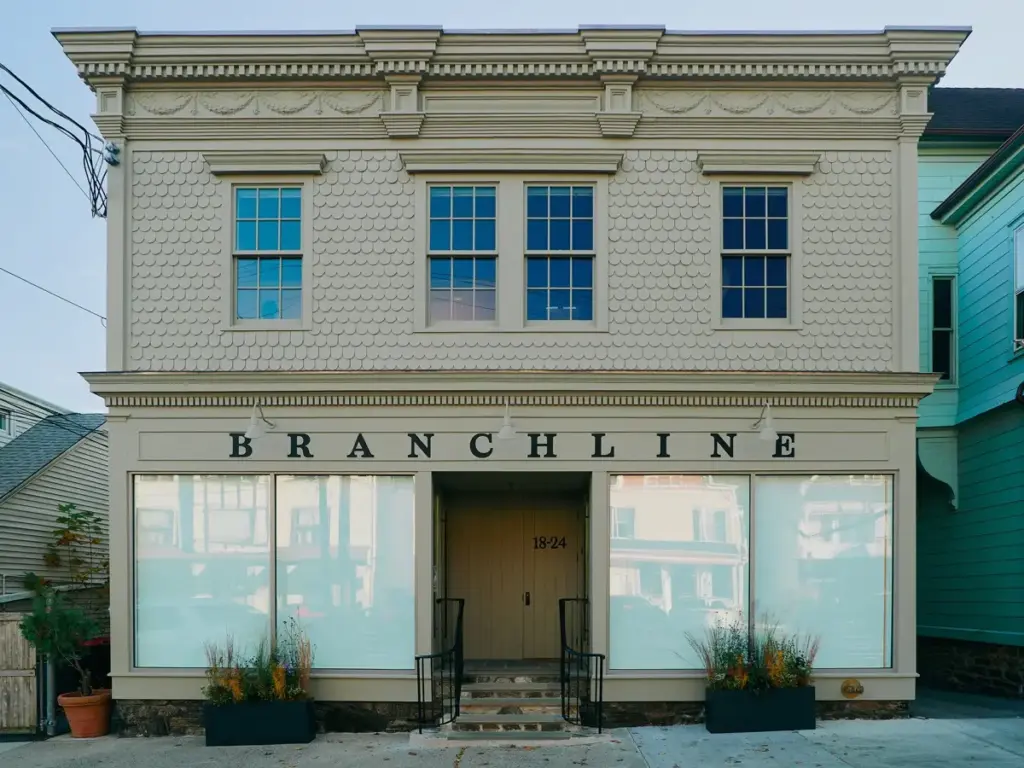
Less than two blocks from the Metro-North train station in Katonah, a nondescript, gray two-story building sits quietly on one of the main commercial drags of this historic Hudson Valley town. Emblazoned in a kerned-out serif font, its name—Branchline—gently belies what actually awaits visitors inside: a striking, public-facing exhibition space dedicated to showcasing the renowned Gochman Family Collection (GFC).
Established just five years ago, the GFC has rapidly evolved into one of the world’s leading private holdings of contemporary Indigenous art, boasting an inventory of more than 850 works. Until now, the vast majority of these pieces were primarily housed in the New York City apartment of Becky Gochman, the collection’s founder and custodian, and her family. While approximately 200 works are typically out on loan to major museums and cultural institutions around the world at any given time, and the family has generously opened their home to museum groups, school classes, and visiting artists for private tours and special events, the ultimate ambition has always been much larger. The organization has long sought a permanent, dedicated venue to make its extensive holdings as widely and publicly accessible as possible.
That mission has now materialized in Katonah. “It’s one thing to articulate a mission, but what matters to me,” GFC creative director and curator Rachel Martin, who is Tlingit, said during a media preview, “is if I’m putting that language out into the world, [then] I’m making sure that our organization is following that with action.” Martin added that she envisions Branchline as a vital place for “bringing community together, which means making the Native community feel like they are very much a part of what the decision-making parts of this are, and then also inviting the community of Katonah to come in and learn about new artists that they might not have heard of.”
Anticipating that many patrons and art enthusiasts will travel north from New York City via the Metro-North rail line, the GFC deliberately chose the name Branchline. The moniker references the transportation term for a railway line that branches off a main route, as well as the conceptual place “where paths diverge and new paths begin,” as GFC director Laura Phipps explained. “We were excited about all the sort of ideas that ‘branch line’ conjures—both thinking about the metaphor of the train and the metaphor of trees—and what we can do to experiment and grow in this space.”
Completely free to the public, Branchline is deliberately taking its time to grow into its new physical surroundings. When fully realized, the cultural hub will encompass approximately 10,000 square feet spread across four interconnected buildings along an L-shaped plot that stretches from the main building’s entrance on the Parkway all the way to Katonah Avenue. The initial inauguration highlights the first completed phase of the project. The main building currently houses a three-room gallery on the ground floor, two residencies or bedrooms upstairs designated for invited artists to spend time and conceptualize projects, and a fully functional ceramics studio taking shape downstairs.

Architectural plans and renderings on display during the preview reveal an ambitious blueprint for the property. The back door of the main building will soon open onto an outdoor sculpture deck, which will lead visitors toward a newly planned barn designed specifically for the exhibition of large-scale works. (The property’s original barn was unfortunately found to be in such structural disrepair that it had to be completely demolished to make way for the new construction.) The future barn will then connect to an experimental project space known as the Annex. From there, visitors can follow a patio pathway that ultimately leads to the back entrance of Twig, a local retail store and café.
Inaugurating the Space with "Line Break"
For now, early visitors will experience Branchline’s core ambitions through a more traditional, highly curated exhibition. Occupying the modest, nearly 2,000-square-foot ground-floor gallery is “Line Break,” an inaugural show organized by GFC assistant curator Moonoka Begay, who is Ndee and Diné, alongside collection associate Nicole van Brugge.
“Lines are a core facet of all visual language,” the exhibition’s introductory wall text observes. However, rather than focusing purely on formal artistic execution, Begay and van Brugge use the concept of the line as a powerful metaphor for lineage, bloodlines, cartographic borders, geographical horizons, and even acoustic sound barriers.
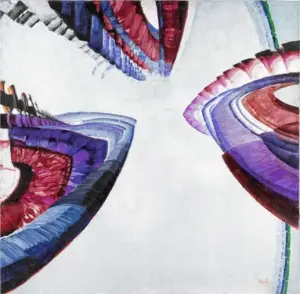
Comprising a tight, thoughtful selection of 28 works by 18 Indigenous artists, “Line Break” presents compelling visual dialogues between different generations working across a diverse array of mediums and styles. Jaune Quick-to-See Smith’s 1988 work, The Spaniard, which offers a semi-abstract aerial perspective of the Flathead Indian Reservation in Montana, hangs in striking proximity to Sara Flores’s Untitled (Shao Pei Maya Kené) from 2024. Flores’s painting is executed in the intricate geometric abstract visual language of the Shipibo-Conibo people, whose complex designs, as noted in the exhibition brochure, serve to “map the community’s local worldview, environmental understanding, and cosmology.”
Further along the gallery walls, Teresa Baker’s Echoes (2024) and George Morrison’s Night Shadows. Red Rock Variation: Lake Superior Landscape (1994) present vibrant, abstract meditations on the natural landscape through wildly contrasting materials. Baker utilizes acrylic, yarn, willow, and artificial sinew layered onto AstroTurf, while Morrison employs traditional acrylic on canvas mounted on board.

Even works that initially appear purely formal quickly reveal deeper narratives upon closer inspection. Across from the pieces by Quick-to-See Smith and Flores hang two works from Nadia Myre’s “Code of Construction” series. In these pieces, the artist arranges strung ceramic cylinders into distinct geometric squares that depict official ground-to-air distress signals, specifically for “Require Map and Compass” and “Not Understood.” Myre’s choice of medium directly honors the rich historical tradition of wampum belts, which have long been utilized by Indigenous communities of the Northeast Woodlands to record and communicate vital political and diplomatic relationships.
This piece finds a thematic counterpart in Faye HeavyShield’s the red line II (2025), consisting of a delicate strand of red beads strung entirely by hand. Displayed as a flexible coil rather than a rigid structure, the piece serves as a subtle metaphor challenging the apparent immutability of form, shape, and time.
Sound, Space, and Future Growth
The exhibition finds its emotional and conceptual centerpiece in Raven Chacon’s Storm Pattern (2021–24). The installation features a handwoven wool textile accompanied by a multichannel sound piece, the low, resonant hum of which visitors can hear immediately upon stepping into the gallery. In 2016, Chacon observed the distinct acoustic signatures produced by surveillance drones flying above the Oceti Sakowin camp at Standing Rock, where water protectors had gathered to oppose the Dakota Access Pipeline.
The sounds—ranging from piercing high frequencies to soft, ambient hums—merged with the noise of the protesters’ own countersurveillance drones. Perceiving a complex musical score within this tense acoustic environment, Chacon recorded the audio and translated the erratic flight paths of the drones into a traditional Diné weaving structure and style, creating a stunning physical textile that permanently records a moment of modern resistance.
Rounding out the core galleries of “Line Break” are elements designed to evolve and change over time. The GFC commissioned artist Matthew Kirk to create a site-specific installation along an exterior alleyway wall of the building. Spanning three plywood panels, Kirk has collaged painted tar paper into abstract shapes and forms. The ephemeral nature of the work was already apparent during the morning preview, as the exposed paper began to warp under a light rain.

A short walk down the same alleyway leads to the Annex, a space that remains actively under construction with exposed plywood framing and temporary work lights illuminating its two floors. Rather than concealing the raw, unfinished nature of the building, the GFC team has chosen to lean into it. The Annex currently houses an intimate exhibition of drawings by Shuvinai Ashoona, an artist who maps imaginative scenes—visions that could potentially materialize one day—onto the stark Arctic landscape surrounding her home in Nunavut, Canada.
Organizers acknowledge that they have not yet finalized what the Annex will look like in the long term, even after construction officially concludes. Its future appearance will depend entirely on how invited artists choose to interpret open-ended prompts that grant them the autonomy to shape the space according to their own visions.
“What GFC is doing is not trying to become an institution,” Martin reflected. “It’s trying to just meet where things are needed, and a space is definitely needed for art that is outside of the white box that you’re used to seeing, so that’s what we’re offering.”