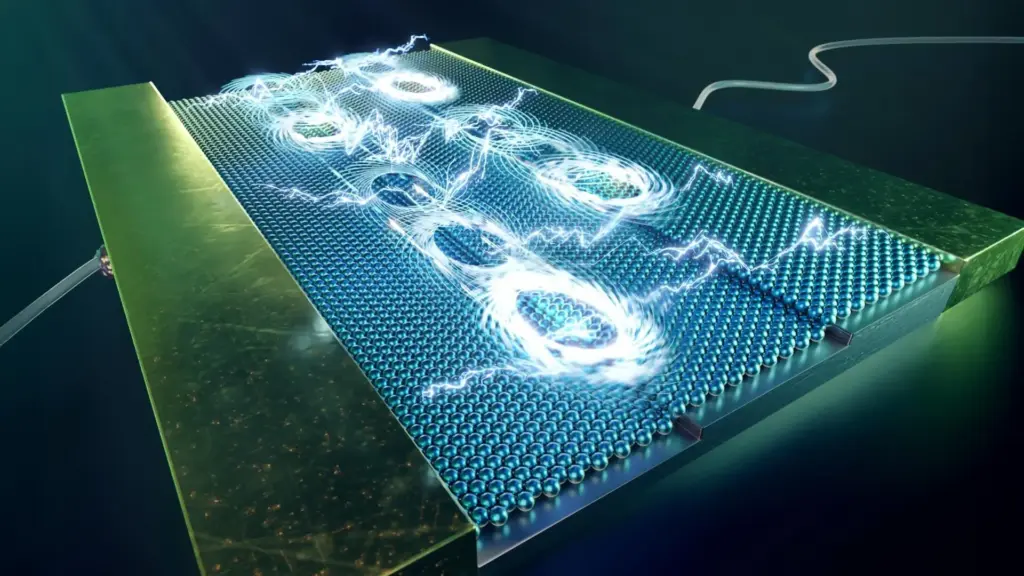
TOKYO — In a breakthrough that could fundamentally reshape the design of future electronics, researchers in Japan have discovered that surface steps just a single atom high can act as microscopic railroad tracks, powerfully guiding the movement of quantum vortices inside an ultrathin superconductor.
Under precise experimental conditions, the research team found that these swirling packets of magnetic energy moved more than 1,000 times more easily along the atomic-scale steps than they did across them. Furthermore, the investigators demonstrated that this directional phenomenon can be dynamically adjusted simply by tweaking external variables such as temperature or the surrounding magnetic field.
The discovery was made by a team of materials scientists and physicists at the Research Center for Materials Nanoarchitectonics (MANA), a premier facility operating under Japan’s National Institute for Materials Science (NIMS). Published in the peer-reviewed journal Physical Review B, the findings offer a novel, highly sophisticated approach to mastering quantum mechanical behavior. Ultimately, the discovery could assist engineers in developing next-generation superconducting electronics capable of processing vast amounts of information with significantly reduced energy consumption.
Why Controlling Quantum Vortices Matters
Superconductors are a remarkable class of materials defined by their ability to conduct electrical current with absolute zero electrical resistance when cooled below a specific critical temperature. Because they do not lose energy to heat during power transmission, superconductors have long held immense promise for revolutionizing electrical grids, high-speed computing, medical imaging equipment, and ultra-efficient electronic devices.
However, the practical engineering of superconductors comes with persistent hurdles. Most Type-II superconductors are penetrated by magnetic fields, which pierce the material in the form of tiny, localized quantum structures known as vortices. Each vortex consists of a microscopic core surrounded by circulating electrical currents.
When these vortices remain stationary, the superconductor maintains its zero-resistance state. But when external forces—such as transport currents—cause these vortices to break loose and drift across the material, they generate energy dissipation and electrical resistance. This movement degrades the performance of superconducting devices, introducing friction-like losses into an otherwise frictionless system.
Consequently, finding ways to pin, trap, or direct the travel of these vortices has been a central goal for condensed matter physicists for decades. Until now, however, dictating the precise pathways of vortices in extremely thin, two-dimensional superconductors has proved extraordinarily difficult due to the complex interplay between quantum forces and material imperfections.
To investigate and overcome this challenge, a research team led by Takashi Uchihashi at MANA focused their attention on an ultrathin superconductor featuring a specially prepared surface characterized by a regular series of atomic-scale steps. By employing scanning tunneling microscopy—an advanced imaging technique capable of resolving surfaces down to the individual atom—the team confirmed that these parallel steps were uniformly spaced. Crucially, they were able to directly observe individual quantum vortices positioned neatly along these topographical tracks.
Atomic Steps Act Like Rails for Quantum Motion
Armed with high-resolution imaging capabilities, the MANA team set out to measure the transport properties of the ultrathin superconductor to understand how the atomic steps influenced vortex mobility. Using precise four-terminal resistance measurements, which allow scientists to isolate and measure minuscule electrical voltages and resistances across specific directional axes, the researchers uncovered a dramatic anisotropy in the material.
The experiments revealed an extraordinary difference in how easily the vortices could travel depending on their trajectory. When exposed to intermediate magnetic fields, vortices flowed more than 1,000 times more easily along the direction of the atomic steps than they did when forced to move perpendicular to them.
In a very literal sense, the atomic steps functioned precisely like miniature rails, establishing preferred, low-resistance corridors for quantum motion across the face of the material.
"Our study shows that atomic-scale steps can act as effective rails that guide superconducting vortices, and that this guiding effect can be tuned simply by changing the temperature or magnetic field," said Takashi Uchihashi, lead researcher of the MANA study.
The research team also identified a particularly fascinating regime of behavior when the applied magnetic field was held within a specific window, ranging approximately from 0.10 to 0.20 tesla. Within this particular magnetic threshold, vortices were able to flow fluidly and continuously along the atomic steps without becoming snagged or trapped by random impurities and crystal defects scattered throughout the broader material.
This specific phenomenon, known to physicists as one-dimensional pinning-free vortex flow, represents a significant achievement. It means that quantum vortices can travel along a defined, unobstructed trajectory without encountering the typical obstacles that normally pin them down and degrade superconducting efficiency.
At the lowest extremes of temperature, the researchers documented yet another exotic quantum effect governing the system. Under these cryogenic conditions, the movement of the vortices was no longer dictated by classical thermal activation, but rather was governed by quantum tunneling. This fundamental quantum phenomenon allows physical objects to pass directly through energy barriers that would normally block their passage under the laws of classical physics, adding another layer of precise control over the microscopic system.
A New Path Toward More Efficient Superconductors
The implications of the MANA study extend far beyond fundamental physics, demonstrating that even the most minute surface features—those measuring a mere single atom in height—can exert a commanding influence over complex macroscopic properties like electrical resistance and quantum vortex dynamics.
By exploiting these natural atomic steps as guiding tracks, scientists and materials engineers may soon be able to steer vortex motion with unprecedented spatial and directional precision. Furthermore, the demonstrated ability to tune this guidance mechanism simply by adjusting environmental variables like temperature and magnetic field opens up versatile new pathways for tailoring superconductor performance on demand.
While translating these foundational insights into commercial applications will require substantial further research and engineering development, this atomic-scale methodology points toward a promising horizon. By mastering the intricate dance of quantum vortices and managing heat flow at the atomic level, future researchers may unlock a new generation of superconducting technologies capable of unprecedented processing speeds paired with ultra-low power consumption.