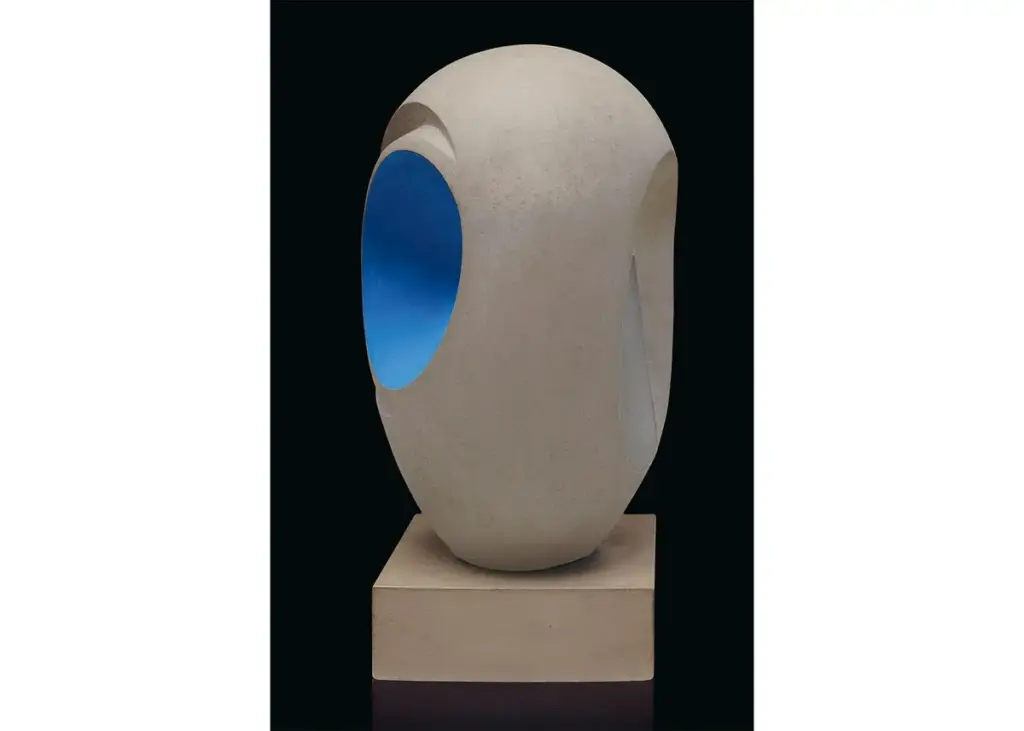
LONDON — A pivotal mid-career sculpture by the celebrated British modernist artist Barbara Hepworth is set to cross the auction block this autumn, emerging as a major highlight of the upcoming art market calendar. Christie’s has announced that its high-profile modern British and Irish art evening sale in London on October 21 will feature Sculpture with Colour (Eos), a striking and historically significant work created in 1946. Auction house specialists have placed a pre-sale estimate of £5 million to £8 million, translating roughly to $6.6 million to $10.5 million, reflecting both the scarcity of masterworks from this period and the enduring strength of the market for twentieth-century British sculpture.
Hepworth, widely recognized alongside her contemporary Henry Moore as a defining figure of British modernist sculpture, carved the approximately two-foot-tall piece from a single block of Hopton Wood stone, a dense and fine-grained variety of limestone native to Derbyshire. The sculpture possesses a distinct egg-like, biomorphic contour characteristic of Hepworth’s exploration of organic forms during the mid-twentieth century. Resting upon a short, integrated platform, the stone features three meticulously hollowed-out recesses that reveal inner surfaces coated in pigment. These cavities are painted in deliberate hues of pale gray, off-white, and deep blue.
According to an official statement released by Christie’s, the deliberate incorporation of these specific tones was intended by the artist to evoke vast, elemental expanses, specifically referencing “the depths of the ocean, the boundless sky and the infinite reaches of the cosmos.” This chromatic dimension marked a profound departure from traditional sculpture of the era, introducing a sophisticated interplay between mass, void, and color that would become a signature of Hepworth’s mature practice.
Beyond its formal innovations, Sculpture with Colour (Eos) occupies a fascinating chapter in the cultural and photographic history of post-war Britain. The artwork holds the distinction of being one of Hepworth’s earliest sculptures to integrate color into its interior spaces. Furthermore, its early provenance is immortalized through a famous 1948 photograph captured by the legendary American photographer and photojournalist Lee Miller.
Miller, who maintained a close personal and professional friendship with Hepworth, traveled to the artist’s coastal studio at Carbis Bay in Cornwall to document her life and work. Hepworth and her family had relocated to Carbis Bay in 1939 just before the outbreak of the Second World War, seeking refuge and a fertile creative environment away from London. The resulting black-and-white photograph by Miller was eventually published in the October 15, 1949, issue of American Vogue, offering readers a rare and intimate glimpse into the sculptor’s domestic and creative sanctuary.
In the photograph, Hepworth is captured seated in a relaxed pose with her arms and legs crossed. The composition is rich with contextual details of the period: a modest tea set rests in the foreground, while a cat is comfortably curled up on a nearby couch. Positioned prominently on a table to the right of the artist is Sculpture with Colour (Eos), serving as a silent testament to the daily integration of art and life in Hepworth’s Cornish enclave. Shortly after Miller captured the scene, Hepworth relocated once again to nearby St. Ives, a coastal town that would become synonymous with her legacy and where her former home and studio now operate as the permanent site of the Barbara Hepworth Museum and Sculpture Garden.
The upcoming auction also highlights the distinguished ownership history of the limestone carving. The current consignor acquired Sculpture with Colour (Eos) at a Christie’s auction in 2016, where it dramatically outperformed expectations by selling for $5.4 million against a pre-sale estimate of $1.2 million to $1.8 million. Prior to that sale, the sculpture belonged to the esteemed estate of American philanthropists David and Geraldine Pincus, renowned collectors who had originally purchased the piece from the prominent Martha Jackson Gallery in New2 York in 1962.
The Pincus collection is legendary within the global art market for its museum-caliber holdings. Notably, the estate also famously consigned Mark Rothko’s monumental 1961 painting Orange, red, yellow, which achieved a staggering $86.9 million at Christie’s in 2012, making it the second most expensive painting by Rothko ever sold at public auction. The inclusion of Sculpture with Colour (Eos) in such distinguished collections underscores its exceptional quality and desirability among blue-chip international collectors.
For art historians and market specialists alike, the sculpture’s journey over the past eight decades encapsulates the broader arc of Hepworth’s critical acclaim. Alice Murray, head of modern British and Irish art at Christie’s in London, emphasized the enduring centrality of the piece to the artist’s overarching narrative. Murray noted that the limestone carving has remained a touchstone for Hepworth scholarship, pointing to its inclusion in the artist’s very first postwar solo gallery exhibition in 1946.
The piece’s historical resonance was reaffirmed recently to contemporary audiences when it was featured prominently in the critically acclaimed exhibition “Hepworth in Colour,” which was on public view at the Courtauld Gallery in London earlier this summer. As the work prepares to return to the auction block this October, collectors and institutions will have a rare opportunity to acquire a museum-quality sculpture that bridges the natural landscape of Cornwall, the pioneering modernism of post-war Britain, and the international stage of twentieth-century art history.