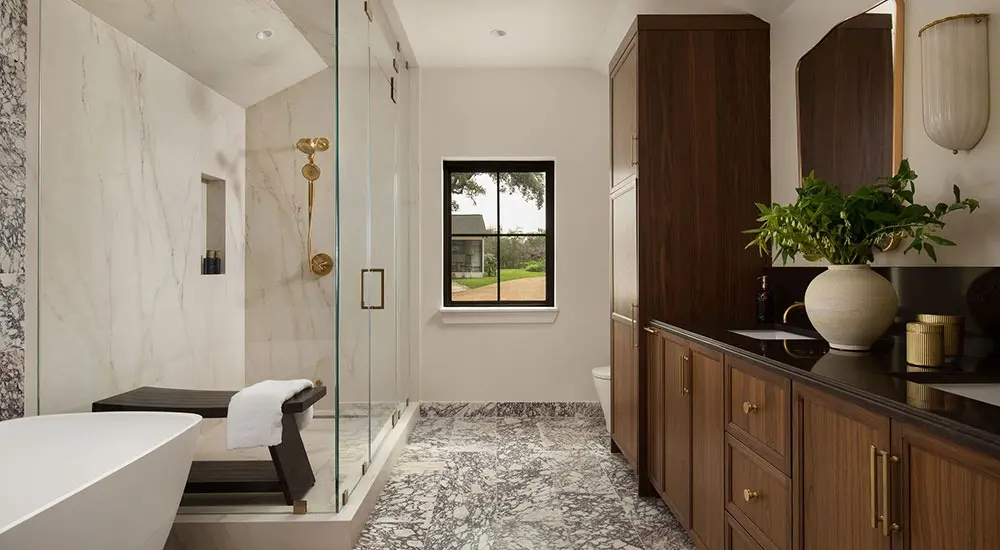
Homeowners are devoting significantly more time to daily wellness routines inside their bathrooms following recent renovations, turning the traditional utility space into a dedicated sanctuary for personal care and relaxation. According to the latest findings from the 2026 U.S. Houzz Bathroom Trends Study, which surveyed 1,619 U.S. homeowners, half of all renovating homeowners now spend more time in their bathrooms after completing an upgrade.
The comprehensive report reveals that these extended hours are most frequently dedicated to beauty and pampering routines, cited by 28% of respondents, followed closely by rest and relaxation at 23%. While smaller segments of homeowners utilize specialized amenities such as steam features at 4%, niche wellness additions like cold plunges, red light therapy, sauna sessions, and even recording beauty tutorials each account for 1% of the surveyed population.
Marine Sargsyan, Houzz head of economic research, highlighted the shifting expectations that consumers place on their home environments. Homeowners want their bathrooms to work harder for them to support both daily routines and self-care, a trend that is clearly reflected in both financial commitments and architectural choices. Sargsyan noted that median spending has rebounded to $15,000, while nearly half of all renovating homeowners are actively expanding the physical dimensions of their showers to elevate everyday comfort.
When asked about the elements that contribute most to relaxation within a newly renovated bathroom, more than three-quarters of respondents—76%—pointed to cleanliness as the leading factor. A spacious shower followed closely at 71%, with organized storage rounding out the top three at 67%. Environmental lighting also plays a crucial role in helping individuals unwind, with natural light and dimmable lighting cited by 40% and 39% of homeowners, respectively. More than a quarter of respondents look to a comfortable bathtub for relaxation, while water features such as waterfall faucets and rainfall showerheads have seen a notable increase, rising by 6 percentage points from the previous year to reach 19%. Elements of nature and sound, including greenery and music, were identified as the most relaxing features by 12% and 6% of homeowners, respectively.
Despite the growing emphasis on enhanced comfort and specialized wellness features, the vast majority of bathroom renovations—some 82%—maintain the original overall footprint of the room. For the projects that do decide to expand outward, additions are the most common method, accounting for 32% of expansions. Among homeowners who choose to expand into pre-existing interior space, more than a quarter elect to reduce or entirely eliminate a closet at 27%, while slightly over a fifth absorb part of an adjacent bedroom at 22%.
Overall bathroom projects frequently involve substantial structural alterations. Forty percent of homeowners choose to completely rework the layout of the space, and 38% undertake modifications to the walls. However, shower enlargements emerged as the fastest-growing major structural change in the latest study. Nearly half of all renovating homeowners—49%—increased the size of their shower, representing a 10 percentage point increase year over year. Furthermore, among the 26% of renovating homeowners who opted to remove a bathtub entirely, the vast majority—79%—reclaimed that valuable floor space to enlarge the shower, while 24% chose to relocate the shower to a different area of the room.
Alongside these extensive structural and architectural changes, a growing number of homeowners are turning to professional expertise to execute their visions. Nearly 9 in 10 renovating homeowners, or 89%, hired at least one professional for their bathroom project, representing a 5 percentage point increase compared to the previous year. General contractors remain the most sought-after professionals, hired by 52% of respondents, followed evenly by specialized bathroom remodelers and cabinetmakers at 23% each.
To help industry professionals plan, visualize, and execute these increasingly personalized and multipurpose spaces, digital design solutions have become essential. Software platforms such as Houzz Pro provide construction and design professionals with advanced digital tools, including 3D floor planners, material selections, and mood boards. These technologies offer homeowners a much clearer picture of their finished space before construction begins, while enabling professionals to collaborate more effectively with their clients and streamline business operations.
Financial investment in these residential upgrades has also shown renewed strength. The national median spend on bathroom projects rebounded to $15,000 in 2025, recovering from a dip to $13,000 in 2024. Expenditures for major remodels, defined as projects where at least the shower was upgraded, climbed even higher, reaching an overall median of $25,000. For the top 10% of major projects, spending reached nearly three times that amount at $70,000. Larger bathrooms measuring 100 square feet or more commanded significantly higher budgets, registering a median spend of $30,000—a 20% increase from 2024—with the top 10% of expansive projects reaching $75,000 or more.
The study also highlighted several shifting aesthetic and functional preferences in bathroom design. When it comes to accent walls, which were upgraded by about a third of renovating homeowners at 34%, pattern has officially edged out color as the primary method for creating a focal point. Pattern was favored by 53% of respondents, surpassing color at 48%, followed by surface material at 45% and texture at 25%. Blue and white emerged in a direct tie as the most popular accent wall colors, each chosen by 19% of homeowners.
Wet rooms have also continued their upward trajectory, now accounting for 18% of renovated bathrooms compared to 13% two years prior. The primary motivations driving the popularity of wet rooms are a better utilization of available space, cited by 41% of respondents, and accessibility or universal design principles, noted by 40% of homeowners, which marks a significant jump of 14 percentage points.
Vanity trends indicate a preference for wider units equipped with advanced built-in features. Vanities larger than 72 inches, representing the widest available option on the market, rose by 7 percentage points to reach 21%, officially surpassing both 60-inch models at 18% and 72-inch models at 17%. Soft-close hardware remains an overwhelming favorite among consumers, incorporated into 83% of drawers and 76% of doors. While other built-in features remain less common overall, electrical outlets and dedicated hair tool organizers each saw notable gains, rising 7 percentage points to 32% and 19%, respectively, with drawer organizers positioned between them at 25%.
Reflecting the trend toward larger vanities, the installation of double sinks has become increasingly standard in modern bathroom designs. Installations jumped by 17 percentage points year over year, with 64% of renovated bathrooms now featuring double sinks, up from 47% in the previous study. Undermount basins represent the most popular style at 68%, experiencing a substantial popularity surge of 11 percentage points over the year.
Specialty toilet features have similarly gained traction, with nearly half of renovating homeowners—47%—incorporating advanced functions into new or upgraded toilets, marking a 9 percentage point increase. Bidet toilet seats, adjustable water pressure, and air dryers each rose by 10 percentage points to reach 31%, 30%, and 28%, respectively, closely followed by heated seats at 27%, which increased by 8 percentage points. Convenience-oriented features also recorded growth, with self-cleaning functions and built-in nightlights each rising 6 percentage points to 22% and 20%, while self-deodorizers increased by 5 points to 14%.