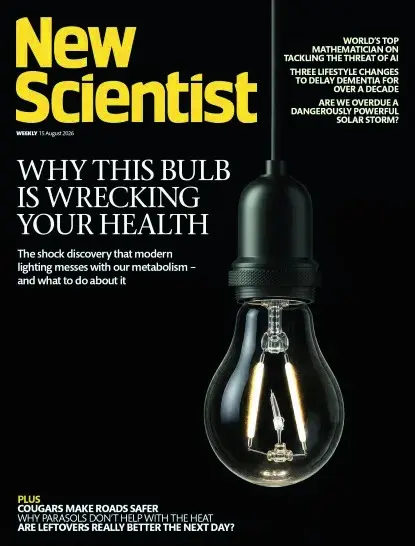
When the August cover story of New Scientist hit newsstands and flooded industry social media feeds, it sparked an immediate and polarized reaction across the architectural and lighting sectors. Featuring a provocative cover line asking whether modern indoor lighting is actively undermining our health, the article thrust a complex debate straight into the public consciousness. While some critics dismissed the framing as alarmist, others welcomed the mainstream spotlight on a subject they feel has been neglected for decades.
Amidst this flurry of debate, industry figures and researchers have begun unpacking the deeper implications of the feature. Among them is Ulysse Dormoy, a board member of the Good Light Group, a passionate light quality campaigner, and the CEO of UK-based distributor Atrium. Motivated by the global publication’s cover story, Dormoy sat down to share his thoughts on how modern society interacts with light, challenging long-held industry assumptions and advocating for a broader, more biological perspective on how we illuminate our indoor environments.
Light: The Missing Pillar of Human Health?
For generations, public health conversations have focused squarely on a few recognized foundations: nutrition, exercise, sleep, and air quality. These pillars are universally acknowledged as essential for human wellbeing. Light, however, has traditionally remained outside that core conversation. In standard architectural and engineering practice, light is predominantly treated as a functional requirement—something that merely enables us to see. Consequently, lighting standards have historically revolved around visual performance, spatial comfort, energy consumption, and safety.
While these remain critical parameters, Dormoy and other advocates argue that this narrow definition misses a crucial biological reality. Light is not just a visual tool; it is a profound biological input. The modern human environment represents a radical departure from the conditions under which biology evolved. Just as industrialized food systems and sedentary lifestyles required society to rethink nutrition and physical activity, the shift toward spending up to ninety percent of our time indoors under restricted artificial spectra demands a serious reassessment of our light diet.
The Pursuit of Efficiency
Over the past fifty years, the lighting industry has pursued an exceptionally admirable and successful goal: maximizing energy efficiency. Driven by technological leaps from fluorescent lamps to advanced LEDs, the sector has delivered extraordinary improvements in luminous efficacy, reduced maintenance requirements, and supported global carbon reduction and sustainability objectives.
However, this relentless drive toward efficiency has inadvertently created a blind spot. The phrase "better light" has increasingly become synonymous with "more lumens per watt." Yet, as Dormoy points out, human beings are not lux meters. A lighting system can be exceptionally efficient at producing visible light while simultaneously creating a spectral environment that bears little resemblance to the natural daylight under which human biology developed. The possibility that this efficiency-driven paradigm overlooks crucial characteristics of light warrants rigorous scientific and commercial investigation.
We Have Been Here Before
To understand the current crossroads of lighting and health, one only needs to look at how modern society has approached other fundamental aspects of life. Human ingenuity has successfully engineered food systems that provide abundance, yet many populations remain undernourished due to the ultra-processed nature of modern diets. Similarly, modern transport systems minimize physical exertion, requiring people to deliberately schedule exercise into their days to compensate for lost natural movement.
Indoor living represents a parallel transformation. Modern populations live and work under artificial illumination, breathe conditioned air, and remain connected to digital displays long after sunset. Each individual innovation has delivered undeniable benefits, but collectively, they mark a profound divergence from ancestral environments. The central question is not whether modern life is inherently better or worse, but whether the solutions of the past century have inadvertently generated new challenges for human physiology.
The Forgotten Energy Debate
One of the most compelling arguments raised in the ongoing light and health discourse centers on how the lighting industry defines and measures energy. Traditionally, light is viewed exclusively as a consumer of energy. Success is quantified by how few watts are consumed to achieve a required luminance level.
Yet, fundamentally, light is also a provider of energy. This principle is accepted without question in other scientific domains. When horticulturists illuminate plants, they recognize that light delivers radiant energy driving essential biological processes. Photovoltaic panels convert incoming light directly into electrical current.

When it comes to human beings, however, this energetic exchange is rarely discussed outside of basic visual tasks. Emerging research into photobiology, photobiomodulation, and mitochondrial function suggests that light plays a far more active physiological role than previously assumed. If specific wavelengths influence cellular and biological processes, then the spectral composition and quality of light reaching the human body matter just as much as the electrical efficiency required to generate it. This does not mean uncritical acceptance of every claim surrounding specific bands of the spectrum, such as red or near-infrared light. Rather, it suggests that the future framework of lighting design should expand from a conversation about energy consumption to one encompassing energy exchange—evaluating not just how much power a system draws, but what physiological role the contained energy plays once it reaches the occupants.
Why Light Deserves a Table at the Discussion
Discussions surrounding light and health often risk becoming polarized when framed as an indictment of specific technologies, such as LEDs. Experts emphasize that the debate is not about good versus bad technology, but rather about whether the biological consequences of indoor environments have been adequately considered during the architectural design process.
Light does not operate in a vacuum. It interacts continuously with sleep patterns, physical activity, nutrition, stress levels, and behavioral habits. An office worker spending ten hours a day under static electric lighting, consuming processed foods, and sleeping poorly is experiencing the cumulative impact of multiple compounding environmental factors. Integrating light into the broader health conversation—alongside sleep, air quality, and nutrition—offers a more holistic framework for understanding chronic modern health trends.
The Conversation We Need to Have
Addressing the complex intersections of light and biology requires breaking down professional silos. It demands genuine collaboration among neuroscientists, chronobiologists, clinicians, architects, workplace strategists, public health specialists, building services engineers, and lighting professionals.
Signs of this cross-sector alignment are already emerging. Regulatory frameworks and industry standards are evolving to reflect new scientific consensus. The WELL Building Standard v2, for instance, incorporates and rewards minimum Melanopic Equivalent Daylight Illuminance (m-EDI) levels, reflecting research into intrinsically photosensitive retinal ganglion cells (iPRGCs) and their impact on human circadian rhythms, mood, alertness, and sleep. Furthermore, professional bodies such as the Society of Light and Lighting have begun revising position statements to integrate these biological recommendations into formal guidance.
Any Other Questions
Building on these broader industry shifts, the Good Light Group caught up with Ulysse Dormoy to explore his perspective on the evolving relationship between lighting design and human health.
Reflecting on what initially sparked his deep dive into the non-visual effects of light, Dormoy explains that his journey began five years ago with an intuitive sense rather than formal research. Sensing that light sat at a critical intersection between technology and human wellbeing, a colleague challenged him to prove it to the wider business. That challenge led him to foundational literature, including Scott Zimmerman’s paper Melatonin and the Optics of the Human Body, which transformed his view of illumination from a purely visual medium into a biological input.
When asked about the single most pressing outstanding question in the field, Dormoy points directly to the concept of dose. While modern photobiology and photobiomodulation actively search for beneficial wavelengths, there is a risk of reductionism. Human biology evolved under rich, dynamic, broadband sunlight that varied continuously across time, season, and geography. Today, individuals spend approximately ninety percent of their time indoors under spectrally restricted sources. The defining research challenge for the next generation, according to Dormoy, is understanding dosimetry—the complex interplay of wavelength, intensity, duration, and timing—to determine how to responsibly integrate natural light characteristics into modern built environments.
Addressing how the lighting industry can make a tangible positive impact, Dormoy stresses the need to broaden the definition of quality lighting at a project’s inception. Too often, lighting is treated as a line-item cost to be minimized rather than a foundational investment in human health. Because architectural lighting is rarely a personal choice—with occupants bound to the illumination prescribed by designers, engineers, and building owners—the industry carries a profound ethical responsibility. By combining evidence from lighting engineering, architecture, medicine, and neuroscience, the built environment can ultimately evolve to support human health just as effectively as it supports vision.