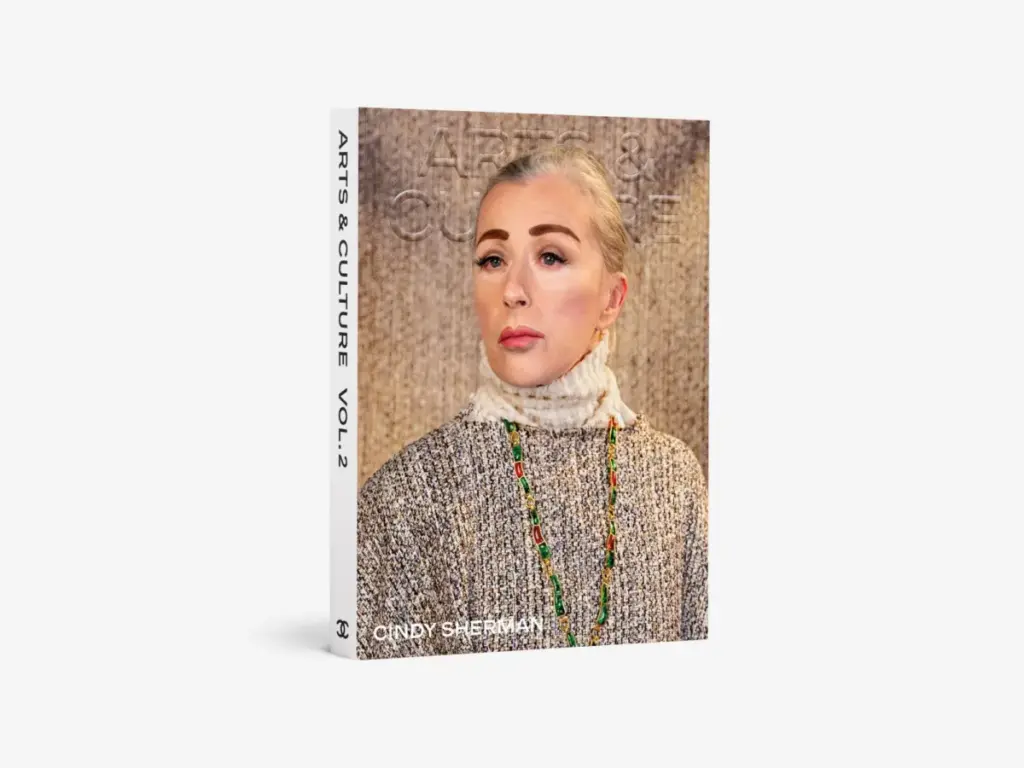
Good morning, and welcome to your daily overview of the international art world. From high-fashion collaborations featuring iconic contemporary photographers to fierce legal battles over historic opera house ceilings, the cultural landscape continues to shift across museums, galleries, and ancient archaeological sites. Below is a comprehensive look at the major headlines, developments, and institutional updates shaping the arts community this week.
The Headlines
Cindy Sherman Drapes Herself in Raw Chanel Tweed for New Photographic Series
On October 23, French luxury house Chanel is set to release the second volume of Arts & Culture, its expansive, free 300-page digital and print magazine. The new issue is highlighted by a striking, unexpected portfolio of fresh photographs by master American artist Cindy Sherman. Staying true to her legendary career-long exploration of identity, persona, and transformation, Sherman appears in the images wearing Chanel—though not in the traditional, polished sense of tailored ready-to-wear garments.
Instead, the fashion brand provided Sherman with direct, exclusive access to its archives, shipping rolls of raw, unsewn vintage fabrics directly to her studio. According to reports from Vanity Fair, Chanel gave the artist absolute creative freedom to handle the materials however she saw fit.
“I said, ‘Well, is it okay if I cut things up, cut holes into them and whatnot?’” Sherman recalled in her interview with Vanity Fair. Much to the artist’s delight, the luxury brand embraced the proposal without hesitation.
The resulting collaboration yielded a brand-new series of photographs appropriately titled "Fabric Matrons." The images will make their physical gallery debut at Hauser & Wirth’s Mayfair location during the upcoming Frieze London art fair. Early previews published in Vanity Fair reveal Sherman playing imaginative dress-up, cutting poncho-style openings into heavy rolls of classic Chanel tweeds. Rather than looking ridiculous or out of place, the styling achieves a thoughtful, resonant gravity. Sherman’s characters appear solemn, world-weary, and emotionally weighted by experience, all while swathed in glamorous, heavily bejeweled garments.
Reflecting on the aging process and the psychological underpinnings of the characters she constructed for the series, Sherman shared a candid entry from her personal creative journal. “At one point I remember writing in my journal, ‘Who the fuck wants to look at pictures of old ladies anyway?’” Sherman noted. The art world is now poised to find out as "Fabric Matrons" reaches audiences in London and through Chanel’s widely distributed publication.
Austrian Presidential Candidate Vows to Return Historic Aztec Headdress to Mexico
In political developments intersecting with cultural heritage repatriation, Austrian presidential candidate Gunther Fehlinger-Jahn has pledged that, if elected, he will return a contested 16th-century feathered Aztec headdress currently housed in Vienna’s Weltmuseum to its home country of Mexico, The Art Newspaper reports.
For decades, the Mexican government has persistently requested the repatriation of the magnificent, ornate Quetzal headdress, scientifically known as the quetzalapanecayotl. Measuring approximately 4.5 feet high and 5.75 feet wide, the artifact historically belonged to Aztec ruler Moctezuma, though historical consensus suggests he may never have actually worn it. The exact historical circumstances and trajectory by which the precious object left Mexico centuries ago remain shrouded in mystery and ongoing academic debate.
“Austria and Mexico should negotiate a bilateral solution based on friendship rather than confrontation,” Fehlinger-Jahn stated regarding his campaign promise.
The geopolitical friction surrounding the object is not new. As recently as 2020, the Mexican government formally requested to borrow the fragile headdress for a high-profile domestic exhibition. However, Austrian cultural and museum officials ultimately rejected the loan request, citing the extreme physical fragility of the ancient feathers as an insurmountable barrier to transport.
The Digest
Beyond the major headlines, several significant developments have emerged across international institutions, galleries, and archaeological sites:
A legal battle has erupted in France involving the iconic ceiling of the Palais Garnier opera house in Paris. A descendant of the 19th-century classical academic artist Jules-Eugène Lenepveu has initiated legal action demanding the complete removal of Marc Chagall’s celebrated, vibrantly colorful 1964 ceiling painting. The legal complaint is grounded in the fact that Chagall’s masterwork was painted directly over an original oil-on-copper fresco created by Lenepveu, igniting a fresh debate over historical preservation versus modernist artistic intervention, as reported by The Guardian.
In gallery expansion news, French contemporary art gallery Galerie Christophe Gaillard has announced plans to establish a brand-new international outpost in Bangkok. Set to open in March 2027, the new space will be situated inside the prominent Bangkok Kunsthalle, further cementing the Thai capital’s growing status as a vibrant hub for contemporary international art, according to The Art Newspaper, France.
Meanwhile, in London, the enduring cultural legacy of British singer Amy Winehouse continues to be examined nearly a decade and a half after her tragic death. A new contemporary art exhibition titled "Nothing Personal," running through January 23, features meticulous simulacra of the late singer’s personal items created by artist Alex Margo Arden, offering viewers an intimate, conceptual excavation of fame, memory, and personal identity (ARTnews).
In restitution and law enforcement news, two stolen paintings by Impressionist master Auguste Renoir were successfully recovered in what French authorities described as "record time." The Ministry of Culture announced that the canvases are currently undergoing thorough technical examination by conservation experts to check for any potential damage sustained during the theft before they are officially returned to their permanent home at the Renoir Museum in Cagnes-sur-Mer.
On the archaeological front, long-standing folklore and medieval Welsh myths have finally found solid scientific footing. A persistent legend claiming that the Roman emperor Magnus Maximus established a strategic military camp near Frenni Fawr in Wales has just been substantiated by definitive new archaeological evidence uncovered in the region, as detailed by The Guardian.
The Kicker
As institutions adapt to changing cultural demands, leadership transitions are driving new visions for major American museums. Zoë Ryan, the recently appointed director of the Hammer Museum in Los Angeles, recently sat down with the Los Angeles Times to articulate her forward-looking strategy for steering the institution into its next major chapter and cementing its status as an essential anchor of the Westside Los Angeles arts district.
At the core of Ryan’s strategic vision is a renewed commitment to expanding educational outreach, which includes robust professional training initiatives for regional schoolteachers who work to integrate arts curricula into underfunded classrooms. Additionally, amplifying the historical contributions of overlooked women artists remains a top institutional priority, demonstrated clearly by two major survey exhibitions scheduled for the fall focusing on the influential practices of Huguette Caland and Mavis Pusey.
Among her array of "bold projects" designed to break down traditional barriers between high art and the local public, Ryan is spearheading the creation of "the Nook," a dedicated ground-floor communal room designed specifically for hands-on artmaking, public reading, and independent study. For Ryan, initiatives like this embody a philosophy of "radical welcome," ensuring that the museum functions not merely as a passive gallery space, but as an active, inclusive civic living room for the entire community.