Quantum entanglement has long captured the imagination of physicists and the general public alike, representing one of the most profound and striking differences between the rules governing our everyday macroscopic world and the hidden mechanisms of the subatomic realm. In an entangled system, fundamental particles such as photons become linked so deeply and fundamentally that their individual properties cannot be fully described or understood independently. Instead, the entire system must be treated as a unified, holistic whole, defying our ordinary intuition.
That deeply counterintuitive idea famously clashed with classical expectations that each individual particle should possess its own separate, distinct physical reality—a foundational feature of quantum mechanics that famously troubled Albert Einstein, who skeptically referred to the phenomenon as "spooky action at a distance." Yet, despite its paradoxical nature, entanglement has graduated from a philosophical debate among twentieth-century pioneers to become one of the absolute most essential ingredients for emerging quantum technologies. Today, it serves as the foundational bedrock for advanced secure communication networks, hyper-fast quantum computing, and complex information transfer systems that promise to revolutionize modern science.
The Challenge of Measuring Quantum Entanglement
Building these transformative technologies will require scientists and engineers not only to reliably create multi-photon entangled states in laboratory settings, but also to determine efficiently and accurately which precise type of entangled state they have successfully produced. Without a fast and reliable method for verification, scaling up quantum hardware remains a monumental hurdle.
One of the most standard and widely utilized approaches in the field is known as quantum tomography, a sophisticated technique used to reconstruct and estimate an unknown quantum state by performing a vast multitude of separate measurements. The primary difficulty with quantum tomography, however, is that the sheer amount of data and the number of individual measurements required rise exponentially as more photons are added to the system. Consequently, scaling a quantum system by adding even a modest number of photons can suddenly demand dramatically more computational power and measurement time, creating a severe bottleneck for experimentalists.
An entangled measurement offers a potentially much more efficient and elegant alternative to this cumbersome process. Instead of gathering a massive collection of individual measurements and attempting to mathematically reconstruct the state afterward, this type of advanced measurement is capable of identifying a specific entangled state using a streamlined, one-shot approach.
For many years, scientists had already successfully accomplished such a measurement for the Greenberger-Horne-Zeilinger, or GHZ, state, which is widely recognized as one of the best-known and most frequently studied forms of multi-photon entanglement. However, despite decades of theoretical and experimental effort, no comparable method had ever been successfully proposed or experimentally demonstrated for the W state, another critically important and distinct type of multi-photon entangled state with unique properties.
A Collaborative Milestone from Kyoto and Hiroshima
A dedicated team of researchers at Kyoto University and Hiroshima University set out to directly address this persistent missing capability in the toolkit of experimental quantum optics. Through meticulous theoretical planning and precise optical engineering, their concerted efforts ultimately resulted in a revolutionary new method for performing an entangled measurement capable of definitively identifying the W state.
Reflecting on the historical significance of the breakthrough, corresponding author Shigeki Takeuchi notes the lengthy timeline required to achieve this milestone. More than twenty-five years have passed since the initial theoretical proposals concerning the entangled measurement for GHZ states were first put forward to the scientific community. Now, the research team has finally obtained the corresponding entangled measurement for the W state as well, complete with a genuine, highly accurate experimental demonstration involving three-photon W states.
Using Symmetry to Identify the W State
To overcome the immense technical hurdles associated with detecting and verifying the W state, the researchers cleverly built their innovative approach around a distinct mathematical property inherent to the state itself, known as cyclic shift symmetry. In relatively simple terms, this means that the spatial or temporal arrangement of the photons within the system can be systematically shifted in a repeating cycle while still preserving an important and underlying structural pattern that identifies the state.
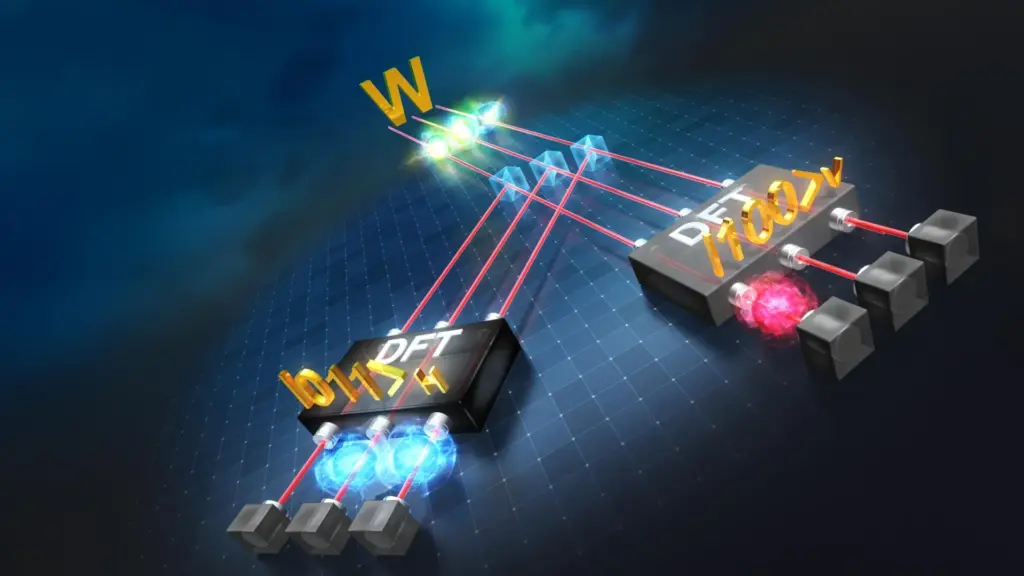
Leveraging this specific symmetry, the team theoretically developed an advanced entangled measurement scheme based on a carefully designed photonic quantum circuit. At the heart of this circuit is a quantum operation known as a Fourier transformation, a powerful mathematical tool capable of reorganizing quantum information in a way that brings hidden patterns to the surface, making otherwise nearly impossible-to-detect correlations immediately apparent. Crucially, the theoretical framework developed by the team can, in principle, be applied to W states containing any arbitrary number of photons, opening a clear pathway for future scalability.
Following their theoretical breakthroughs, the researchers constructed a sophisticated physical device to put their innovative ideas to the test using three distinct photons. They utilized high-stability optical quantum circuits engineered to operate continuously for long periods without requiring constant, active external control, ensuring the reliability and consistency of the experimental data.
By carefully injecting three individual photons into the newly developed device with precisely selected polarization states, the researchers successfully demonstrated that the system could accurately distinguish among different types of three-photon W states. Each of these unique states represents a particular, highly specific non-classical correlation shared simultaneously by the three incoming photons, proving that the device was functioning precisely as intended.
To validate the performance of their hardware, the team also measured the operational fidelity of the entangled measurement. In the context of quantum information science, fidelity indicates how reliably and accurately a quantum system performs its intended task. In this specific scenario, the fidelity metric corresponds directly to the exact mathematical probability that the optical device successfully produces the correct, verified result when provided with a pure W-state input.
A New Tool for Quantum Teleportation and Beyond
This successful experimental advance carries profound implications for several diverse areas of modern quantum technology, offering researchers a powerful new instrument to manipulate and verify fragile quantum states.
One of the most prominent fields that stands to benefit is quantum teleportation, a fascinating process that transfers delicate quantum information from one physical location to another across space. Despite the somewhat sensationalized name often popularized in science fiction, quantum teleportation does not physically transport physical matter across the room. Instead, it ingeniously leverages the phenomenon of quantum entanglement to securely transfer the exact quantum state that contains the underlying information, leaving the original particle behind while reconstructing its identical state elsewhere.
Beyond quantum teleportation, the newly developed measurement approach could also contribute significantly to the creation of advanced quantum communication protocols, novel methods for reliably transferring multi-photon quantum entangled states over distances, and entirely new paradigms of measurement-based quantum computing.
Emphasizing the foundational philosophy behind the work, Takeuchi explains that in order to accelerate the ongoing global research and development of practical quantum technologies, it remains absolutely crucial to deepen our fundamental understanding of basic physical concepts so that scientists can continuously conceive of innovative, out-of-the-box ideas.
Scaling the Technique to Larger Quantum Systems
Building upon the success of their initial three-photon demonstration, the research team is already looking ahead to the next phases of their scientific journey, with clear plans to extend their newly minted approach far beyond the confines of the current laboratory setup.
Their primary, longer-term goal is to successfully adapt and apply this measurement method to much larger-scale and more general multi-photon quantum entangled states, where the complexity and number of particles are vastly increased. In tandem with these theoretical expansions, the research team also intends to actively develop advanced, on-chip photonic quantum circuits capable of performing complex entangled measurements natively on a microscopic semiconductor chip.
By shrinking the physical footprint of the optical architecture, the technology could eventually become significantly more compact, stable, and vastly easier to integrate seamlessly into the complex, multi-layered quantum systems of the future.