Two years ago, walking through the galleries of the Baltimore Museum of Art, I encountered the infamous 1892 photograph of two men standing atop a towering hill of bleached buffalo skulls. The image, still shocking after more than a century of public circulation, was partially concealed by a small, wall-mounted curtain crafted by Yurok artist Stormi Turner. That delicate intervention gave the historical photograph the profound depth of tragedy it warranted. It mirrored the care and reverence with which human remains are treated in modern museum spaces—often accompanied by warnings, placed behind restricted doors, or draped under protective covers that visitors must deliberately choose to lift. Turner’s installation honored an animal that numerous Native American communities lived alongside in a symbiotic relationship for millennia.
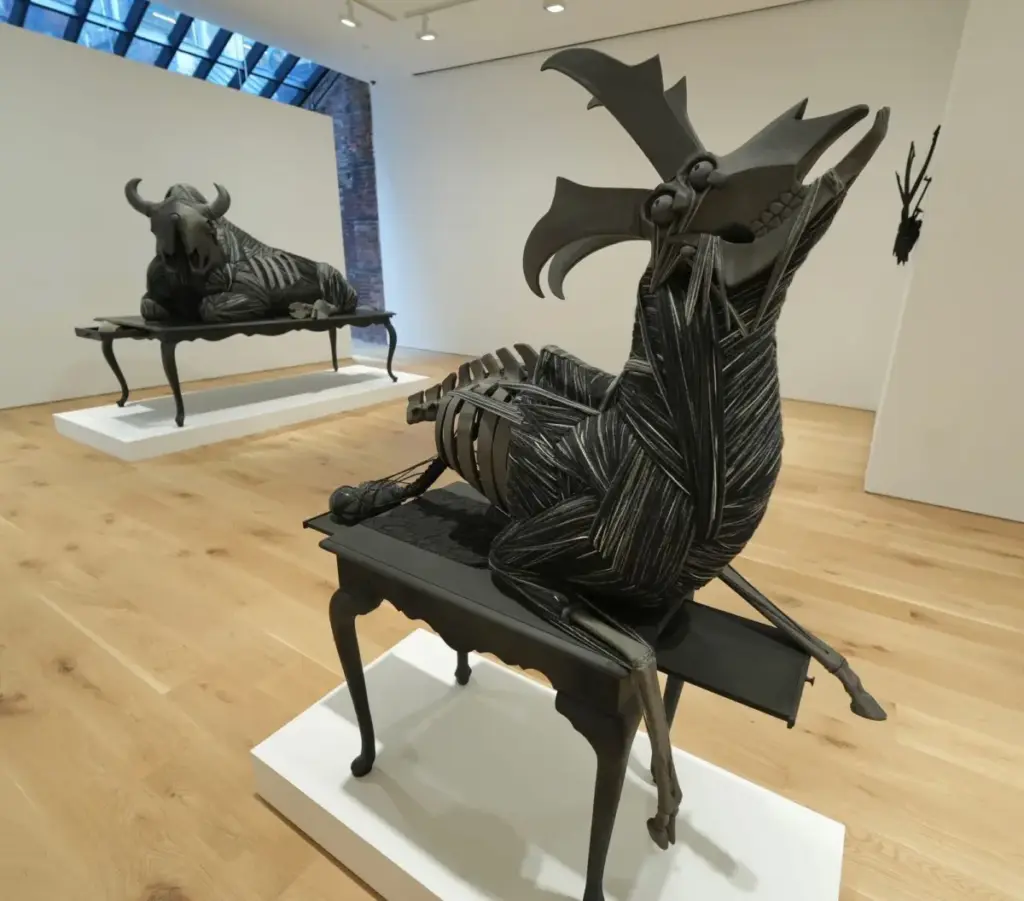
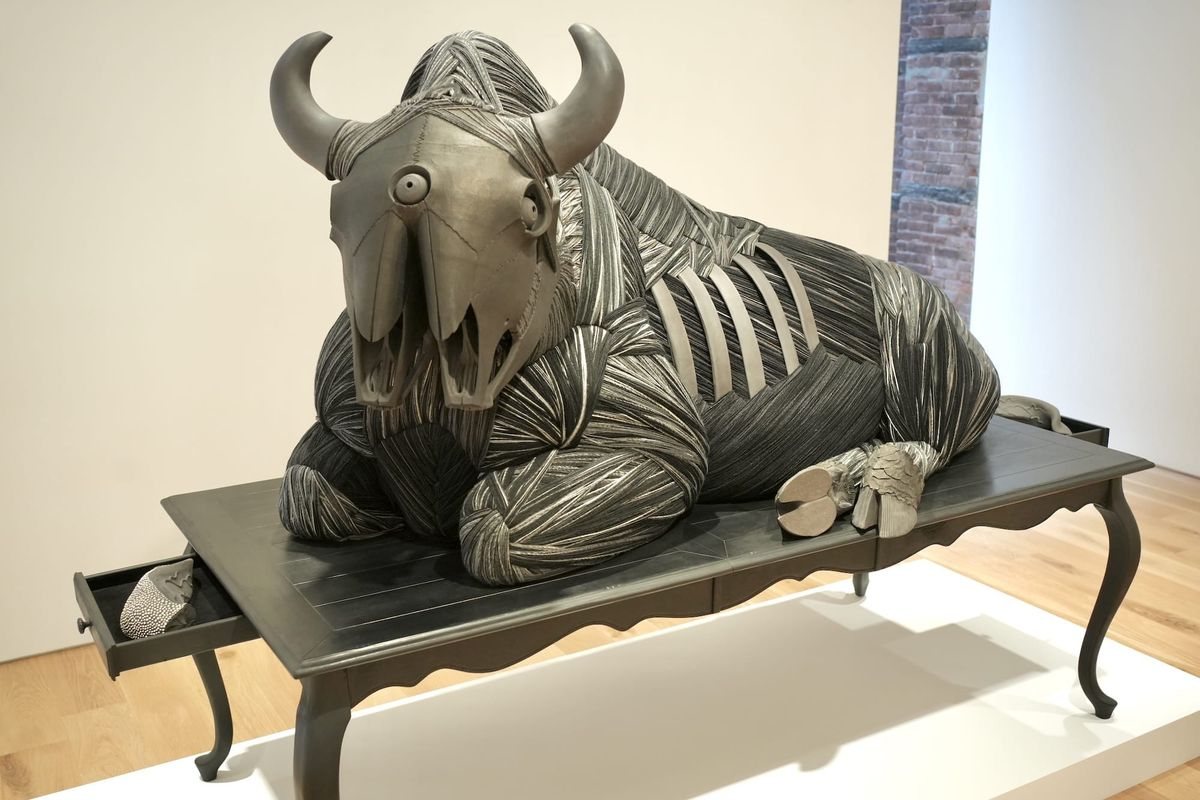
That haunting memory resurfaced recently as I stepped into Cannupa Hanska Luger’s powerful new exhibition, American Traditional, currently on view at the Garth Greenan Gallery in Soho. In this compelling body of work, Luger temporarily steps away from the participatory, ceramics-heavy projects that have defined much of his celebrated career. Instead, he arrives at something stark, declarative, and deeply piercing—a seamless synthesis of wood, ink, and historical archives that arguably stands as his strongest artistic statement to date.
To understand the weight of Luger’s new work, one must reckon with the sheer scale of what was lost on the North American continent. In Mari Sandoz’s foundational 1954 historical study, The Buffalo Hunters: The Story of the Hide Men, the author notes that North American bison once vastly outnumbered humans across the landscape. Sandoz observed that there was "apparently no disease on all the continent that threatened the buffalo in any number." This seemingly charmed, uninterrupted existence for the largest land mammal on Turtle Island came to a violent end with the arrival of European settlers. Armed with horses, firearms, and rapidly expanding railroads, settlers transformed the slaughter of the bison into an industrialized, systematic commercial activity designed to reshape the continent.
Luger, who was born on the Standing Rock Reservation and is an enrolled citizen of the Three Affiliated Tribes of the Fort Berthold Reservation, brings deep generational roots on the Great Plains to his practice. He is intimately familiar with the catastrophic history of destruction that forcibly severed the bison from the Indigenous nations of the region. As Sandoz detailed, the bison was "almost the sole subsistence of the Plains Indian—his shelter, clothing, food and fuel."
Yet, contemporary scholarship urges a much deeper understanding of this devastation than earlier histories often provided. Cree scholar Tasha Hubbard expands significantly upon Sandoz’s findings. For Plains nations, the buffalo were never merely a natural resource or a separate species; they were recognized as kin and considered part of the First Peoples. Consequently, Hubbard argues, the systematic eradication campaign waged against the bison was nothing less than a genocide carried out by proxy—serving as a devastating "second major wave of trauma for Plains Indigenous peoples" following the catastrophic impact of introduced epidemic diseases.

The architects of this campaign made their intentions chillingly explicit at the time. Hubbard highlights the explicit advice given to hunters by Colonel Richard Irving Dodge: "Every buffalo dead is an Indian gone." Military commanders like General Philip H. Sheridan understood the strategic implications of the slaughter long before historians fully documented them. In 1875, when the Texas legislature proposed a bill to protect the rapidly dwindling bison population, buffalo hunter John R. Cook recorded Sheridan’s fierce objection to the measure. Sheridan argued that the hide hunters had accomplished more to permanently resolve what the government termed the "Indian question" than the entire regular army had managed over the preceding three decades. He urged lawmakers to supply the hunters with ample powder and lead, concluding that for the sake of lasting peace, they should be allowed to "kill, skin and sell until the buffalo are exterminated."
Within American Traditional, Luger confronts this dark history through striking material metaphors. In one central piece titled Requiem, the artist places a black, abstracted bison form directly atop a blackened, somber rendering of a 19th-century American wood dining table. The domestic furniture piece, charred and drained of warmth, becomes a silent witness to the parlor politics and colonial appetites that fueled an ecological and human catastrophe. Throughout the exhibition, Luger engages with the complex archive of Manifest Destiny, using the vocabulary of minimalist sculpture and historical artifacts to expose the violence embedded within the nation’s foundational myths.
Other works in the gallery, including American Traditional and Shoots Today, Kills Tomorrow, further dismantle the romanticized tropes of the American frontier. By marrying the sleek, modern abstraction of his sculptural forms with the heavy burden of archival documentation, Luger creates a visual tension where aesthetic beauty seduces the viewer, only to immediately reveal the visual history of destruction deeply embedded into every element. The materials speak of a deliberate, calculated erasure, yet the presence of the bison remains defiant, honoring a profound ancestral kinship that federal policies and industrial slaughter ultimately failed to extinguish.