The Hong Kong art market’s ongoing recovery continues to trace an uneven trajectory, heavily influenced by a mixed macroeconomic backdrop across Asia that is visibly weighing on collector budgets. This delicate economic climate was on full display during the latest round of high-profile evening auctions in the special administrative region, where major international auction houses navigated both eager bidding wars and sudden, high-stakes withdrawals.
The broader financial health of the region presents a complex picture. Mainland Chinese equities dropped to a 13-month low this month, while the Japanese yen dipped to a multi-decade low in June, putting pressure on key buyer demographics. In contrast, South Korea’s economy gained traction on the back of strong semiconductor exports, while capital from the Middle East has continued to flow into traditional financial hubs like Hong Kong and Singapore amid prolonged geopolitical friction.
With China’s domestic market continuing to face persistent headwinds, commercial galleries have been forced to bear the brunt of the downturn. The abrupt closure earlier this month of Tang Contemporary’s Wong Chuk Hang space in Hong Kong—triggered by months of accumulated rent arrears, which the gallery directly attributed to a sharp contraction in sales—sent visible shock waves across the local commercial art market.
Despite these retail pressures, the top international auction houses reflected a resilient, albeit cautious, tone during their marquee modern and contemporary art evening sales. Staged between September 28 and 30, the combined sales at Christie’s, Sotheby’s, and Phillips in Hong Kong generated a total of $184.6 million. This marked a steady, if modest, increase from the $164.9 million achieved during the spring season earlier in the year. (All figures are reported in USD and inclusive of buyer’s premium, unless otherwise noted.)

However, a closer look at the results reveals lingering hesitation. Unlike the March auctions, which delivered two white-glove sales with a 100 percent sell-through rate, the autumn season yielded just one such designation, achieved by Christie’s. Notably, Christie’s reached its perfect sell-through rate only after quietly withdrawing two major lots prior to the event: Jonas Wood’s 2016 painting Wood Grain Pot 4 and Cheong Soo Pieng’s 1926 canvas Paysage (Landscape).
Sotheby’s Opens the Season with Private Collections and Cautious Marquee Bidding
Firing the first shot of the auction week, Sotheby’s kicked off its evening proceedings on Monday with a dedicated single-owner collection sale featuring billionaire Joe Lewis’s extensive holdings of paintings and works on paper by Léonard Tsuguharu Foujita. Building on the momentum of a previous Sotheby’s London sale from Lewis’s collection earlier this year, the Hong Kong auction realized $8.7 million. Of the 15 works offered, an impressive 80 percent sold above their high estimates. The top lot for this portion of the evening was Foujita’s 1949 oil-and-ink masterpiece Le rêve (Hommage à La Fontaine), which soared to $3.38 million against a presale estimate of $510,000 to $765,000.
Yet as the evening progressed into the main marquee sale, buyer caution and risk aversion quickly came to the forefront. While the opening lot—Wood – Rift I by Chinese artist Hu Xiaoyuan—surpassed its high estimate by over 160 percent to fetch $212,080 and establish a new auction record for the artist, momentum quickly faltered as the second and third lots both failed to find buyers. The biggest surprise of the night came when the season’s anticipated top lot, Mark Rothko’s 1965 Chapel-series masterpiece Untitled (Plum and Dark Brown), was withdrawn prior to bidding. It had been estimated to sell for between $9.94 million and $16.3 million.
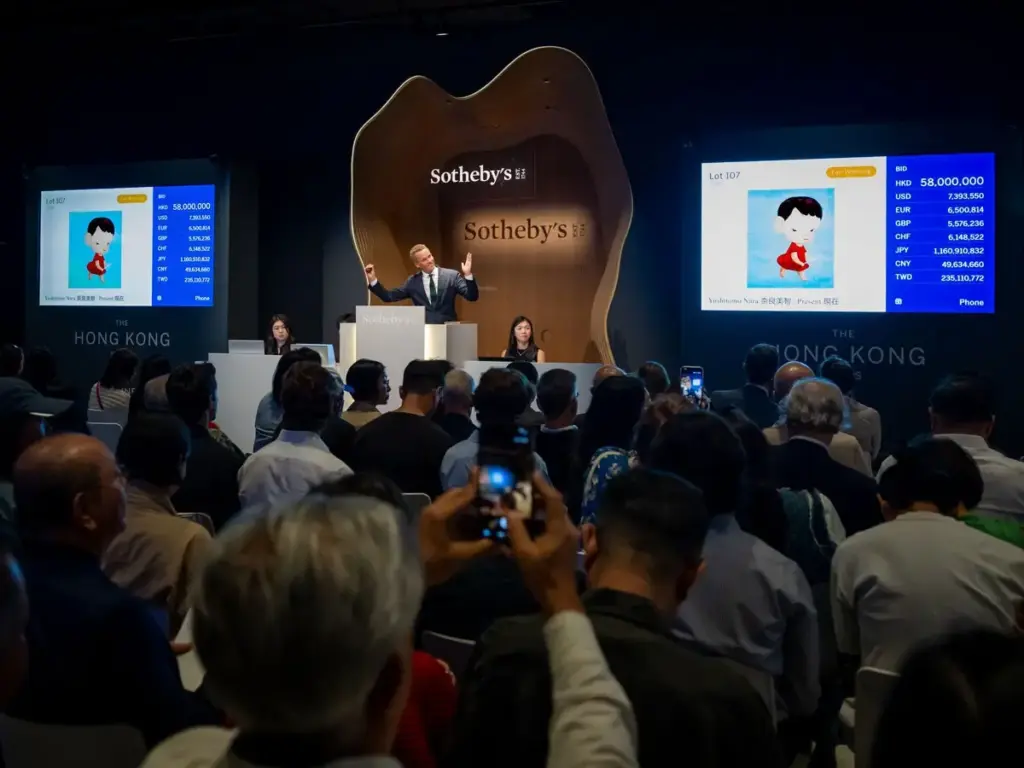
Without the Lewis portion included in the main tally, the Sotheby’s evening sale concluded with a total of $87.3 million and an 88.5 percent sell-through rate. Inclusive of the Lewis collection sale, the house reported a 91 percent sell-through rate and a total haul of $124.3 million, marking its highest overall evening total since the fall of 2023. The main auction’s top lot ultimately ended up being Yoshitomo Nara’s 1994 painting Present, which fetched $9.13 million after making its return to the market following an appearance at Sotheby’s New York in 2004.
Christie’s Mixes Old Masters and Contemporary Highlights
At Christie’s on Tuesday night, underbidding activity proved to be remarkably buoyant across a diverse selection of European Old Masters and established contemporary Asian artists, ranging from Peter Paul Rubens to Liu Ye, who is now in his 60s.

In a standout moment during the Old Master offerings, intense bidding escalated for Rubens’s Landscape with Willows between two determined phone buyers until Rebecca Yang, Christie’s China chairman, brought down the hammer at $1.5 million—representing 150 percent above its low estimate—drawing a sharp burst of excitement and applause from the salesroom floor.
Ada Tsui, vice president for Christie’s Asia Pacific, noted she was particularly impressed by the competitive bidding on Liu Ye’s work, which sparked a fierce head-to-head battle between a Hong Kong-based collector and a Western buyer. The underbidding activity was notably strong, demonstrating that Western collectors are increasingly willing to compete aggressively for top-tier pieces in the region.
However, performance across other marquee lots remained mixed. Yayoi Kusama’s 2011 painting A-Pumpkin (YHP) hammered at $5.99 million—coming in 2.08 percent below its low estimate and realizing roughly $300,000 less than a comparable painting of identical dimensions sold at Sotheby’s the previous evening. Meanwhile, Gerhard Richter’s Abstraktes Bild (1991) hammered at $3.568 million, falling 26 percent short of its low estimate before factoring in the buyer’s premium, which brought its final price to $4.47 million.
Cristian Albu, head of auction and private sales for Christie’s Asia Pacific, acknowledged that the house took a calculated risk by bringing that particular Richter work to the evening sale. While Richter produced a prolific body of work across diverse media, Albu noted that this marked the first time Christie’s had presented an oil-on-wood painting by the artist in Asia. While the consignor acquired the piece at Christie’s London in 2006 for a fraction of its current value, Albu reflected that a dedicated regional exhibition explaining the breadth of the artist’s material evolution might have better contextualized the work for local collectors.
Regarding Kusama’s performance, both Tsui and Albu defended the final result as solid despite the below-estimate hammer price. Tsui pointed out that the artist’s advanced age and potential market saturation had been priced in long ago, making a final price of over $7 million with buyer’s premium a very respectable outcome, particularly when multiple clients were bidding at that elite level back-to-back with a competitor.

At the end of the night, Christie’s marquee 20th- and 21st-century evening sale generated $92.6 million, marking a 28 percent increase year-on-year, though that growth was supported by 14 additional lots compared to the previous year’s offerings.
Structural Challenges and the Shrinking Eight-Figure Buyer Pool
Reflecting on the broader season, auction house veteran Yuki Terase, cofounder of advisory firm Art Intelligence Global, highlighted the structural challenges currently facing top-tier secondary market offerings. With a global art calendar packed tightly with international fairs, major gallery exhibitions, and private secondary market inventory, buyers returning from the summer break were met with a sudden influx of competing choices.
Terase explained that while there is a vast pool of collectors who can comfortably and intuitively spend up to a few million dollars, once transactions cross into eight figures and above, the prospective buyer pool shrinks dramatically.
This dynamic was clearly exemplified by top-tier market trophies in Asia this season, such as Jean-Michel Basquiat’s Ancient Scientist (1984). Sold at Christie’s for $9.81 million, it claimed the title of the most expensive work sold at auction in Asia for the season. Yet, its hammer price of $7.97 million landed just 11.61 percent above its low estimate. Having previously changed hands in Hong Kong at a joint Phillips and Poly Auction sale in December 2020, the transaction underscored how premier eight-figure lots increasingly rely on unlocking fresh capital and attracting new high-net-worth buyers rather than depending on existing participants to repeatedly re-engage.
Phillips Navigates Transition with Client-Centric Strategy
At Phillips on Wednesday night, the autumn sale marked the house’s first Hong Kong evening auction since the departure of Asia chairman Jonathan Crockett earlier in the month and a broader wave of senior leadership exits globally. Acting as interim lead, Dina Zhang, head of modern and contemporary art for China, actively worked to dispel market rumors that Phillips might scale back its regional footprint. Instead, Zhang emphasized that the firm is focusing on client retention and acquisition through tailored services, flexible consignment strategies, and a willingness to incorporate edgier works into category niches that larger competitors might overlook.

Zhang noted that the firm remains highly competitive in specific categories and price ranges, adding that whenever Phillips competes for a major consignment against rival houses, she encourages clients to provide transparent feedback regardless of the outcome.
Across a lean catalog of just 16 lots, the Phillips Modern & Contemporary Art Evening Sale generated over $6.4 million, concluding with a healthy sell-through rate of 87.5 percent. The sale’s top lot was another work by Gerhard Richter: 1983’s Abstraktes Bild (522-1), which achieved $2.93 million, trailing the price of the Sotheby’s Richter—painted eight years later—by about $1.54 million.