By Sameer Sodhi, Business Leader-Entertainment and Color Kinetics at Signify
For decades, the financial and structural value of architecture has been measured through a familiar, albeit narrow, set of metrics: construction costs, energy performance ratings, occupancy rates, and calculated return on investment. Yet, one of the most profoundly influential elements that brings any built environment to life—transforming cold structures into vibrant, engaging spaces—often remains entirely overlooked in those traditional calculations: architectural lighting.
Traditionally, lighting has been viewed as little more than a finishing touch, a functional necessity applied at the tail end of a project to ensure visibility and basic code compliance. However, a growing consensus among urban planners, designers, and industry leaders makes it increasingly clear that lighting is far more than mere decoration. It is a vital, transformative tool that shapes human experiences, defines places, influences public behavior, supports local economies, and contributes significantly to civic identity. The pressing question facing the architectural and urban design communities is no longer whether lighting matters, but whether we can accurately measure the sweeping, often overlooked value it creates for modern cities.
A recent impact analysis conducted by Color Kinetics, which examined four distinct illuminated public spaces across the United States, provides compelling evidence that strategic architectural lighting delivers measurable returns extending far beyond basic aesthetics. The comprehensive report, titled “Lighting Public Spaces – Impact and Analysis,” explores projects ranging from major civic landmarks to intricate public art installations. The study found that thoughtfully designed architectural lighting generated tangible economic, social, and cultural benefits that stretched well beyond the initial capital investment.
Beyond Lumens and Energy Savings
In the day-to-day operations of lighting design and engineering, professionals are well-equipped to quantify energy consumption, long-term maintenance savings, and carbon emission reductions. While these technical measures are essential for meeting contemporary sustainability standards, they tell only a fraction of the broader story.
The Color Kinetics report broadens this perspective by considering lighting’s profound effects on community engagement, tourism metrics, local economic development, visual prominence, strategic partnerships, environmental sustainability, and overall human wellbeing. It treats lighting not as an optional accessory, but as fundamental infrastructure that actively shapes how cities function and how communities connect. As modern architecture increasingly prioritizes human interaction, holistic wellbeing, and distinct local identity, dynamic lighting has emerged as a central instrument in delivering these critical outcomes.
When Buildings Become Destinations
Perhaps the strongest and most visible evidence of lighting’s true value lies in its unique ability to transform ordinary, familiar places into memorable, magnetic destinations. A striking example of this phenomenon can be found in Milwaukee, Wisconsin, where the Daniel Hoan Memorial Bridge was once viewed simply as functional transport infrastructure—a concrete and steel thoroughfare carrying motorists across the harbor.
Today, the integration of dynamic architectural lighting has completely reimagined the bridge, transforming it into a radiant visual icon that reflects the city’s evolving identity. This illumination connects residents and visitors to the waterfront in an entirely new way, establishing the structure as one of the city’s most recognizable and beloved landmarks. Rather than fading into the background at night, the bridge now serves as a vibrant canvas, hosting community and civic events, supporting various causes and public initiatives, and anchoring annual festivals throughout the year.
The way a piece of architecture looks and feels after dark can have a massive, quantifiable impact on its digital presence, driving millions of online impressions, fueling tourism campaigns, and generating widespread media coverage. This digital footprint has effectively positioned the bridge as an ambassador for the city itself. Through the power of light, conventional infrastructure has been successfully elevated into cultural infrastructure.
This represents an important distinction in how modern cities evaluate success. Performance is no longer measured solely by how well a physical structure handles its intended mechanical or logistical function, but by how successfully it contributes to the wider cultural and social identity of a place.
The Economics of Experience
Architectural lighting also creates substantial economic value in ways that traditional procurement and valuation models often struggle to capture. The recent report estimates that the four featured lighting projects collectively generated nearly $30 million in total impact through direct capital investment, supply chain activity, and wider regional economic effects. Yet, the indirect economic impacts may ultimately prove even more significant.
The experience of West Sacramento’s venue known as The Barn demonstrates how thoughtful, connected lighting can actively support comprehensive placemaking. Originally conceived as an event and dining venue, the integration of connected lighting helped establish the site as the vibrant focal point of a rapidly growing mixed-use district. Today, the space attracts a steady stream of concerts, festivals, sporting events, and community gatherings, while simultaneously helping to activate and draw visitors to the surrounding waterfront.
In the wake of this transformation, approximately ten residential developments have subsequently been built or are currently under construction nearby. This spatial evolution highlights the vital role that quality public spaces and illuminated environments can play in wider urban regeneration. The economic value created by these projects extends far beyond initial construction economics. Visitors tend to stay longer in the area, local businesses benefit directly from increased footfall, and the location develops a distinct, positive identity that encourages repeat visits and sustained private investment. These lucrative outcomes are rarely measured in traditional lighting specifications, yet they represent perhaps the greatest long-term return on investment for a municipality.
Lighting as a Civic Platform
One of the report’s most compelling findings is that architectural lighting is increasingly functioning as a dynamic form of public communication. Philadelphia City Hall illustrates this evolution perfectly. The historic building’s programmable lighting system allows it to respond instantly to national celebrations, charitable awareness campaigns, and major civic events. This capability transforms a historic stone landmark into a responsive, living expression of the city’s collective identity. Whether celebrating major sporting victories or marking important social causes, the building ceases to be a mere physical backdrop and instead becomes an active, participating member of public life.
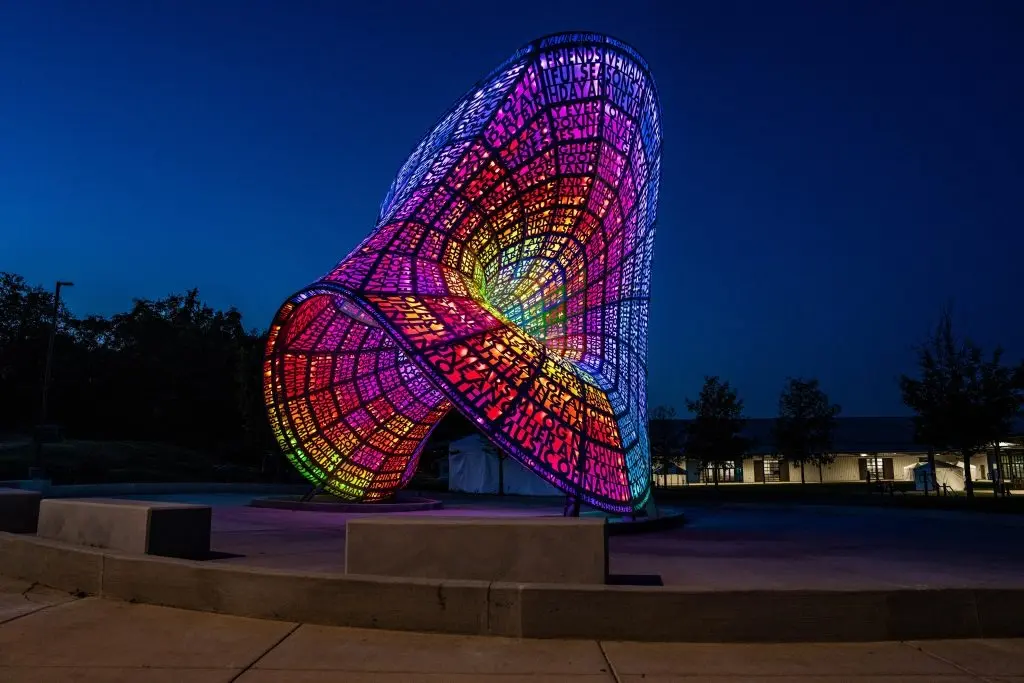
Similarly, Nashville’s public art installation, Loqui, demonstrates how illuminated public art can amplify community voices and foster civic pride. Working in tandem with the sculpture’s innovative and unique shape, the lighting design was specifically crafted to personify the words of the city’s residents, inviting personal stories in and projecting them outward for the public to experience. The installation incorporates words and stories contributed by more than 400 local residents, creating a permanent piece of public art that is fundamentally shaped by the very people it represents. In this context, lighting does not merely serve to illuminate the artwork; rather, the lighting becomes an integral, inseparable part of the artistic experience itself.
These projects suggest that good lighting is no longer solely about achieving basic visibility after dark. Increasingly, it is about fostering participation and connection.
Towards Better Measures of Good Design
The ongoing challenge for architects, lighting designers, and their clients is that many of these valuable qualitative benefits remain entirely absent from conventional project evaluations. A standard business case typically focuses narrowly on initial installation costs, operational energy savings, and scheduled maintenance cycles. While these operational measures are undeniably important, they systematically overlook critical questions regarding how a lit environment shapes human behavior and civic life.
These broader outcomes may be inherently more difficult to quantify than a kilowatt-hour reduction, but they are no less valuable to society. Qualitative indicators—such as meaningful stakeholder engagement, expansive digital reach, measurable tourism activity, and active community participation—can and should sit alongside traditional economic modeling to provide a comprehensive, holistic understanding of lighting’s true contribution to the built environment.
Designing for Lasting Value
As cities around the world continue to invest heavily in urban regeneration, climate resilience, and healthier public environments, public expectations of architecture will continue to evolve. Buildings and public spaces are increasingly judged not only by how efficiently they operate mechanically, but by how effectively they create meaningful, memorable experiences for the people who use them.
Architectural lighting is uniquely positioned to support that ambitious goal. It possesses the distinct capacity to extend the usability of public spaces long after the sun goes down, strengthen local identity, encourage vital social interaction, and help transform ordinary civic infrastructure into iconic, cherished landmarks. When thoughtfully integrated from the earliest conceptual stages of design, lighting transcends its traditional role as a mere aesthetic upgrade and becomes a strategic, high-value investment.
Perhaps this is the true measure of good design: not simply how beautifully a building is lit, but how effectively that light helps people connect with architecture, with one another, and with the places they call home. If architecture is ultimately about creating lasting, meaningful value for society, then lighting deserves to be measured not as an optional enhancement, but as one of its most powerful contributors.
www.signify.com/gb