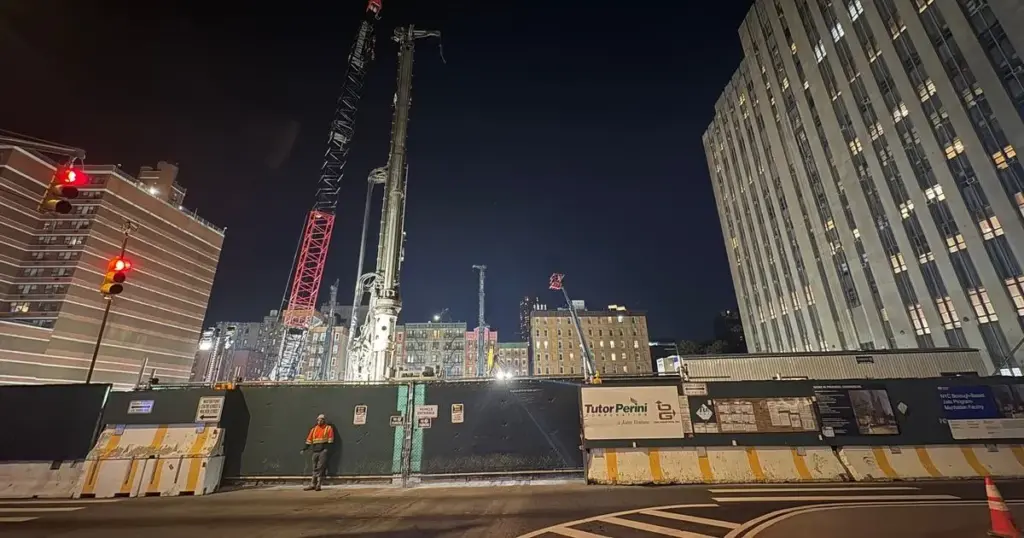
David Wallach was walking back to his Lower East Side apartment on a Tuesday evening around 8 p.m. when he craned his neck to witness one of Lower Manhattan’s latest after-hours spectacles. At the busy corner of White and Centre Streets in Chinatown, he watched as a cluster of giant drill rigs across the street bored aggressively into the earth at the site of the borough’s forthcoming 335-foot-tall jail facility.
“It’s strange to see construction happening this late at night,” the photographer noted, his thoughts abruptly interrupted by the booming, rhythmic rat-rat-rat of the heavy drills. The operation also immediately drew the attention of nearby bargoers on Baxter Street, who marveled aloud to their friends with wide eyes, shouting that the late-night intensity was crazy. A pair of documentarians leaving a party nearby at the Firehouse Cinema instinctively whipped out their phones and stood right in the middle of the street, recording the swirling cacophony as floodlight-illuminated drills and lumbering cranes operated against the dark night sky. One of them acknowledged a grim reality for the surrounding neighborhood, bluntly remarking that the situation “sucks for the neighbors.”
Alexis, a local resident who lives in the back of a rental building directly on Baxter Street, agreed completely with that assessment. “It’s terrible,” she said of the relentless construction. “The ground shakes. We feel trembling even if we don’t hear it.”
This disruptive reality, it turns out, could define daily and nightly life for the community for more than half a decade. Over the next five-plus years, residents and local businesses surrounding the former site of the Manhattan Detention Complex, historically known as the Tombs, will find their days and now their nights filled with earsplitting drilling, heavy machinery, and persistent ground vibrations.
The project is already running notably behind schedule. The city is all but guaranteed to blow past its legally mandated deadline to close the troubled correctional complex on Rikers Island and replace it with a network of four new modern jails across the boroughs by 2027. The 1,040-bed Manhattan jail, which from the outside will ultimately resemble a bland, corporate office building, looks to be the last of the four facilities to finish, with an anticipated opening date pushed out to 2032.
To meet that distant target date, Tutor Perini and O&G Industries, the project’s design-build team, are forced to adhere to an intense, aggressive construction schedule that has directly fueled the constant late-night ruckus. Frustrated neighbors and local community groups—some of whom have already tried and failed to block the jail’s construction in their backyard through previous legal battles—took definitive action on a Wednesday by filing a fresh lawsuit in Manhattan Supreme Court to put an immediate halt to the disruptive after-hours work.
“They’re already going to miss the legal deadline by five years. That doesn’t mean that Chinatown should have to suffer,” said Vic Lee, a co-founder of the business-boosting nonprofit Welcome to Chinatown, which serves as one of the advocacy groups suing the administration. “At what cost does this come?”
According to an official advisory published by the city earlier in the month, work and heavy operations on White Street are scheduled to stretch from at least 6 a.m. through midnight during the week. Additionally, material deliveries are slated to run from 4 a.m. to 7 a.m., alongside mandatory daytime work on Saturdays.
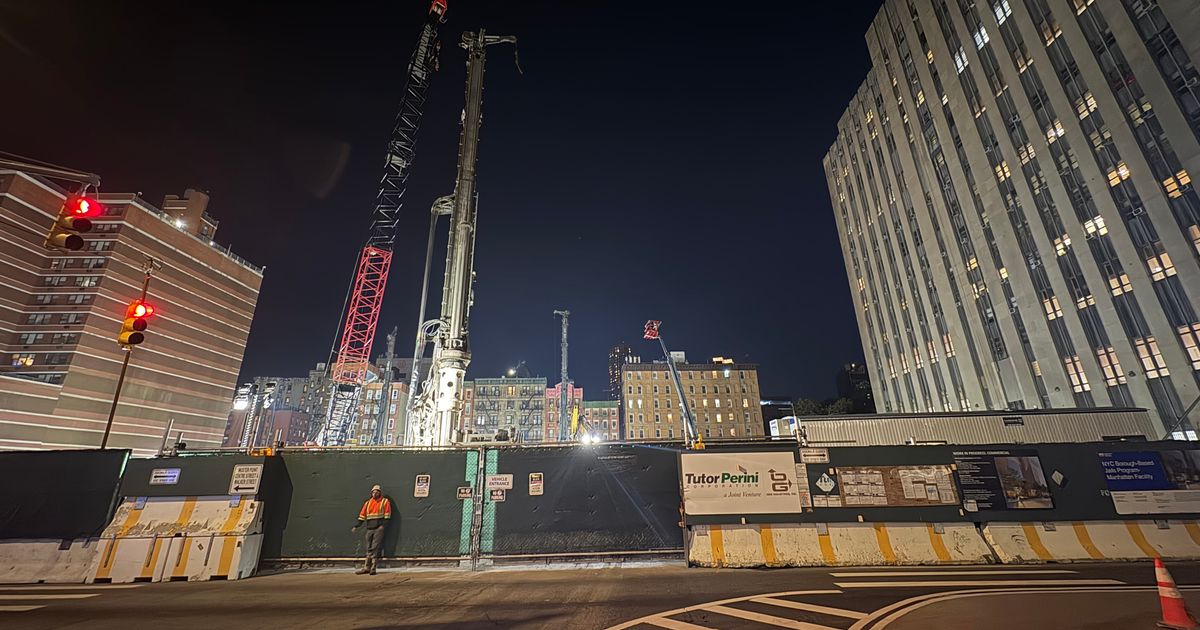
To the contractors’ credit, the city and its building teams emphasize that steps are being taken to mitigate the impact on the surrounding community. These measures include the installation of dust and noise monitors directly on the site, alongside the deployment of heavy sound blankets and specialized noise barriers designed to dampen the roar of the equipment.
Even so, the jail site’s neighbors allege in the new lawsuit that this ramped-up, around-the-clock construction schedule is actively ruining their quality of life.
“The only time that I am now able to sleep with no noise or disruption is for the four hours from midnight to 4 a.m.,” said Jon Alpert, a 77-year-old documentarian who lives at 87 Lafayette Street, in a sworn affidavit. “It is torture,” he added, noting that the suffering is doubly acute because he is currently recovering from treatment for metastatic prostate cancer and desperately requires uninterrupted rest. Furthermore, the nonprofit media-arts center that he co-founded and co-directs, DCTV, is located in the very same building. Its audio-recording services, 7 p.m. public screenings, and popular evening classes have become nearly unworkable under the constant barrage of noise and vibration.
Other local plaintiffs share similar harrowing accounts of daily life next to the active job site. Per the filed complaint, 77-year-old Betty Lee and her husband were already unable to comfortably open the windows of their rent-stabilized apartment on Baxter Street due to standard daytime street noise; now, the elderly couple must also endure essentially daylight conditions all evening long under the blinding glare of the site’s massive temporary floodlights.
Meanwhile, Ping Ai Mei, an 88-year-old resident living at the Chung Pak low-income senior housing facility situated directly next to the construction zone, claims she has developed persistent health issues resulting from the heavy demolition dust. She reported that the situation forced her to relocate to a different unit within the building last year in search of relief. With major construction activities expected to push deep into the night for years to come, Ping worries that the swirling dust and structural vibrations will only intensify.
“We all live in New York City, and we all have experienced, for, like, two or three days, Con Edison or DEP doing some late-night work, but you know it’s going to end fairly soon,” said Christopher Marte, the local city councilmember and co-founder of the neighborhood advocacy group Neighbors United Below Canal, which is also a plaintiff in the lawsuit. “This is pretty much permanent.”
According to the legal complaint, the city is placing an excessive and unfair burden on the surrounding residential and business community by implementing this rushed construction schedule, all in the name of meeting an arbitrary 2032 completion target. The city has previously asserted that keeping strictly to a weekday-only schedule during normal working hours would push the final completion deadline out to 2034 and add another $340 million to the jail’s estimated price tag, which currently sits at $3.9 billion, according to details cited in the suit.
However, the legal filing argues that the work the city views as necessary to satisfy that self-imposed deadline is fundamentally illegal. Building a new correctional facility, the lawsuit claims, does not meet the strict legal test required to justify extended after-hours work permits, which are generally reserved under city regulations for projects directly tied to immediate public health and safety emergencies.
The suit also alleges that the city has violated state environmental laws, asserting that the current intensive plan amounts to more than double the intensity and duration of construction activity that was considered in the jail’s original environmental-impact study.

“This means that the community will be subjected to unbearable noise, dust, overnight glaring lighting, and other construction effects,” the lawsuit states, emphasizing that the city has failed to conduct any further environmental review to adequately evaluate the expanded impacts on the surrounding neighborhood resulting from the new around-the-clock construction schedule.
Advocates for closing the notoriously violent complex on Rikers Island argue that shutting down the facility as rapidly as possible is a humanitarian necessity that would improve the health, safety, and human rights of both incarcerated individuals and the corrections staff. Fifteen people died while being held in custody on Rikers in 2025, and multiple deaths have been recorded in the months since.
Proponents of the borough-based jail plan maintain that the severe trauma stemming from rampant violence on Rikers stays with individuals long after they leave. Stanley Richards, the Correction Department commissioner, has previously noted that the system has long inflicted deep harm on both those incarcerated and the vulnerable communities they ultimately return to.
Earlier in the month, Dana Kaplan, the administration’s official "Close Rikers" czar, told the press that the city maintains a clear moral imperative to get the new borough jails open as quickly as possible so that both detainees and Department of Correction staff can finally be transferred to modern facilities with significantly improved conditions.
“Beginning the after-hours work allows us to be on the fastest timeline possible towards completion,” Kaplan said regarding the accelerated construction timeline.
Sam Raskin, a mayoral spokesperson, stated that City Hall is currently reviewing the claims outlined in the new lawsuit. He reiterated that the administration remains fully committed to meeting both its moral and legal obligations to close the jails on Rikers Island and successfully transition the city toward a safer, more humane borough-based correctional system.
Still, even individuals directly involved with the project’s day-to-day execution harbor private doubts about the toll it will take. One construction worker responsible for monitoring noise levels near the site offered a sobering assessment of the situation for those living nearby.
“It’s not going to be great,” the worker said, “especially if you’re trying to sleep at these hours.”