A fashion show or a live performance may last only a few minutes, but what happens in the room during that fleeting window of time is remarkably difficult to capture or replicate. For Dutch spatial designer Dennis Vanderbroeck, this temporary collectiveness sits precisely at the heart of his practice. Moving fluidly between the worlds of fashion, theater, music, and contemporary performance, Vanderbroeck approaches architecture and spatial design not as static monuments, but as active frameworks for human encounter. To him, the relationship between performers, artists, and audiences matters just as much as the physical enclosure itself.
With a deep professional background rooted in theater, Vanderbroeck focuses acutely on the emotional and psychological experience a physical setting creates. His elaborate designs deliberately set the scene for unpredictable human interactions, leaving deliberate room for spontaneity and the unexpected. "I always say that our designs are just a tool to facilitate the experience," Vanderbroeck tells designboom. "It’s more about the experience of the moment than the space itself." This philosophy was vividly demonstrated during the recent Milan and Paris fashion weeks, where the designer unveiled two remarkably distinct approaches to staging major runway events: a rugged, scaffolded runway that amplified collective energy for Diesel, and a modular, transitional arrangement that hinted at upcoming movement for Miu Miu.
The Space Between the Collective and the Individual
Vanderbroeck’s recent high-profile collaborations with Diesel and Miu Miu reveal two compelling, contrasting ways of exploring the complex relationship between a crowd and a person. His ongoing creative dialogue with designer Glenn Martens at Diesel developed across several seasons, driven by a shared ambition to make contemporary fashion feel more inclusive, approachable, and socially charged. Their final collaboration for the brand culminated in a rigid industrial scaffolding structure paired with a highly performative setting built around community, raw presence, and deliberate spatial disruption.
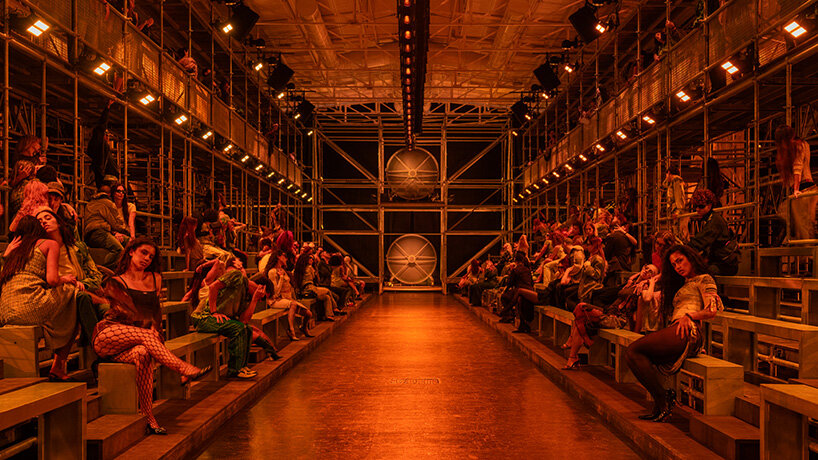
Within this environment, the dynamic contrast between the group and the individual became the primary focal point of the spectator experience. While crowds of attendees occupied the expansive, multi-tiered scaffolding structure, live performers intermittently disrupted the scene, and models wove their way dynamically through the labyrinthine space.
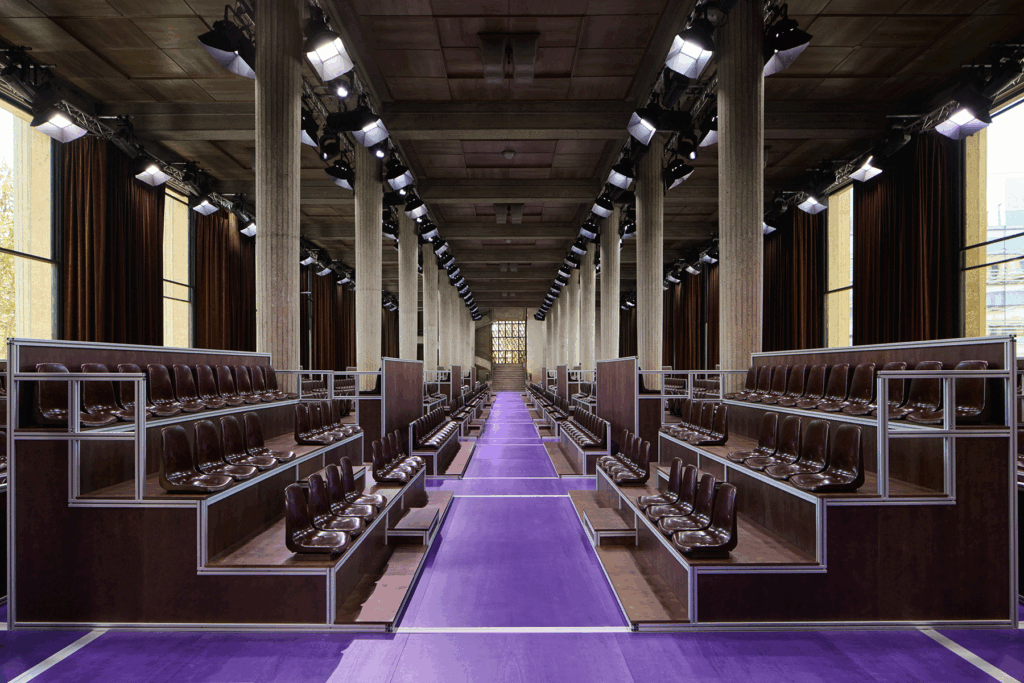
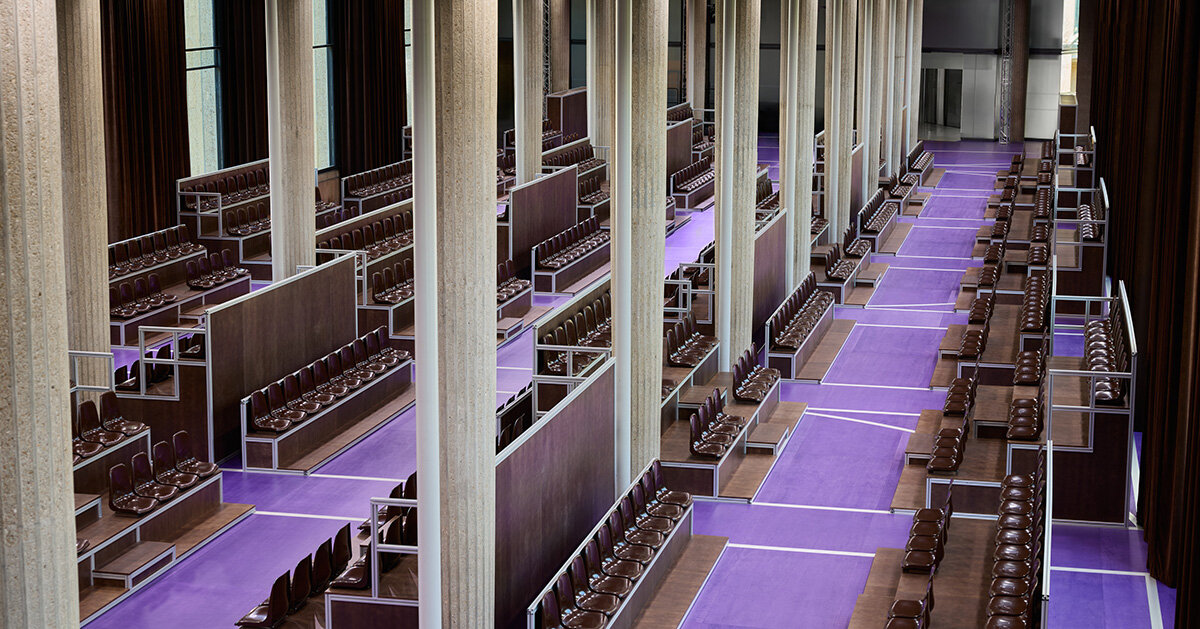
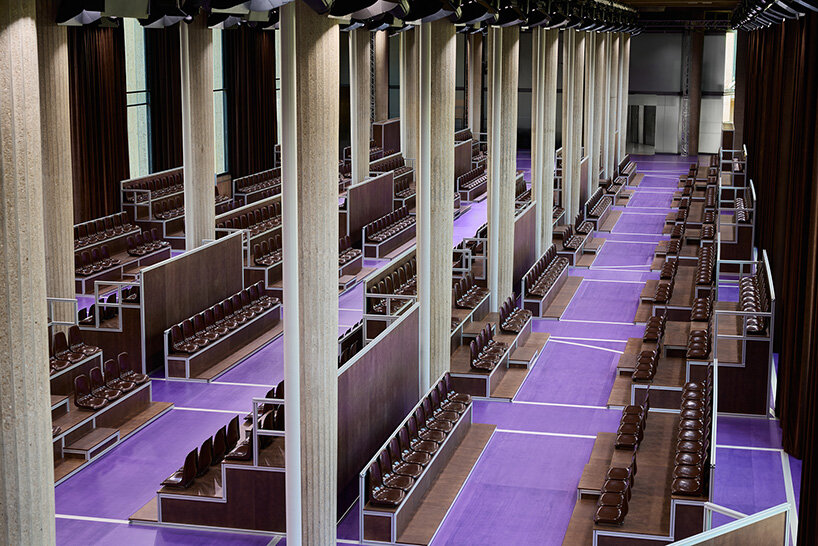
In stark contrast, for the Miu Miu Spring/Summer 2027 presentation at the historic Palais d’Iéna in Paris, Vanderbroeck approached the runway through an exercise in intense physical proximity. Working alongside the luxury fashion house for the very first time, the designer and his team crafted a configuration featuring tightly arranged bleachers and an unusually narrow catwalk. This intimate layout deliberately evoked the moody, close-quarters atmosphere of 1990s runway shows. Here, the audience sat shoulder-to-shoulder, while models brushed past them within arm’s reach.
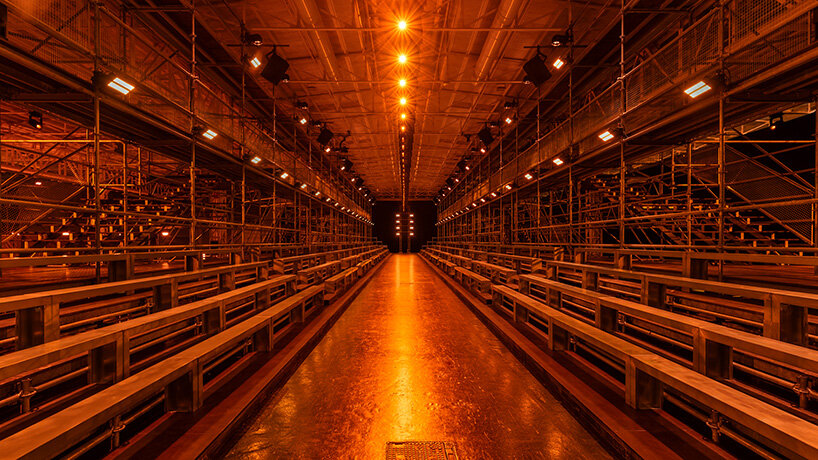
Although these two distinct projects emerged from completely separate creative conversations, both deeply investigated the friction between individual solitude and collective immersion. "In our fashion work, we always try to do something with this idea of the collective versus the singular, the individual," Vanderbroeck highlights. "That friction is forever interesting to me." At any typical fashion show, public attention is ostensibly fixed entirely on the garments moving down the runway, yet the actual memory of the event is powerfully colored by the crowd surrounding you. Vanderbroeck skillfully manipulates this social dynamic through strategic spatial layouts, drawing the audience directly into the narrative without ever dictating how they ought to react or feel.
Designing Movement Within a Static Space
The concept of a space that consciously anticipates its own future use also heavily influenced Vanderbroeck’s debut project with Miu Miu. The runway show was meticulously developed in tandem with Geste de Consolation (Gesture of Consolation), an immersive upcoming exhibition by acclaimed French filmmaker Alice Diop, presented as part of the Art Basel Paris Public Program. "We wanted to create a space that suggests movement and that suggests transition. So for the exhibition, the same venue will be repurposed almost, reframed, and recontextualized," the spatial designer explains.
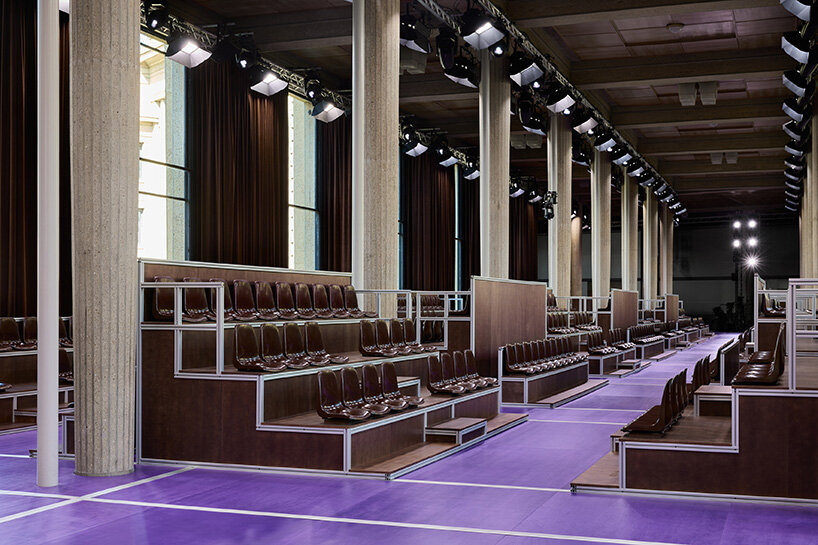
To achieve this, metal tracks were laid directly across the historic floor to support modular, movable bleachers, imbuing the runway with an innate sense of physical trajectory even while the foundational structure remained momentarily still. The arrangement was intentionally engineered to seamlessly accommodate the art exhibition that would immediately follow, ensuring that specific elements of the fashion presentation would be reconfigured and reinterpreted with entirely new meanings in a different cultural context.
Vanderbroeck describes this methodology as building a dynamic stage. Drawing heavily on his foundational training in theater, he treats a set not as a finished, static backdrop, but as a flexible organism capable of absorbing multiple shifting scenarios over time. The design thus becomes part of an extended chronological sequence, shaped just as much by what is scheduled to happen next as by the immediate event unfolding in the room.
From the Theater to the Live Stage
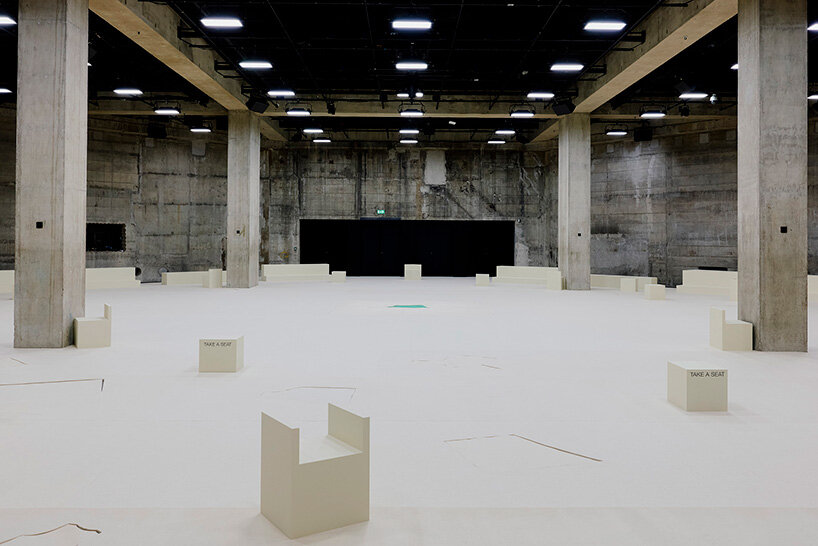
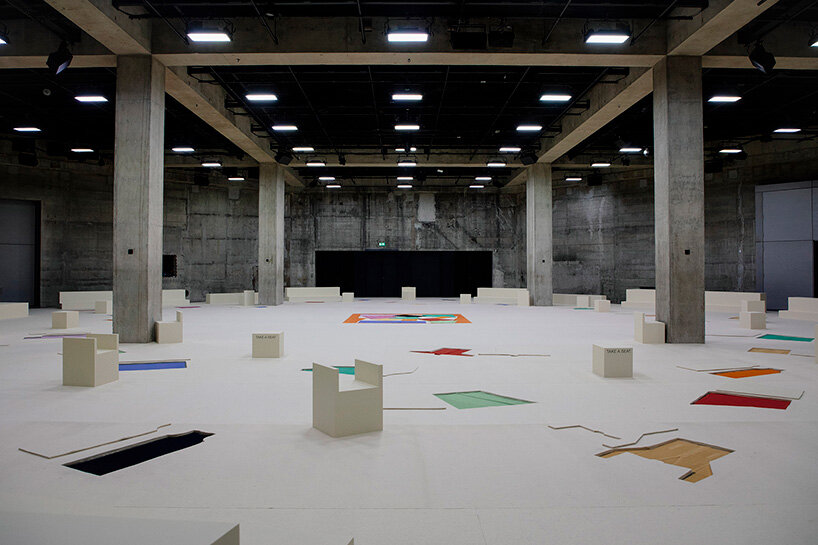
Theater remains an enduring, vital reference point in Vanderbroeck’s multidisciplinary practice, informing his spatial interventions even when he is designing for entirely different forms of live performance. For Issey Miyake’s OPEN STUDIO presentation at London’s Tate Modern, he turned to the monumental, circular geometry of the museum’s brutalist concrete tanks to explore themes of intimacy and the comforting architecture of an embrace. By utilizing the existing architectural curves, he was able to curate varying degrees of psychological proximity between the performers and the surrounding audience members, guiding spectators on a journey from a shared, collective sense of embrace down to quiet, one-to-one interactions between an individual performer and a single observer.
Vanderbroeck also carefully considered the visitor’s physical journey through the museum itself, tracing a path from Henri Matisse’s iconic cutout The Snail into the cavernous expanse of the Turbine Hall and finally descending into the South Tank. The resulting installation operated as a continuous narrative sequence of spaces and chance encounters, where architecture, historical artwork, and live choreography mutually informed the conceptual core.
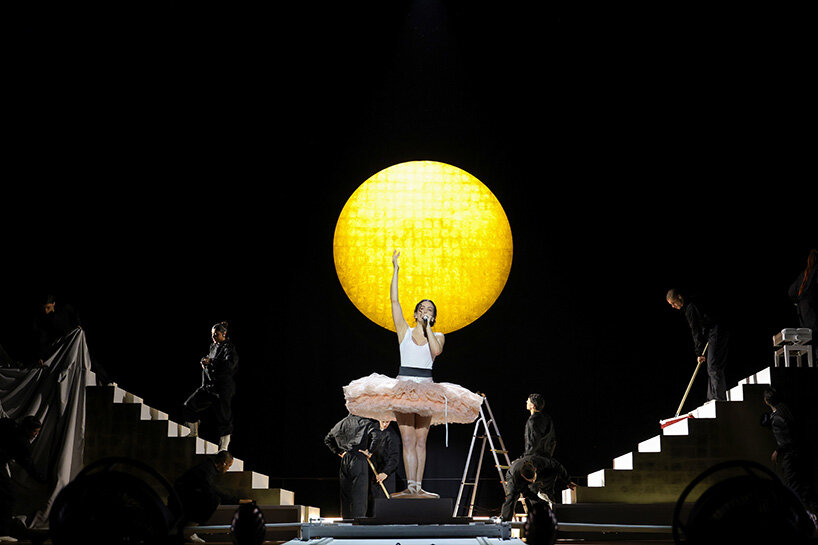
This acute sensitivity to how physical settings shape live experiences extends naturally into the realm of large-scale musical performance. For the Lux Tour, Vanderbroeck collaborated closely with Rosalía and her creative team, synthesizing disparate references drawn from high fashion, popular culture, theater, and fine art. He views the ambitious project as an accumulation of his entire career trajectory thus far. "With Rosalía, honestly, it was an accumulation of my whole practice in one project, where fashion, music, but also popular culture and theater and the references through fine art all came together," Vanderbroeck notes.
Beyond the Image
In an era dominated by digital media, where live events are instantaneously documented, filtered, and circulated across social platforms, Dennis Vanderbroeck remains steadfastly grounded in the irreplaceable value of physical, in-person experience. While he fully acknowledges that striking imagery matters immensely—particularly within the image-obsessed ecosystem of fashion—he never initiates a design process by imagining how a set will look reduced to a glowing smartphone screen.
"I’m always trying to intentionally design from the physical experience," he shares. "If it then resonates well online or resonates well on your phone or something, then perfect. But it’s never the main intention." This philosophy translated directly into the set design for Rosalía’s tour, where camera directions were choreographed to follow the spontaneous energy of the live performance rather than dictating it. For Vanderbroeck, capturing an event on film is merely a way of archiving its memory, but it can never truly substitute for the visceral reality of occupying the room.
The designer views the widespread contemporary impulse to photograph live experiences as a desperate attempt to anchor a fleeting memory—a way of confirming one’s own presence in a specific historical moment before it slips away. Yet, the resulting photograph remains fundamentally detached from the living event, which relies entirely on a delicate constellation of real bodies, physical movement, and passing time.
That inherent unpredictability is precisely what continuously draws Vanderbroeck back to the traditional theater. Having recently designed the set for a production of Anton Chekhov’s The Seagull, he vividly recalls the opening preview in front of a live audience as a moment of profound vulnerability where, despite months of rigorous preparation, the collective reaction remained entirely unknowable. "You never can predict how an audience is going to respond," he reflects. For the spatial designer, that initial, unfiltered collision between a creative work and its public serves as a humbling reminder that design ultimately has its limits. He can meticulously shape the setting and establish the ideal physical conditions for an experience, but once the doors open and the people fill the room, what happens next remains entirely out of his hands.