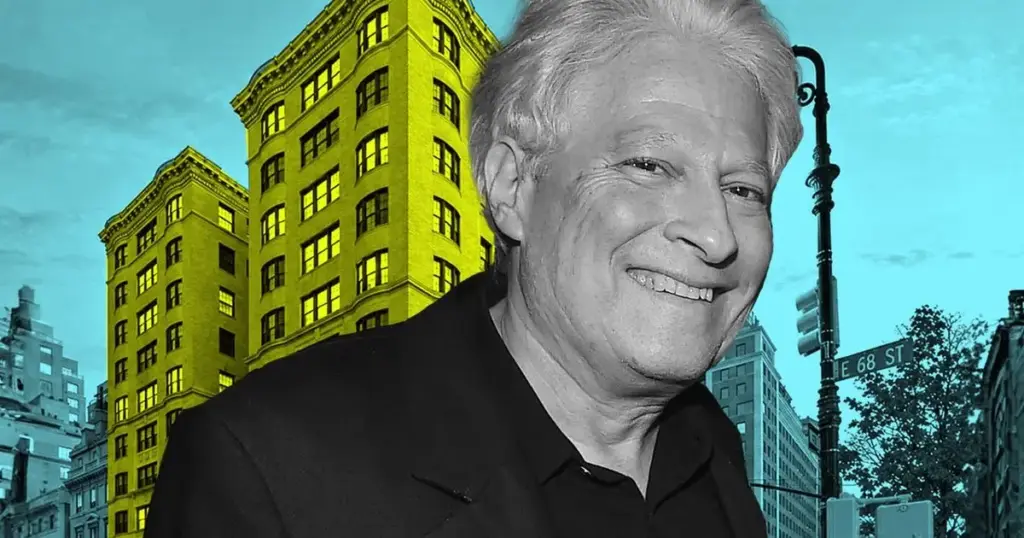
When the condominium residences at The Marquand—a meticulously executed prewar conversion located at 11 East 68th Street—first hit the New York City real estate market a little over a decade ago, they were presented as a study in understated elegance. The units featured a refined palette of creams and neutrals, embodying the kind of tasteful, safe, and universally appealing finishes that experienced development and sales teams routinely advise for luxury new developments. However, the man behind the project, HFZ Capital Group founder and developer Ziel Feldman, chose an entirely different aesthetic path for his own personal residence.
Reserving one of the building’s two grand triplex penthouses for himself and his wife, Helene, Feldman opted for a dramatic, moody, and deeply personal color palette dominated by blacks, deep browns, and dark hardwoods. This cavernous yet striking home was dramatically brightened only by the occasional splash of white, introduced primarily through book-matched marble. The resulting interior was a bold departure from standard luxury staging, bringing to mind the ambiance of a modern, sophisticated lair. The space featured dark woods, exotic stones, and heavily veined marble surfaces that served as a striking backdrop against which high-end contemporary artworks—including pieces by acclaimed artists like Tracey Emin and Sanford Biggers—seemed to vividly glow.
As one fellow developer once remarked to New York magazine regarding Feldman’s signature style, the real estate executive was always well-known within the industry for favoring a heavy dose of "razzle-dazzle." Now, years after first attempting to part ways with the property during a period of intense personal and corporate restructuring, Feldman and his wife have listed the 21-room monument to their distinct tastes for $27.5 million. Madeline Hult Elghanayan and Sabrina Saltiel of Douglas Elliman hold the listing, though representatives for the brokerage did not return requests for comment regarding the sale.
The expansive triplex is far more than a physical reflection of the couple’s lavish aesthetic inclinations; it also stands as a tangible remnant of a much wealthier, high-flying era in New York City real estate. Feldman, a former real estate attorney who successfully transitioned into the upper echelons of luxury development, had originally harbored grand ambitions of joining the historical ranks of old-line New York real estate dynasties, such as the Zeckendorfs and the Dursts.
That lofty goal appeared to be well within his grasp back in 2015 when HFZ Capital Group commenced development on The XI, a striking, twisting, Bjarke Ingels-designed double-tower complex overlooking the High Line in West Chelsea. Even the marketing and sales gallery for that ambitious project was theatrical, featuring a custom-designed immersive art installation by renowned set designer Es Devlin. Yet, before the soaring towers could be brought to completion, HFZ suffered a catastrophic corporate implosion.
The downfall was accelerated by a spectacular and public falling out between Feldman and his former business partner, Nir Meir. Meir was subsequently arrested and faced serious criminal charges connected to an alleged $86 million fraud scheme involving financial improprieties at The XI. While Feldman publicly maintained that Meir bore the primary responsibility for the spectacular collapse of HFZ Capital Group, Meir’s legal battles and preparations for trial have continued to dominate real estate headlines. To the credit of the underlying vision, The XI ultimately proved to be a fundamentally sound concept despite the administrative and financial chaos surrounding its development; the condominiums sold briskly after veteran developer Steve Witkoff stepped in to take over and complete the stalled project.

Following an extended period of laying low while sorting out the legal and financial wreckage of his former firm, Feldman has gradually re-entered the industry. Eschewing the ultra-flashy developments of his past, he has quietly returned to the real estate game alongside his daughter as a partner in GoodHomes, a national firm focused on affordable and workforce housing.
The decision to list The Marquand penthouse once again highlights the long shadow of those turbulent years. Back in 2020, as Feldman was actively fending off a wave of investor lawsuits, mounting debt, and delinquent loans in a desperate bid to save HFZ Capital Group, he initially brought the 6,100-square-foot triplex penthouse to the market with an asking price of $39 million. Now, with years of perspective, he appears resigned to accepting a significantly lower price point, marking a distinct step down in scale from the peak of his former lifestyle.
The central question facing potential buyers is whether anyone else will desire the hyper-specific, gothic luxury lifestyle that the penthouse currently embodies. In several of the home’s sprawling rooms, both the flooring and the walls appear to be wrapped in dramatic, dark black marble. In other spaces, the walls are paneled in gleaming, dark hardwood, which serves to sharply offset furniture upholstered in heavy black and dark-gray velvets.
The sheer physical scale of the residence is equally dramatic. The home spans over 6,100 square feet of interior space and is complemented by an astonishing 2,600 square feet of private outdoor terrace area. The layout encompasses five bedrooms, four full bathrooms, and a grand formal dining room that, according to official listing details, can comfortably seat up to 22 guests. This entertaining space is further enhanced by a custom wet bar, making it ideal for large-scale social gatherings.
Additional high-end features woven throughout the triplex include private elevator access directly into the home, sweeping views of nearby Central Park—located less than a block away—and functional fireplaces situated both inside the main living areas and outdoors on the expansive terraces. During the Feldmans’ tenure, the residence was decorated with museum-quality art pieces, including sculptures by John Chamberlain, paintings by George Condo, and even a taxidermied bunny sculpture created by Maurizio Cattelan. Naturally, these blue-chip artworks do not convey with the sale of the apartment.
Despite its grand size and prominent location, the property functioned primarily as a pied-à-terre for the family. During the height of his success, Feldman and his wife also owned an expansive 18,500-square-foot mansion in Englewood, New Jersey, which had been explicitly inspired by a Fontainebleau château the couple had toured during their honeymoon. That suburban estate was successfully sold in 2020, and just a year later, the couple parted ways with their sprawling Bridgehampton estate for $50 million.
For prospective buyers who appreciate the prime Upper East Side location and the unbeatable square footage but struggle to visualize themselves living amidst such dark-hued opulence, the current real estate listing offers a pragmatic solution. It includes a series of professionally produced digital renderings that depict the apartment completely transformed. In these digitally staged images, the heavy black marbles and dark woods are replaced by light creams and neutral tones, allowing the expansive residence to look very much as it might have back in 2013, had it originally been released to the market as a standard sponsor unit alongside the rest of the building’s condominiums.