Welcome back to another edition of the Garden Photo of the Day (GPOD) series, where horticultural enthusiasts from across the country share the triumphs, challenges, and breathtaking beauty of their cultivated spaces. Today, the journey leads back to Broomall, Pennsylvania, to visit Dot and take a closer look at what is currently blooming in her established Zone 7b garden. Longtime readers of the GPOD series may fondly remember Dot from her earlier seasonal updates, which showcased her impressive knack for color theory and plant selection. Part of the enduring charm of following repeat contributors like Dot is witnessing how a residential landscape continues to grow, mature, and transform over time.
Even as the vibrant heat of summer begins to slip away and autumn approaches, Dot’s garden remains a hub of active horticultural life. Far from winding down for the year, she continues to invest in her landscape by planting new perennials and bulbs to secure future displays. While reflecting on the transition of the seasons, Dot shared a brief introduction to her current landscape highlights: "Although summer is slipping away, I am still planting perennials and bulbs. I’ve included some garden highlights that I hope you enjoy."
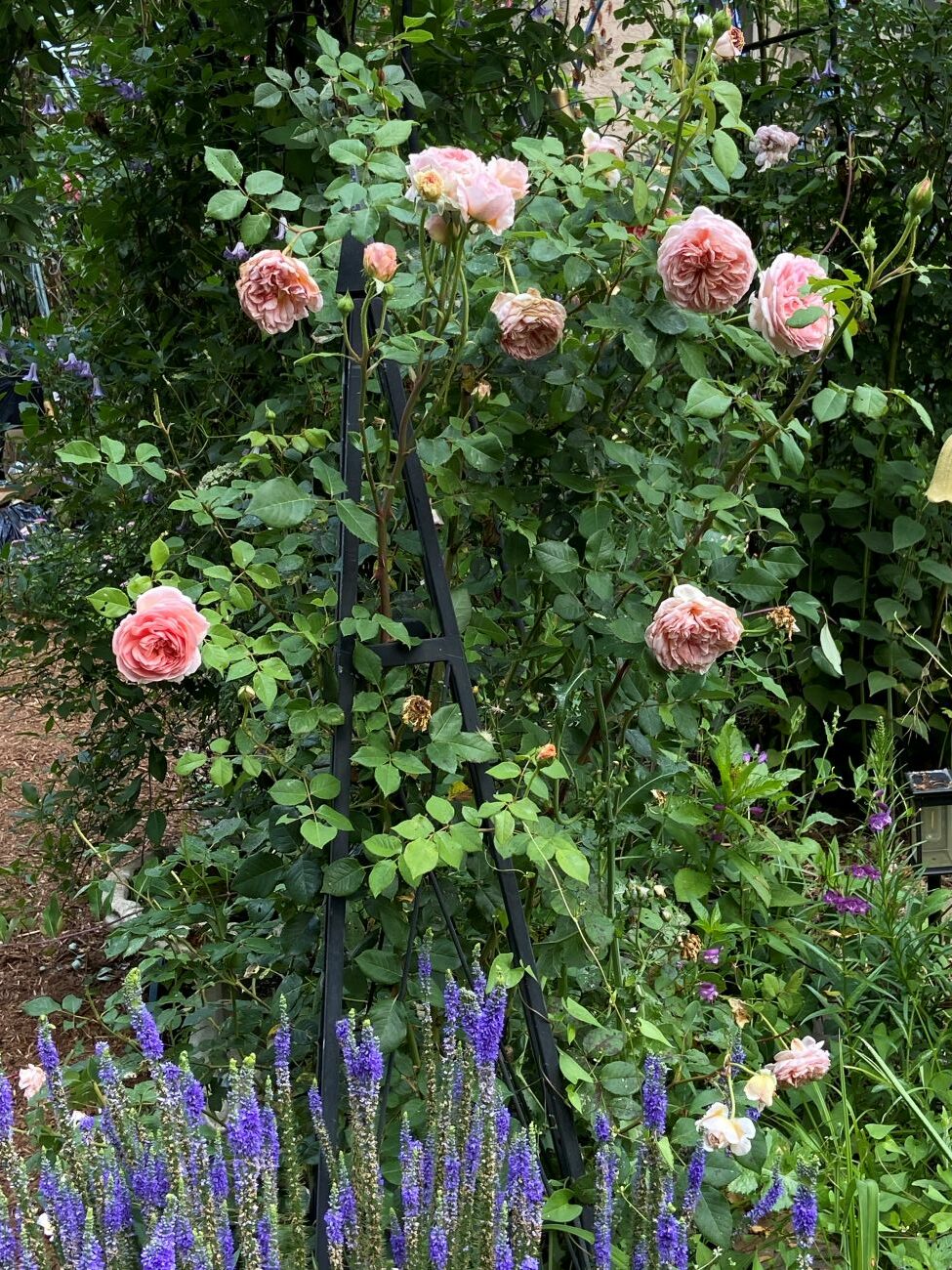
The visual journey through Dot’s Pennsylvania property begins with a striking vertical display near a garden arbor. The classic and beloved ‘Abraham Darby’ rose, scientifically classified as Rosa ‘Abraham Darby’ and rated for USDA Hardiness Zones 5 through 9, ascends the wooden structure with grace. Known for its voluptuous, cupped blooms and rich apricot-pink coloration, the climbing rose creates a magnificent focal point. To anchor the display at the ground level, Dot has planted veronica (Veronica cvs., Zones 3–9) to fill in around the base of the arbor. The cool, vertical purple-blue flower spikes of the veronica create an intentional and striking color contrast against the warm, blush-pink tones of the rose blossoms, demonstrating an expert eye for complementary hues in the perennial border.
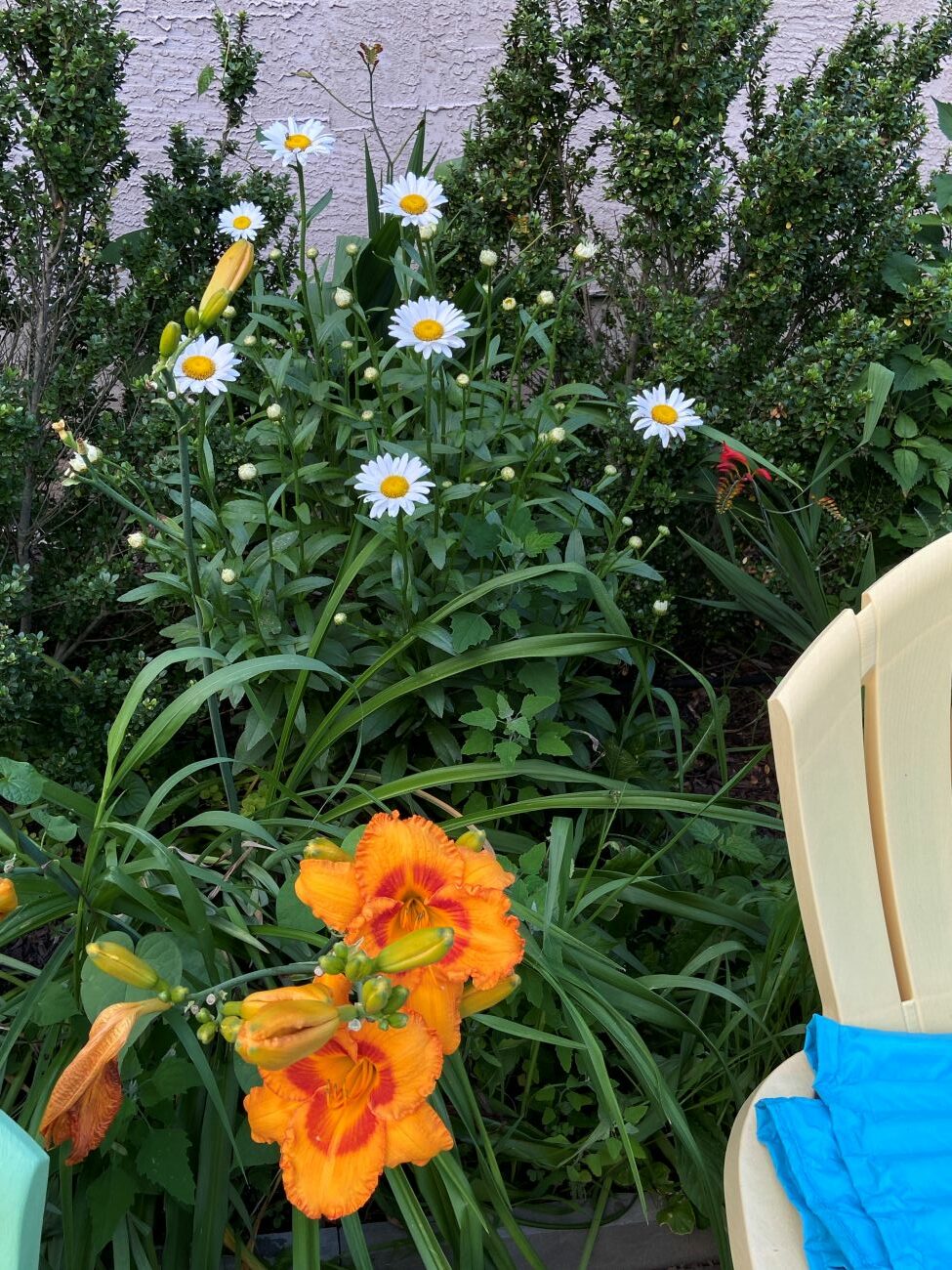
Moving deeper into the landscape behind a quiet seating area, visitors encounter a harmonious mingling of traditional summer perennials. A vibrant orange daylily (Hemerocallis cvs., Zones 3–10) stands shoulder-to-shoulder with classic white Shasta daisies (Leucanthemum × superbum cvs., Zones 5–9). This pairing offers a cheerful, high-contrast combination that brightens the partially shaded spaces near the seating nook, providing a welcoming atmosphere for anyone looking to pause and enjoy the sights and sounds of the Pennsylvania countryside.
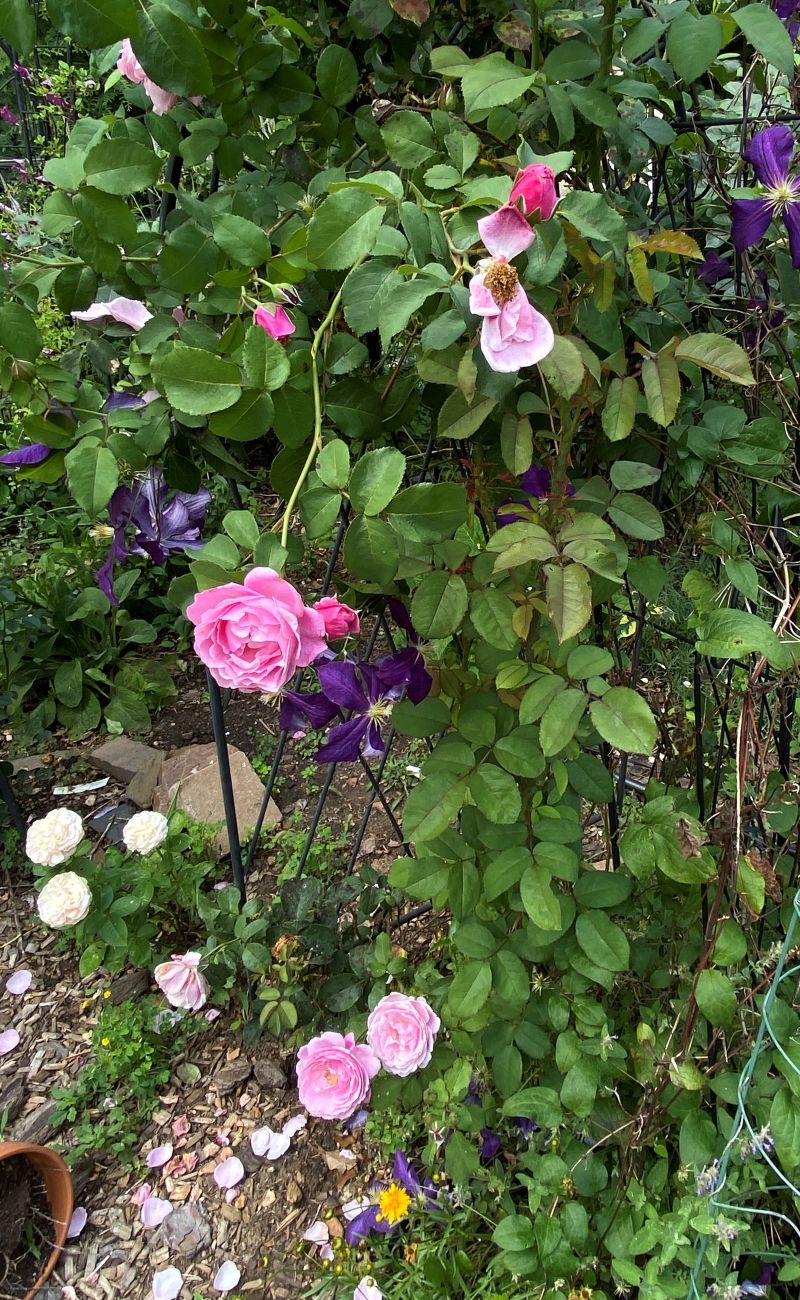
Further along the garden pathways, another vertical vignette captures the eye. The Cathedral Bells rose (Rosa ‘DELamo’, Zones 5–9) climbs in close coordination with the famous ‘Jackmanii’ clematis (Clematis ‘Jackmanii’, Zones 4–8). By training these two vigorous climbers together on a sturdy garden support, Dot allows the deep, velvety purple flowers of the clematis to weave directly through the pink blossoms of the rose. This intermingling of flower forms and rich color palettes ensures that both climbing plants stand out vividly against one another, creating a dense wall of sophisticated floral interest.
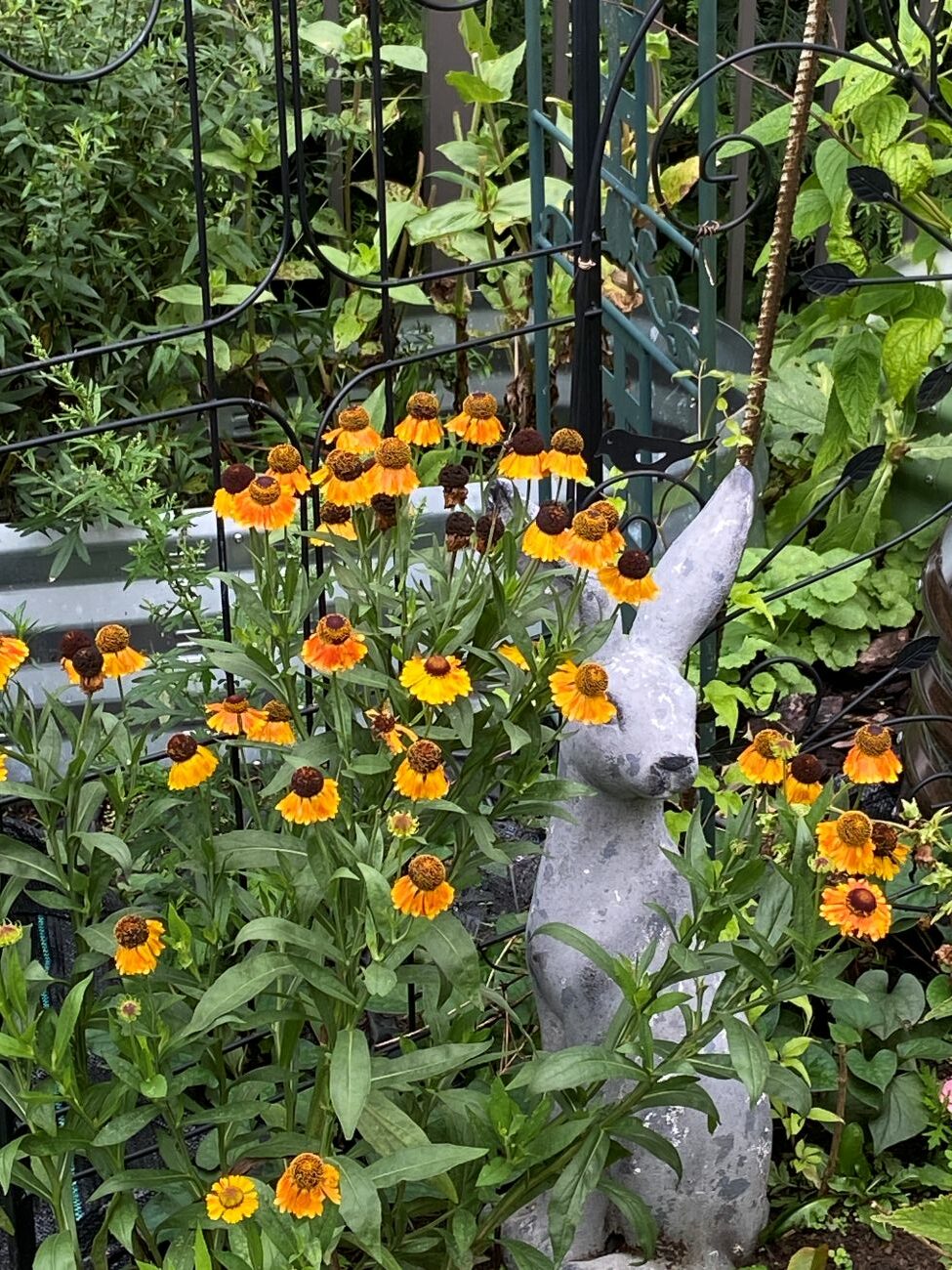
The garden is also playing host to exciting new additions this season. Helenium (Helenium cvs., Zones 3–8), a powerhouse of late-season color commonly known as sneezeweed, has been introduced to the landscape this year. Its fiery orange flowers, accented by dark, prominent central cones, inject a fresh wave of vitality into the beds as the calendar edges toward autumn. Adding a touch of whimsical charm to the scene, a decorative rabbit garden statue is tucked neatly amidst the branching stems of the new helenium, looking entirely at home resting among the rich late-summer blooms.
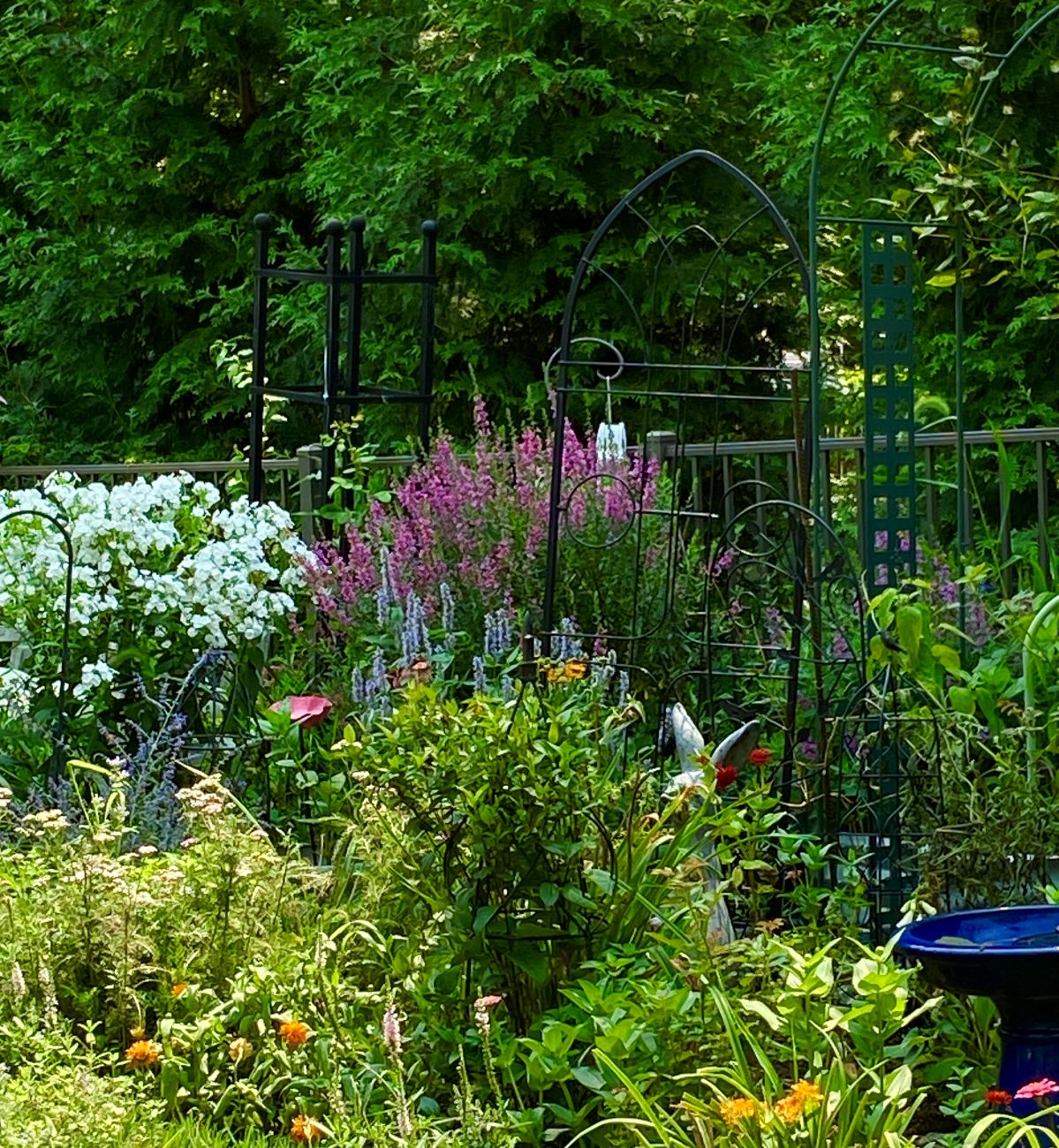
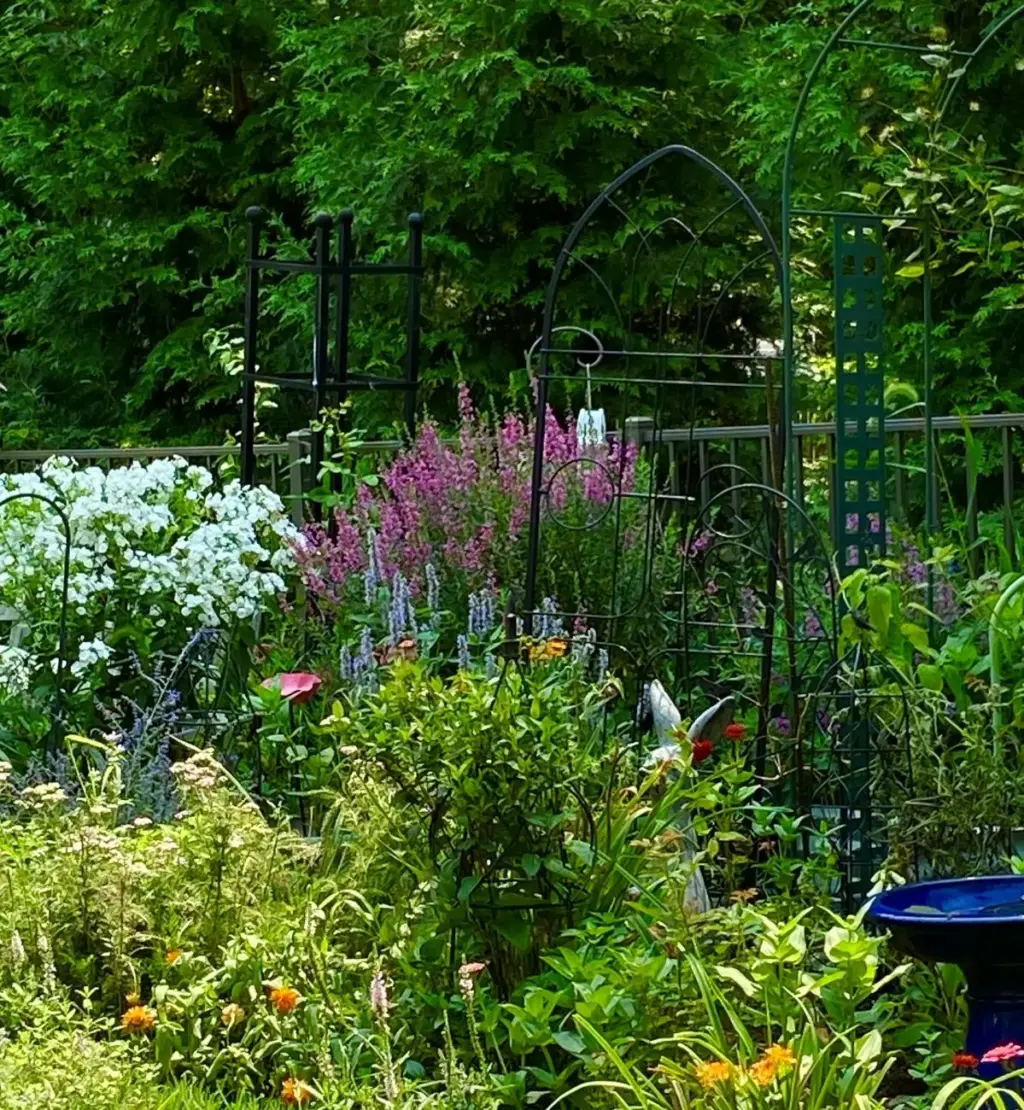
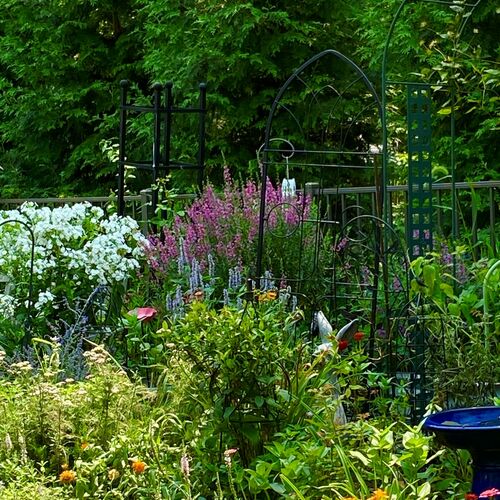
A broader look at one of the mixed perennial beds reveals a complex tapestry of textures and colors working in unison. Here, lythrum (Lythrum cvs., Zones 3–9), white garden phlox (Phlox paniculata cvs., Zones 4–8), bush clematis (Clematis cvs., Zones 3–9), agastache (Agastache cvs., Zones 4–9), and Russian sage (Salvia yangii, Zones 4–9) form a dense, ecologically rich community. Within this multi-layered border, the brilliant white blossoms of the garden phlox serve a crucial design purpose. They break through the dense layers of surrounding purple and blue flower spikes, drawing the eye dynamically across the entire space and preventing the deep cooler tones from becoming visually heavy.
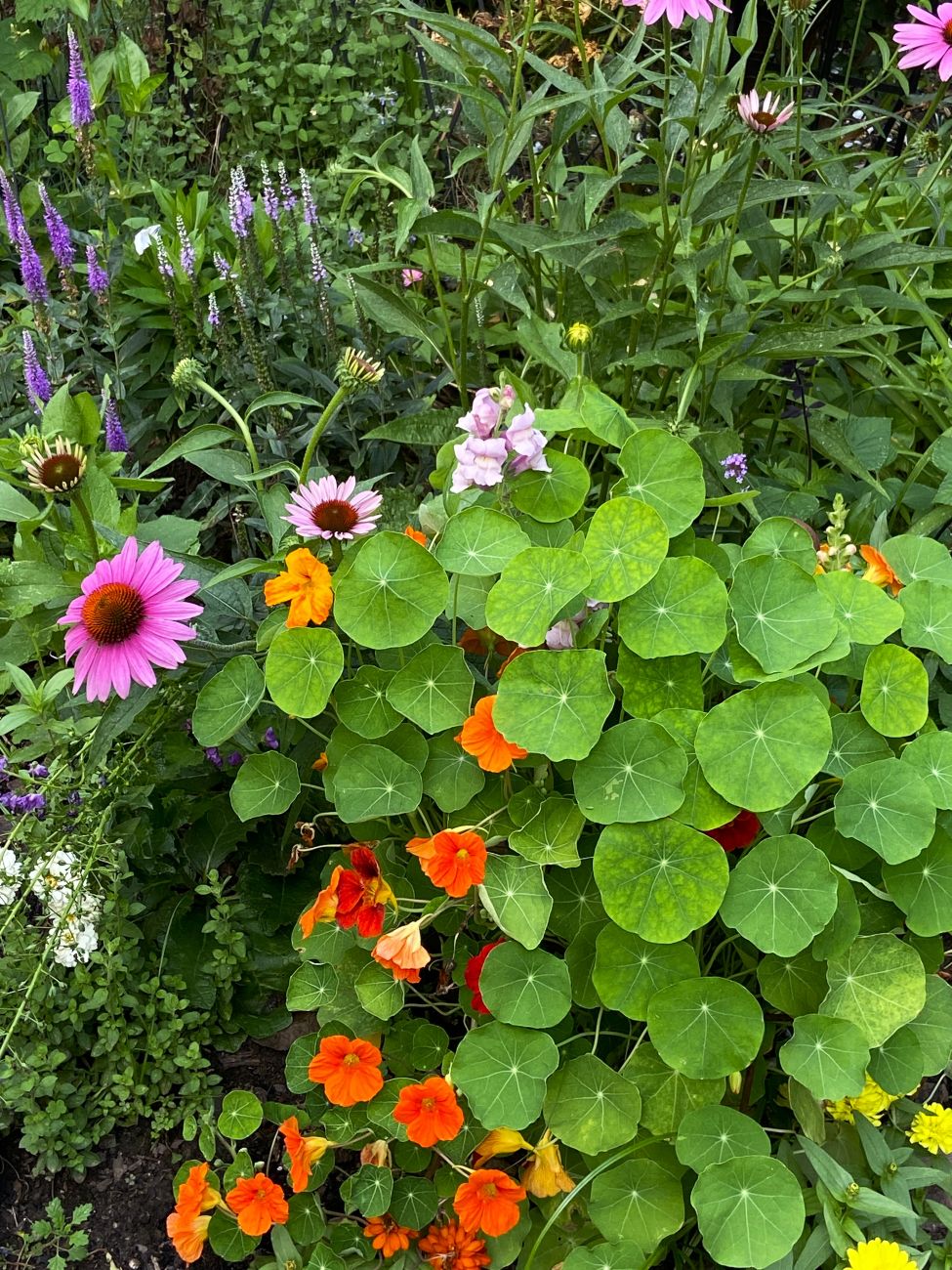
Color contrasts remain a signature theme throughout Dot’s property, particularly in areas where annuals and perennials intersect. Bright orange nasturtiums (Tropaeolum majus) weave their way playfully through stands of purple coneflowers (Echinacea purpurea cvs., Zones 3–9). The saturated, fiery orange of the nasturtium blossoms creates an electric pairing against the deeper, dusty pink petals of the coneflowers. Beyond their aesthetic contribution, nasturtiums serve a practical function in the garden ecosystem, acting as a productive seasonal ground cover that effectively fills in bare soil gaps between established plants and spills gracefully over the timber or stone edges of raised planting beds.
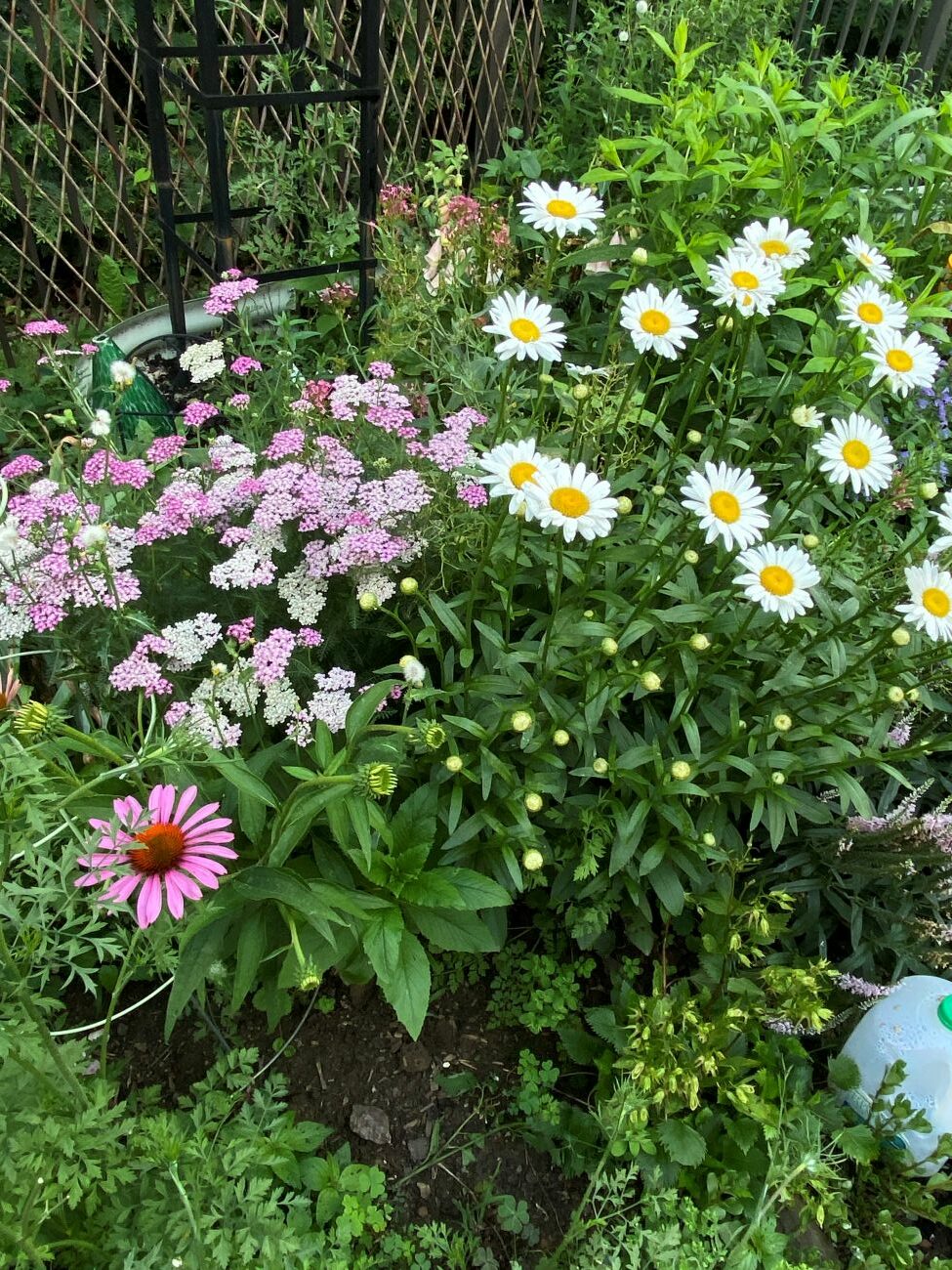
Nearby, another raised bed showcases a masterclass in soft, pastel perennial combinations. Shasta daisies, purple coneflowers, and yarrow (Achillea millefolium cvs., Zones 3–9) are grouped together to generate a delicate cloud of white, cream, and pink tones. The flat-topped flower clusters of the yarrow offer a distinct textural contrast to the daisy-like forms of the Shasta daisies and coneflowers, proving that thoughtful variations in plant architecture are just as important as color selection in garden design.
Dot’s ongoing work in her Broomall garden highlights the rewards of continuous planting and attentive design. From classic roses and clematis sharing vertical space to newly added helenium and sprawling nasturtiums breathing fresh life into established borders, her landscape offers a masterclass in seasonal transition and color pairing for gardeners navigating Zone 7b.