Filmmaker Luca Guadagnino and architect Stefano Baisi have spent nearly a decade creating worlds together. Since Guadagnino tapped Baisi to lead his interior architecture firm, Studio Luca Guadagnino, in 2017, the dynamic duo has consistently blurred the lines between cinema, high fashion, and physical spaces. Together, they have brought the Louvre’s iconic pyramid to a Dior catwalk in the Jardin des Tuileries; created a dreamy, surrealist version of 1950s-era Mexico City for Guadagnino’s 2024 film Queer; and transformed a historic 16th-century school building into a luxury boutique hotel, to name just a few of their ambitious undertakings. Now, their newest collaboration takes their distinct aesthetic into a much wider, more accessible realm with an expansive collection for Zara Home, which comprises more than 200 pieces of furniture and decor, alongside a complete ready-to-wear clothing line.
The partnership represents a significant milestone for both creators, translating their cinematic and architectural vocabulary into items meant for daily domestic life. Guadagnino explains that his and Baisi’s collaborative process for this massive project started by laying their many sources of diverse inspiration out on the table. These reference points included images saved on their phones, works of art, historical artists, and influential intellectuals. From these initial chaotic piles of inspiration came deeper, more rigorous research that gradually guided them and gave a unified coherence to the entire endeavor.

While astute observers can spot the clear influence of French Art Deco, Brazilian modernism, and Italian radical design throughout the catalog, the pair was particularly drawn to the historical designs and philosophies of the Vienna Secession movement. A small silver and coral box from this specific period, originally designed by Koloman Moser, had a particularly strong and lasting impact on the conceptual development of the collection. This historical reverence filtered through a modern lens created a true meeting of the minds for the two designers. Through working so closely together over the years, they found a shared stylistic code that is deeply rooted in historical tradition while constantly striving to find its own contemporary identity.
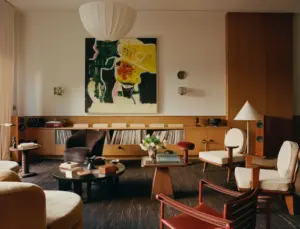
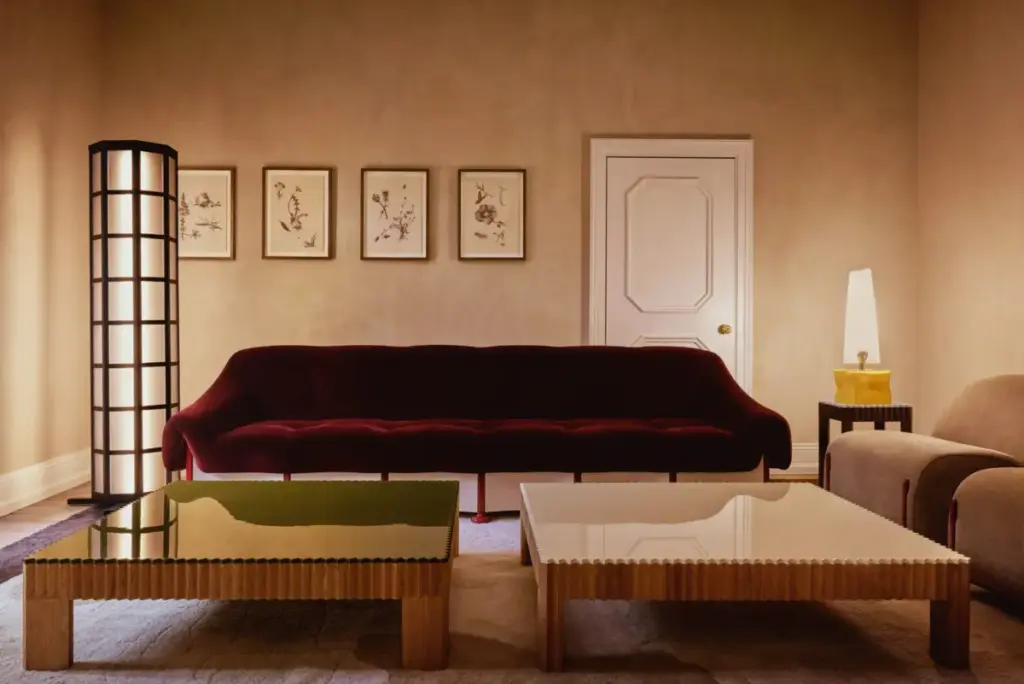
Their combined vision manifests as a highly polished, sophisticated collection where the pieces are sharp, angular, and hard, bearing a striking resemblance to the lines of impeccable tailoring. Guadagnino describes the resulting assortment as a constellation of objects, rooms, and parallel worlds. The physical pieces themselves reflect this cinematic curation. Stainless steel chairs and oak coffee tables with high-gloss lacquered tops feel slick and cool under the light. Meanwhile, the Elsewhere table lamp, featuring a thin, arching steel neck and a sharp triangular shade, feels practically space-age in its precision.

Even the upholstered pieces within the collection possess a remarkable physical presence and posture. The scallop-backed Bretonita sofa, upholstered in a rich hunter-green flannel with contrasting burgundy cord piping, looks both stately and sturdy as it sits across from a traditional mantle in curated display spaces. Conversely, the Uncollected sofa sits lower and longer, grounded by a dramatic black velvet cushion and a warm sycamore base. The dining and kitchen spaces are equally considered, featuring items like the towering Sound chandelier positioned directly over an octagonal table set with ten Purkersdorf chairs, and the minimalist Qubit stool in crisp white resting quietly in a green-clad kitchen space. Furthermore, the tabletop experience is deeply informed by history, with octagonal dinnerware taking direct design notes from Vienna Secessionism.
What excites the designers most about this expansive launch is the democratization of their design language. Baisi notes that the true beauty of the project is that the exact same object can now enter very different homes across the globe and become an integral part of completely different lives. In a way, the collection can exist across many parallel worlds at the exact same time, carrying the weight of high architectural design into everyday households.

To properly celebrate the high-profile launch, Guadagnino directed a short film written by screenwriter Scott Z. Burns, featuring a notable cast starring Jamie Bell, Chase Sui Wonders, Michael Stuhlbarg, and Patricia Arquette, complete with bespoke set design by Baisi. In addition to the short film, the collection will be presented to the public and the fashion world at a two-day public pop-up event hosted at La Pelota in Milan on September 26 and 27, perfectly coinciding with the bustling energy of Milan Fashion Week.
Pieces in the collection range widely in price from $16.90 for smaller decor items up to $18,400 for larger statement furniture pieces. The full collection becomes available starting September 26 on the official Zara Home website.