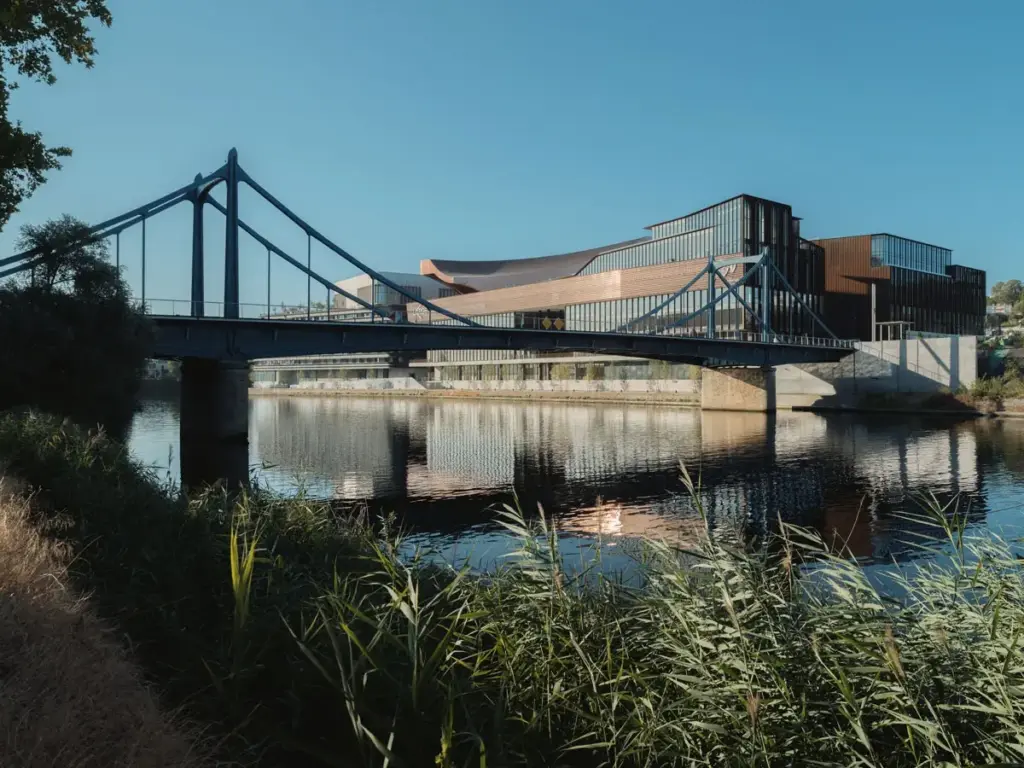
To arrive at France’s newest contemporary art destination, the journey itself functions as an essential prologue to the experience. Situated on the Île Seguin in Boulogne-Billancourt, a western suburb of Paris, reaching the site requires a trip to Pont de Sèvres—the final stop on Métro Line 9—followed by either a leisurely 15-minute walk or a brief five-minute bus ride. For those willing to make the trek, the reward is immediate. Crossing over onto the island means leaving behind the dense, fast-paced fabric of the urban environment for a tranquil sanctuary completely surrounded by water, offering sweeping, picturesque views toward the banks of the Seine and the rolling green hills of Meudon.
This unique insular setting is where Le Large has officially established its roots. The ambitious contemporary art center forms a key component of Pointe des Arts, a sweeping €450 million ($504.5 million) cultural development that also encompasses a cinema, a hotel, and various other public amenities. The realization of this massive construction project marks yet another milestone in the ongoing, multi-decade transformation of an island whose identity was for generations intrinsically tied to heavy industrial production. For much of the 20th century, a sprawling Renault automobile factory dominated the site, employing tens of thousands of blue-collar workers and shipping completed cars out to the world by both road and river.
Architecture, Scale, and Meaning
The center’s name was chosen deliberately to evoke both physical scale and boundless possibility. Designed by the renowned, Pritzker Prize-winning Spanish architecture firm RCR Arquitectes, the building boasts a striking and unconventional geometry. Its structural footprint expands dramatically as it rises, measuring a modest 5,382 square feet at the base before expanding to 16,146 square feet by the time it reaches the fifth floor.
The exterior is wrapped in a warm, copper-colored anodized-aluminum façade composed of intricate, diamond-shaped elements arranged in an overlapping, scale-like pattern. This design serves as a direct architectural nod to a clever double entendre embedded within the institution’s name. In French, the idiom prendre le large translates idiomatically to heading out to the open sea or setting sail.
"The expression resonates with the island setting and its relationship to the water," director Paula Aisemberg explained during an on-site interview with ARTnews ahead of the institution’s grand public opening. "It conveys the possibility of escape, departure, and discovery."

Operating with an estimated annual operating budget of €5 million ($5.6 million), Le Large intends to make flexible use of its total 26,910 square feet of dedicated exhibition space. The venue will fluidly oscillate between hosting a single, monolithic exhibition that overtakes the entire museum—as is the case with its inaugural presentation—and running multiple shows concurrently.
"Or having several shows running simultaneously, one on the fifth floor, another across the sixth and seventh floors. That will be the case for our second season," Aisemberg noted, outlining the flexible curatorial strategy for the future.
A Hybrid Model and Public Engagement
Le Large’s ultimate ambition is to attract the broadest possible cross-section of the public, imagining forms of cultural engagement that extend far beyond traditional art viewing. The center was purposefully engineered to function just as effectively as a communal gathering space as it does an exhibition venue. To that end, approximately 40 percent of its public-facing interior spaces are entirely free for visitors to enter without a ticket.
The ground floor encourages guests to linger, offering an environment where they can briefly view select works from temporary exhibitions while primarily enjoying the sundrenched lobby’s ample seating areas designed for extended conversations. Nearby, a curated bookshop and concept store sit adjacent to a grand flight of stairs that doubles structurally and functionally as an amphitheater-style seating area.
This multipurpose staircase leads visitors upward to an interior mezzanine, from which modern escalators transport them directly to the fifth floor. Before guests even reach the ticketed exhibition galleries, they encounter two distinct spaces designed by acclaimed creator Constance Guisset: Extra Large, an 80-seat coffee shop serving seasonal food alongside panoramic views of the surrounding landscape, and Le Petit Atelier, a dedicated educational space tailored specifically for children aged six to ten, who can participate in free, hands-on artistic workshops.

To financially and operationally support its broad ambitions, Le Large functions on a sophisticated hybrid model. It combines a nonprofit association—complete with a dedicated endowment fund—with a commercial entity tasked with managing venue rentals and private events. The nonprofit association, chaired by prominent art collector Laurent Dumas, oversees the entirety of the Pointe des Arts complex on Île Seguin, operating with an overarching mission to champion and promote French artistic creation.
The primary financial patron behind the institution is the Emerige Endowment Fund, the philanthropic arm of Dumas’s real estate and cultural company, Emerige. Le Large represents the crown jewel in a growing portfolio of contemporary art initiatives spearheaded by Dumas, which already includes prestigious grants for emerging artists and a nationwide corporate art-commissioning program known as 1 immeuble, 1 oeuvre (1 Building, 1 Artwork).
A New Chapter in Paris’s Private Museum Landscape
Dumas’s Pointe des Arts will inevitably draw immediate comparisons to Paris’s two other major collector-founded private contemporary museums: the Fondation Louis Vuitton, established by luxury magnate Bernard Arnault, and the Bourse de Commerce, founded by billionaire François Pinault. From an architectural standpoint, the Fondation Louis Vuitton and Le Large share clear similarities as purpose-built cultural monuments erected from the ground up, whereas the Bourse de Commerce repurposed a historic, landmark Paris building through dramatic contemporary interventions designed by Japanese architect Tadao Ando alongside heritage preservation specialists.
Curatorially, the institutions also carve out distinct identities. The Fondation Louis Vuitton typically mounts blockbuster retrospectives and ambitious international loan exhibitions, positioning itself as a premier global venue for new art-historical scholarship on master artists. Meanwhile, the Bourse de Commerce remains more tightly tethered to Pinault’s personal collection, which directly shapes its thematic group exhibitions and focused artist presentations.
While Le Large’s inaugural exhibition establishes a fascinating dialogue between the historic corporate art collection of Renault and works by contemporary artists, the center’s long-term curatorial trajectory after its opening season remains wide open.

Rather than committing to the accumulation of a permanent collection or serving solely as a permanent physical home for Dumas’s private holdings, Le Large will concentrate its energy on presenting a dynamic, ever-changing calendar of temporary exhibitions.
"Moteur Imaginaire": An Ambitious Inaugural Show
For its inaugural outing, titled "Moteur Imaginaire" (Imaginary Engine), the institution spared no expense, enlisting one of the international art world’s most closely watched curators: Cecilia Alemani, director and chief curator of High Line Art in New York and the acclaimed curator of the 2022 Venice Biennale.
"[The display] follows the car on an imaginary journey, from the factory floor to the assembly line, out into the world as an object of desire, and finally into the algorithm," Alemani told ARTnews during the exhibition’s setup. "That metamorphosis, from mechanism to living organism, is what drives the whole exhibition."
Drawing directly on the rich industrial history of Île Seguin, "Moteur Imaginaire" brings together more than 100 works created by 55 artists hailing from 23 different countries, spanning a chronological timeline from the 1930s up to the present day. For decades, the Renault car company maintained an enlightened policy of commissioning artists through its celebrated Art, Research and Industry program, which actively invited avant-garde creators directly into the factory workshops. Luminaries such as Jean Dubuffet, Arman, Jean Tinguely, and Victor Vasarely all participated in the initiative.
Their historic creations form a core group of roughly 50 pieces drawn directly from the Renault corporate collection. These are thoughtfully juxtaposed with vintage photographs and archival materials documenting the factory and its daily workforce, serving as a tangible bridge connecting the museum galleries to the island’s industrious past.

"We felt it was essential to acknowledge that history," Aisemberg noted regarding the inclusion of the archival artifacts.
Inside the Exhibition Design and Artworks
The physical layout of the exhibition was conceived by French designer Pascal Rodriguez and unfolds across four successive gallery spaces. These rooms are separated by partition walls featuring large, perfectly circular openings cut into their exact centers. Aligned meticulously along a single visual axis, these architectural apertures create a sweeping perspective that directly mimics the repetitive, methodical logic of an automotive assembly line.
"You feel as though you’re inside a machine, a car park, a tunnel, or perhaps inside an engine cylinder," Aisemberg explained of the spatial effect.
Alemani expanded on this conceptual framework, noting the historical weight of the venue. "For almost a century, the Île Seguin was home to the Renault factory, a fortress of production that turned out some 30 million cars: a machine for making machines. I wanted the exhibition to work the same way, as an assembly line for machines and for ideas."
At strategic thresholds throughout the exhibition, Alemani has positioned actual automobiles as sculptural centerpieces. The sequence begins with an 1898 Renault automobile that has been elaborately transformed by Ghanaian artist Paa Joe Junior into a brightly painted wooden palanquin, drawn from Laurent Dumas’s personal collection. This is followed by Arman’s striking intervention on a life-size wooden styling model of a Renault 10, originally handcrafted by company engineers. Invited directly into the factory floor decades ago, the French artist sliced the model into numerous fragments, sealing them neatly within clear Plexiglas boxes.

Also on view from Dumas’s collection is Mohamed El Khatib’s installation featuring a vintage Renault 12. Heavily laden with luggage, travel documents, and traditional cassette tapes, the vehicle powerfully evokes the shared lived experiences of immigrant families who packed up their cars and drove continuously from France down to the Maghreb for summer holidays from the 1970s through the 1990s. Elsewhere, Bertrand Lavier contributes a genuine Renault Formula One race car, completely repainted using the thick, dynamic brushstrokes that have defined his signature artistic practice since the 1980s.
For her first major institutional curatorial project in France, Alemani emphasized the importance of centering contemporary French artists; nearly half of the participants in the show currently live and work in the country.
"Curating it was a wonderful opportunity to get to know the French art scene more closely," she said, noting that the project allowed her to collaborate with creators whose careers she has followed closely for years—such as Sara Sadik, Randa Maroufi, and Mohamed Bourouissa—while simultaneously discovering artists who were previously new to her, including Valentin Ranger, Romuald Jandolo, and Bertille Bak.
Along the way, several participating artists discovered deeply personal, generational ties to the site’s industrial legacy. "Johanna Benaïnous learned that her grandfather had worked on the island," Alemani said. "I met a generation that treats history as living matter. They went into the archives, sat with former workers, and came back with pieces that are urgent, tender, and very much their own."
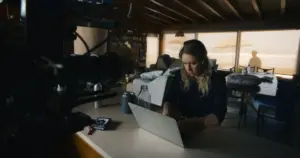
"Moteur Imaginaire" also features 17 brand-new, site-specific commissions. Among them is a compelling film by Clément Cogitore titled Untitled (2026), which thoughtfully revisits the historic 1947 Renault factory strike through a nearly motionless scene of a woman calmly knitting beside a stationary production assembly line. Inspired directly by surviving documentary footage, the work draws viewer attention to the quieter, frequently overlooked dimensions of labor activism and industrial resistance. As the natural light within the frame gradually fades, the scene conveys both the quiet determination of the workforce and the eerie, sudden suspension of industrial productivity.

Cogitore’s film finds a subtle, tactile parallel in a hand-woven tapestry by Zhenya Machneva, which depicts the mechanical engine of her grandfather’s Renault Kangoo.
"Woven on a manual loom, the work brings personal memory into dialogue with industrial history," Aisemberg observed. "Its painstaking technique offers a deliberate contrast to the speed and efficiency of mechanized production."
It is precisely this synthesis of unexpected personal narratives, historical consciousness, and cutting-edge contemporary art that Alemani hopes will captivate visitors as they step onto the reimagined grounds of Île Seguin.
"Opening a new institution is always rare, and doing it on an island so charged with memory is a real privilege," she reflected. "The Renault factory was dismantled long ago, and today a brand-new building rises in its place, open to everyone. Le Large gives this extraordinary site back to the public, and ‘Moteur Imaginaire’ brings its stories back to life."