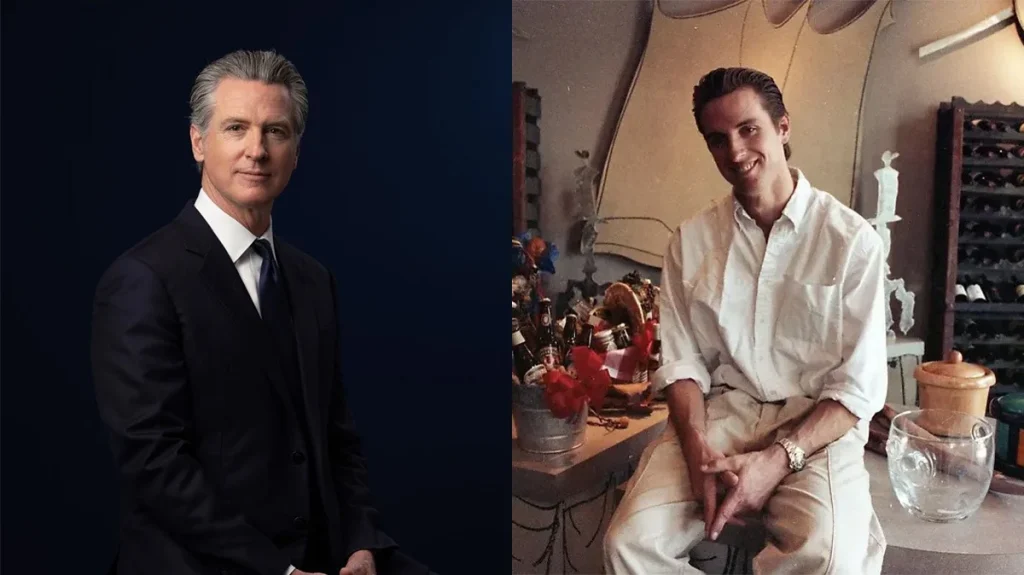
Long before his political ambitions brought him to the halls of power in Sacramento, California Governor Gavin Newsom held a very different kind of aspiration: a desire to make fine wine accessible to everyday enthusiasts. A lifelong aficionado whose passion for the fruit of the vine was first sparked by his father, the San Francisco native took his first major entrepreneurial leap in 1992. Alongside a group of partners that included family friend, oil heir, and composer Gordon Getty, Newsom cofounded the PlumpJack wine shop in San Francisco, setting into motion a hospitality empire that would eventually reshape parts of California’s wine landscape.
Named after Shakespeare’s famously irreverent and larger-than-life character, Sir John Falstaff, the PlumpJack Group has grown over the decades to encompass notable properties, including PlumpJack, Cade, and Odette wineries in Napa Valley, alongside various hotels and restaurants. The enterprise is guided by a leadership team that includes general manager John Conover and Newsom’s sister, Hilary.
When Newsom was elected mayor of San Francisco in 2003, his introduction to the municipal side of government began through a remarkably grounded channel: the city’s department of health required him to install a mop sink in the carpeted floor of his wine shop. That initial bureaucratic hurdle nudged him into public service. He accepted a role on the San Francisco Parking and Traffic Commission before securing a seat on the city’s Board of Supervisors, steadily moving upward through the ranks of California politics. Upon his election as governor in 2018, Newsom placed his ownership interests in the PlumpJack Group into a blind trust to avoid conflicts of interest. Yet, despite a career spent navigating the complexities of state governance, his personal appreciation for fine wine—particularly selections from Napa Valley, Burgundy, Chablis, and Italy—remains entirely intact.
Reflecting on his entry into the world of wine, Newsom often points to his relationship with his father. Wine served as a crucial bridge between them during his youth. Because his father could at times be emotionally difficult to reach, wine emerged as a shared language—a medium that allowed father and son to sit together, converse, learn, and connect without the pressure of forced dialogue.
The journey toward opening the PlumpJack wine shop began over dinner at the historic Balboa Cafe with his father and Pat Kelley, a local wine store proprietor. Newsom became consumed by a singular vision: creating a retail space that offered fine wine without the intimidation factor or the elitism of a precious boutique, but also far removed from a low-end discount rack. He wanted a place where everyday consumers could discover exceptional bottles at approachable price points. At just 24 years old, Newsom managed to raise $174,000 from 15 friends and family members, quit his job, and spend nearly two years battling municipal permits and scraping the venture together.

The choice of the name PlumpJack carried profound symbolic weight for the young entrepreneurs. Drawing directly from Gordon Getty’s opera inspired by Shakespeare’s Falstaff, the founders sought to celebrate a character who openly mocked stuffiness and embraced the vibrant absurdity of life. That exact ethos became the guiding philosophy for the PlumpJack brand.
Following the success of the retail shop, Newsom and his partners pushed further into the hospitality sector just two years later by opening the PlumpJack Cafe. The restaurant operated under the same guiding principle: delivering exceptional wines, including top-tier Cabernets, Pinots, and Zinfandels by the glass, without the steep markups traditionally associated with fine dining. Having developed a deep personal affinity for Oakville and Napa Cabernet, Newsom and his team jumped at the opportunity to acquire an Oakville winery in 1995, eventually expanding their portfolio to four distinct wine estates.
For Newsom, the core appeal of wine has always been experiential rather than ostentatious. He considers himself a drinker and a sharer of wine rather than a collector focused on display. His early preferences leaned heavily toward Oakville Cabernets like Groth and Silver Oak, though his palate has consistently embraced international and domestic varieties alike, spanning Burgundy, Chablis, Pinot Noir, and Italian whites.
As governor, Newsom has had to navigate the broader economic pressures facing California’s agricultural sector, including a severe industry-wide glut that has forced growers to rip out an estimated 40,000 acres of vines over the past year while leaving upwards of 100,000 tons of grapes unharvested. Addressing these systemic challenges, Newsom notes that the state government cannot artificially manufacture consumer demand or instantly correct a massive oversupply that accumulated over many years. Instead, the administration has focused its support on California growers through targeted investments in agricultural research, pest prevention, water resilience, and market development.
At the same time, Newsom has maintained a strict firewall between his personal history in the wine business and state policy formulation. Looking outward at macroeconomic pressures, he points to federal trade policy as a major hurdle for domestic producers. He argues that trade disputes and retaliatory tariffs—such as those targeting American wine in Canada, historically the state’s largest export market—create unnecessary obstacles for local growers precisely when they can least afford them.

Addressing the common public perception that vineyards and wineries are exclusively the domain of wealthy elites who require no government support, Newsom emphasizes the immense economic diversity underpinning the industry. While acknowledging the presence of affluent vineyard owners, he points out that the sector sustains thousands of independent farmers, small and multigenerational wineries, farmworkers, cellar staff, truck drivers, and hospitality employees whose daily livelihoods depend on a thriving agricultural economy. In California alone, the wine industry supports more than 422,000 jobs, making trade stability vital to the state’s broader workforce.
The intersection of ambition, impatience, and personal history also forms the core of Newsom’s reflections outside of politics, including the title of his book, Young Man In A Hurry. The phrase originally stemmed from a 2009 Economist article—one that was not initially intended as a compliment—but over time, Newsom came to view it as an accurate self-critique. He recognizes the impatience, ambition, insecurity, and relentless forward momentum that have defined his life’s trajectory. Through the introspective process of writing the book, he aimed to scrutinize rather than sanitize his personal history, achieving a deeper understanding of his family, his parents, and his own motivations.
When asked, entirely theoretically, about what wines he would choose to see poured at a high-profile state dinner, Newsom offers a characteristic quip: for now, his answer is anything but wine associated with Donald Trump.