The world, as experienced through the vibrant and contemplative canvases of artist Mala Iqbal, is a room we constantly share with strangers—most of whom are looking elsewhere. In her latest body of work, currently on view at the JJ Murphy gallery on Manhattan’s Lower East Side, Iqbal captures the pulsing, fractured reality of modern urban life. Her paintings investigate the delicate choreography of coexistence in a metropolis, examining how people navigate public spaces while wrapped in their own private worlds, digital distractions, and urban armor.
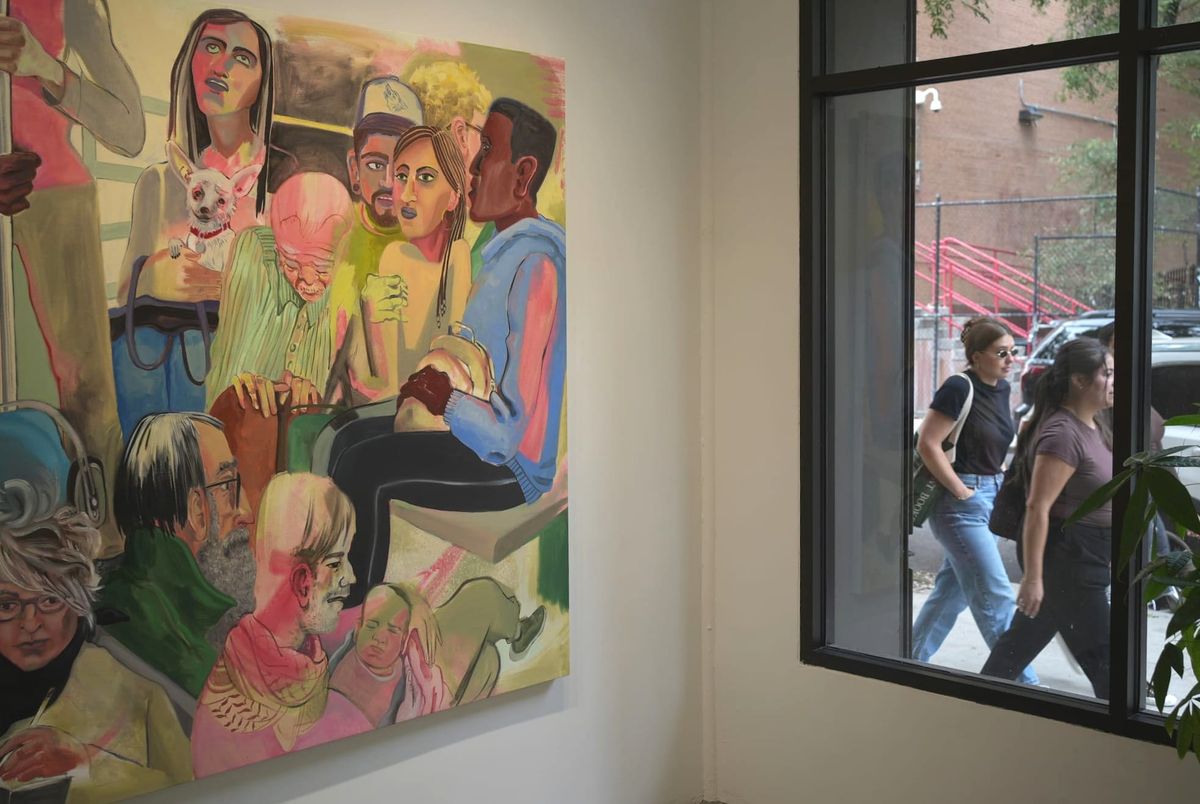
Walking into the gallery, visitors are immediately met by the electric energy of works like Subway Riders (2026), positioned near the front windows. Figures jostle the surface of every canvas with the kinetic momentum of a great city. Many of these human forms are bathed in an intense orange and yellow glow—a tinge of deliberate artifice designed for people who live primarily under electric light, inhabiting environments where even the sun feels insufficient to illuminate the depths of daily existence.
Yet, not all of Iqbal’s paintings rely on this searing artificial warmth. Other works take a more complex, layered approach to narrative and visual perception. In Through the Curtains (2026), Iqbal constructs a deeply reflective sequence across the canvas. Moving from left to right, the viewer encounters a scene of collapse and disruption, which is partially obscured by a tulle curtain rendered in the manner of a faded negative. Beside this, a single figure reacts with an almost numb resignation. Finally, another curtain closes out the scene, adorned with a pictograph-like pattern.
For many viewers, this visual progression serves as a powerful metaphor for contemporary existence: life filtered and transformed by a screen, witnessed rapidly by individuals, and ultimately turned into an indecipherable, distant language. It mirrors how modern technology and digital platforms deliver collapse and violence with every scroll, arriving faster than the human mind can comfortably process.
Throughout the exhibition, Iqbal’s work is deeply concerned with the construction of reality. Her compositions are sometimes cobbled together with disparate elements, other times densely layered, and occasionally philosophized through the careful arrangement of images, figures, and graphic signs. While the long, historical shadow of social realism casts itself over her urban scenes, the overall mood remains remarkably buoyant, echoing the effortless grace and color harmony of Matisse. Furthermore, works like Times Square (2026) utilize a chalky palette reminiscent of Ben Shahn, which infuses the image with its own distinct terroir and visual grit, managing to depict modern anxiety without ever souring into despair.

Many of Iqbal’s settings take place underground, within the subterranean transit systems of the city. Subways are unique environments where false intimacies give commuters the fleeting illusion of knowing one another. Yet, despite the physical closeness of packed train cars, the artist never lets go of the urban masks we wear. Passengers stare into faces that look away, or whose features are intentionally obstructed and rendered into shapely, abstract flourishes, ultimately bringing to light strange yet enticing surfaces that challenge traditional portraiture.
Among the crowd in Subway Riders, one figure is immediately recognizable to those familiar with the contemporary art scene: the painter’s partner, fellow artist Angela Dufresne. In the painting, Dufresne appears to be recording something of her own, gazing outward toward the viewer but not quite making direct eye contact. It is a subtle, poignant detail that reminds observers how our own relationships and interpersonal connections help define us just as much as we attempt to depict them.
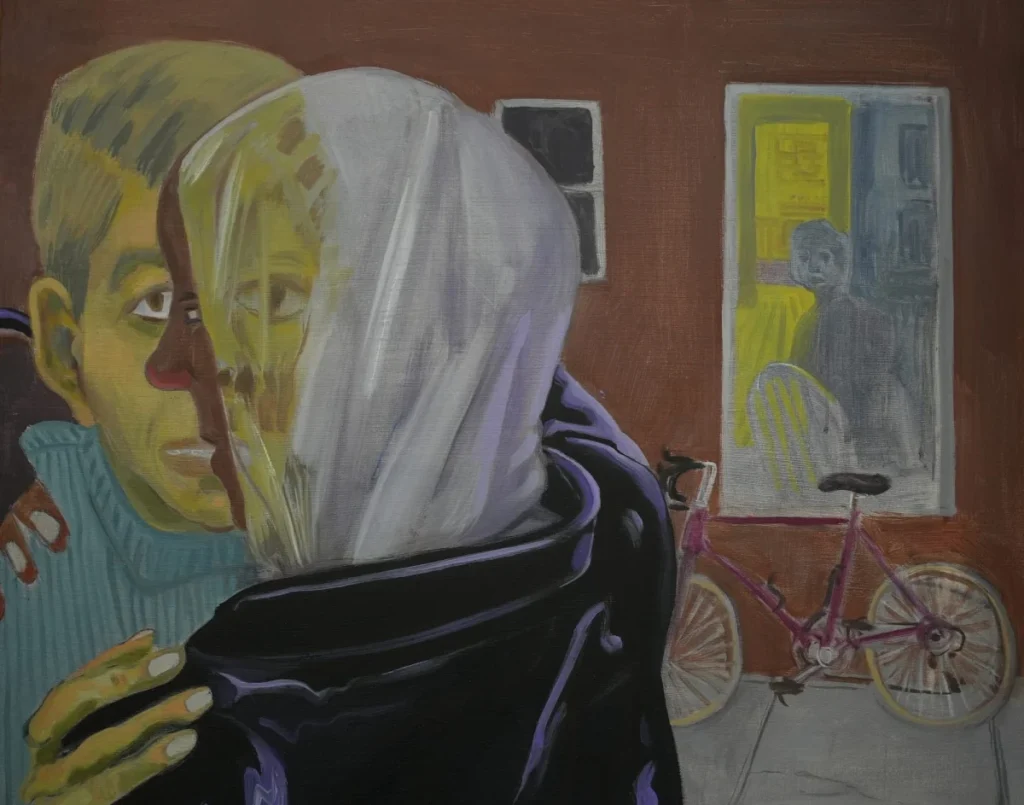
In details like the exquisite brushwork found in Transparent Friend (2025), Iqbal continues to unpack the layers of visibility and emotional distance that define urban psychology. By translating the fleeting glances, shared silences, and digital distractions of city dwellers into rich, painterly surfaces, Mala Iqbal’s new exhibition offers a mirror to a society caught between connection and isolation, reminding us of the silent poetry found in the strangers who populate our daily journeys.