When Sotheby’s reported robust first-half consolidated sales of $4.4 billion in July, industry watchers immediately began parsing the numbers for deeper trends. Among the takeaways was a clear signal that major art businesses are increasingly stretching far beyond traditional auction rooms, pushing their brands and operations into luxury hospitality, real estate, and curated lifestyle experiences. If this year’s Frieze Week in London is any definitive indicator, it appears that smaller, independent art fairs have taken intense notice of this shifting landscape. Rather than competing with massive convention centers or sterile exhibition halls, alternative art ventures like Minor Attractions and the newly arrived London Invitational are leaning heavily into domestic, high-end environments to recalibrate the contemporary art buying experience.
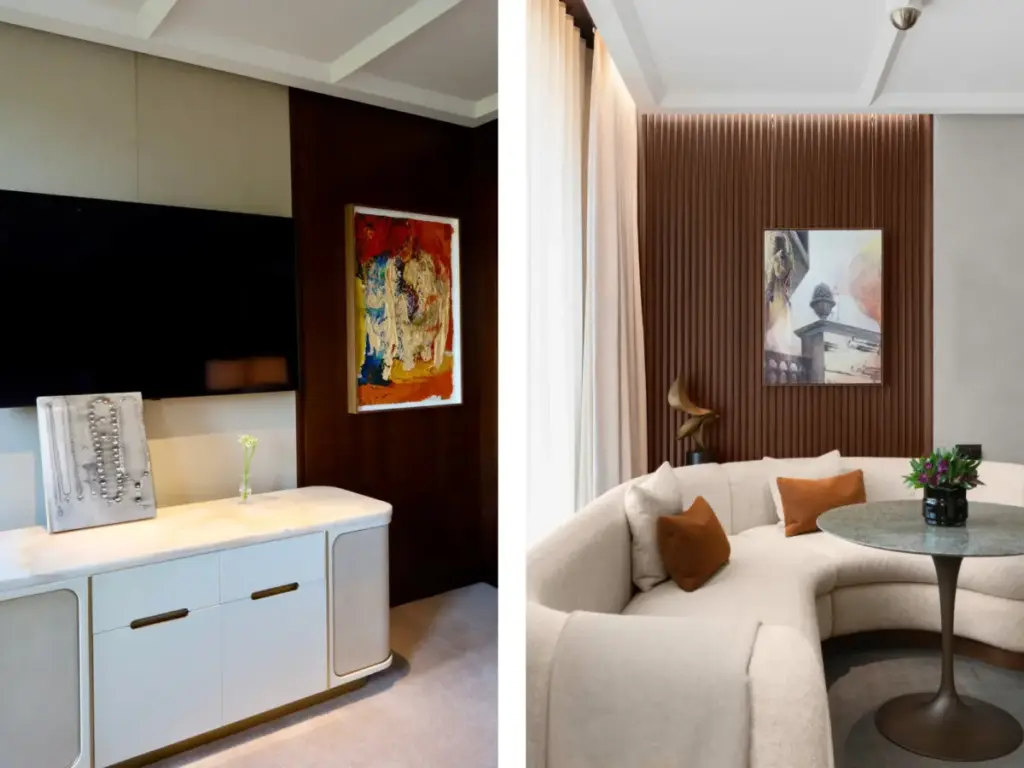
The transformation is evident across the British capital. Minor Attractions opted for a notable location change for its fourth edition, setting up its new home inside The Newman, a recently opened luxury hotel situated in the heart of central London. Meanwhile, the London Invitational marked its inaugural UK outing by staging an ambitious takeover of 13 lavish suites at The Chancery Rosewood in Mayfair. Running through Sunday, the Mayfair pop-up features prominent international galleries including Andrew Reed Gallery, Broadway, Charles Asprey, Europa, François Ghebaly, James Cope Gallery, James Kelly Contemporary, Lomex, Marinaro, Franklin Parrasch Gallery, and Vardaxoglou. Occupying an all-suite property where nightly rates range from £1,200 to £24,000 ($1,600 to $32,000)—and which only opened its doors this past September—the fair represents a bold departure from traditional white-cube booth presentations.
James Cope, the British-born, Dallas-based art dealer and founder of the fair, believes this intimate, hospitality-integrated model is actively slowing down the frenetic art fair experience for the better. According to Cope, such a measured approach is precisely what the market demands as it navigates a "slow and steady" phase following the sudden, frenzied splurge of the post-Covid era.
"I hate hearing about the doom and gloom of the art market—it’s not in a bad place. We’re just coming out of a real bullish market and everyone’s recalibrating," Cope told ARTnews.
Cope, who also participated in Frieze London with his namesake gallery, is intentionally evoking a bygone era of art fairs through his involvement with both the Dallas and London Invitationals. He draws a direct line to historical precedents, such as New York’s Armory Show, which began in 1994 inside the small, domestic rooms of the Gramercy Park Hotel.
"This environment creates a more human time with dealers, collectors, curators, and being in a domestic setting helps you understand how the artwork might look in your home," Cope explained. He emphasized that his ultimate measure of success extends far beyond immediate transactional volume, even though participating galleries in the Dallas Invitational have demonstrated loyalty by continuously returning year after year, proving that "business is being done."
"Are people happy and smiling? I’m a gallery owner, and I want to obviously make sales and enjoy my time," Cope added.
Inside his suite at The Chancery Rosewood, Cope exhibited works by young artists Michelle Rawlings and Coco Young, whose pieces fit seamlessly into the hotel’s plush wooden interiors. His collector demographic spans a wide spectrum, ranging from mid-to-late 20s and 30s up to established collectors in their 50s, 60s, and 70s who work in traditional wealth-generating industries such as shipping, oil, gas, and banking.
Though the London Invitational presents an intimate, residential atmosphere, the financial sums associated with the artwork on display remain substantial. Los Angeles-based gallery Bel Ami brought a strong roster of works by artists Minami Kobayashi, Guillaume Dénervaud, Soshiro Matsubara, Isabelle Frances McGuire, Dan Mitchell, Ian Miyamura, Lauren Satlowski, and Marina Stern, with price points ranging from $5,000 to $33,000. Notably, Matsubara’s work is currently featured prominently at Gagosian London as part of the blockbuster René Magritte exhibition, This Is Still Not a Pipe: The Afterlife of Magritte, which stands as the gallery’s most-visited show to date in London.
Lee Foley, director of Bel Ami, told ARTnews that the gallery has discovered avid, unexpected interest in its program from a younger demographic of new collectors aged between 20 and 40 who work primarily in film and technology.
"There is something special about the art scene being a close-knit community in a time when that’s harder and harder to find. It’s our job to teach new collectors about the artists as we rely on them for business," Foley noted.
At Franklin Parrasch Gallery, offerings started at £2,800 ($3,700) and stretched well into the high five figures. The gallery’s presentation featured a diverse mix of works, ranging from Peter Alexander’s block wedges and Soyoung Lee’s distorted portraits to Sylvia Snowden’s expressive abstract figures and Joe Goode’s signature blue skies. Gallery founder Franklin Parrasch explained that he joined the London Invitational because he is actively interested in discovering new ways to "shape the model" of art commerce. He observes that a prominent contemporary trend is to intertwine art viewing with immersive experiential learning to counteract what some perceive as a struggling market.
"At the same time, I think artists are finding ways to survive and thrive in their own environments. Sometimes not having the copious amounts of money they were making a few years back is good for generating new energy and thought in other areas besides commerce," Parrasch said, adding that collectors today are demonstrating a noticeably more thoughtful and less impulsive purchasing behavior.
Responding directly to current economic headwinds, New York dealer Lauren Marinaro of Marinaro Gallery made a conscious, strategic decision to curate a selection of works priced strictly under $10,000. Her presentation featured pieces by Ever Baldwin, Ridley Howard, Ron Isaacs, Ryan Johnson, and Alessandro Teoldi.
"It’s an approachable number right now and a way for introducing my program to London," Marinaro told ARTnews. "It’s definitely been a hard three to four years, but there’s been a light at the end of the tunnel in the past six months. Art advisers are doing really good work in educating people that’s resulted in new collectors coming in and meeting a lot of young people."
The London Invitational also provided a vital platform for independent dealers operating without permanent brick-and-mortar gallery spaces to showcase their artists to an international audience. Independent dealer Charles Asprey exhibited a series of small- to large-scale paintings by Alessandro Raho, priced between £6,000 and £35,000 ($8,000 to $46,800). Raho’s works depict scenes ranging from the sun-drenched landscape of Los Angeles to intimate floral arrangements found inside his own London home. The artist is perhaps best widely known for his celebrated portrait of actor Judi Dench, which hangs in the permanent collection of the National Portrait Gallery in London.
"My artist doesn’t like exhibiting on white walls and the art world has changed, you don’t necessarily need physical spaces anymore to represent someone," said Asprey, who also serves as a trustee at the Institute of Contemporary Arts in London.
Throughout both Frieze London and the London Invitational, the broader market debate concerning London versus Paris remained a frequent topic of conversation among dealers and collectors alike. New York-based gallery Broadway decided to test the waters by participating in both cities, having previously exhibited at Frieze London two years prior.
"We felt that the combination of these fairs despite what’s been going on with the popularity of Art Basel Paris is that London is getting its footing back," Joe Cole, cofounder of Broadway, told ARTnews. He noted that the gallery experienced its strongest curatorial attendance at Frieze London on the VIP preview day. "I certainly met a number of new collectors from the UK, Europe, and the Middle East that I don’t think I would have met in the US."
With the London Invitational successfully establishing its footprint in the UK, speculation naturally turns toward whether continental Europe—specifically Paris—might be next on the horizon for the boutique fair model.
"I don’t really like Paris," Cope remarked, praising London instead for its truly global, cosmopolitan fabric. "There’s people from Asia and the Middle East and Russia and everywhere in London. There’s so much hype around Paris and I’m not trying to compete with that."