Spoiler alert! This feature explores details revealed roughly thirty minutes into Alejandro G. Iñárritu’s ‘Digger.’ If you have not seen the film yet, you may wish to save this piece for afterward.
About thirty minutes into Alejandro G. Iñárritu’s ambitious new cinematic project, Digger, a model tree falls over, a section of what had appeared to be a rugged hillside smoothly pulls back, and a giant human figure steps out to pick it up. Behind him, a bustling film crew floods the frame. The director immediately starts shouting instructions, Tom Cruise drops the heavy Texas accent he has been maintaining, and everything the audience has watched up to that point dissolves into a technical rehearsal for the 25th-anniversary staging of a fictional play called Fossil Fools.
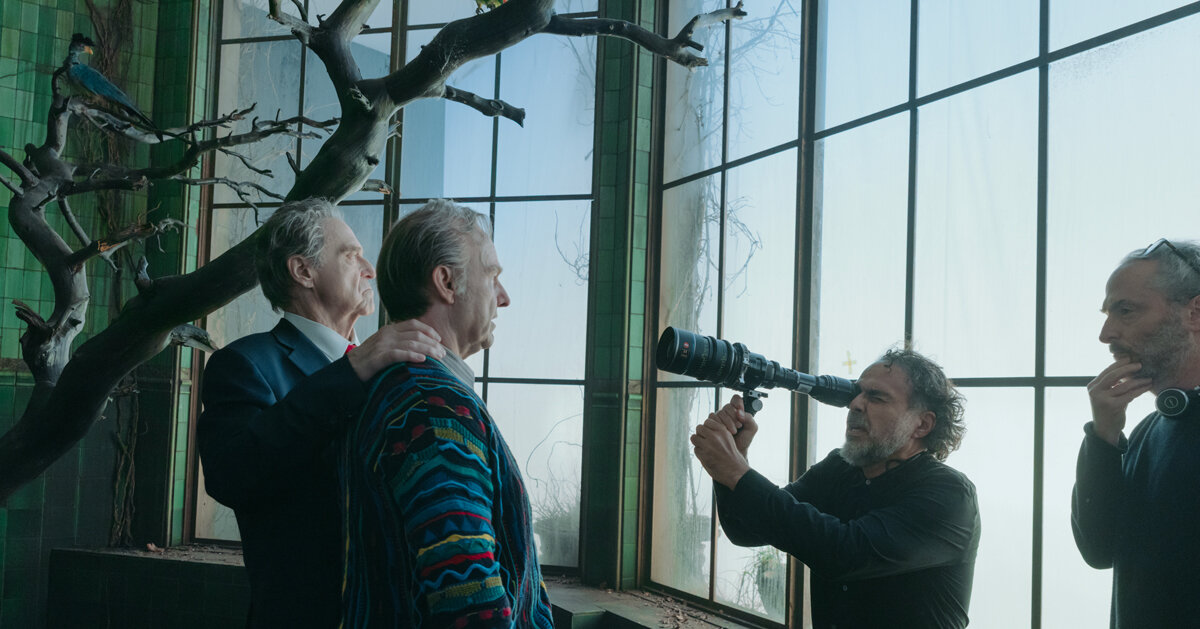
Throughout the opening act, Cruise has been portraying Curtis Markson, an actor cast as the oil baron Digger Rockwell. The play centers on a massive global environmental and climate catastrophe allegedly engineered by Rockwell—widely regarded as the most powerful man in the world. His catastrophic venture involves a massive Greenland drilling operation that inadvertently releases an enormous ice shelf toward Europe, ultimately drowning the coastlines of the globe.
This masterclass in misdirection arrives not through explanatory dialogue, but through the mundane disruption of a stage technician wandering into the shot to fix a fallen prop. It establishes the first of four distinct spatial positions that the film imposes upon its audience. Each position is meticulously arranged through physical scenography rather than announced by a character: a lavish mansion holding disaster at a comfortable distance; a theatrical play viewed by a seated audience; a theatrical production that is revealed to be a dramatic reconstruction of historical trauma; and finally, a reality where all distance vanishes entirely. Across a runtime of 128 minutes, these meticulously crafted sets function as measuring instruments gauging the psychological gap between the spectator and the spectacle, slowly shrinking that distance until the viewer is left with nowhere to hide.
Set Design as a Masterclass in Narrative Architecture

The immersive world of Digger was brought to life by acclaimed production designers Dennis Gassner and Richard Johnson. Gassner, a seven-time Academy Award nominee and winner for Bugsy, boasts a legendary filmography that includes masterpieces like Barton Fink, Road to Perdition, Blade Runner 2049, and several entries in the Daniel Craig-era James Bond franchise. However, the credit most relevant to Digger is Peter Weir’s The Truman Show, for which Gassner constructed an entire suburban town that ultimately proves to be a massive television set.
Digger inverts that dynamic completely. In The Truman Show, the protagonist remains entirely oblivious to the artificial nature of his existence while the audience is let in on the secret from the opening moments. In Digger, every actor on screen knows precisely where they are standing within the artifice, while the paying audience in the cinema is kept entirely in the dark.
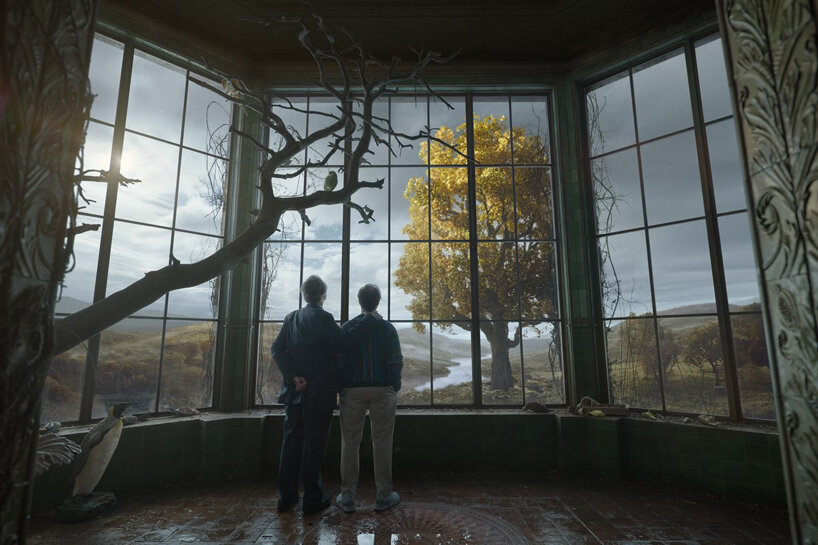
The film’s initial world is constructed as Digger Rockwell’s opulent, isolated mansion. He wakes beside a sprawling bedroom window framing a vista that evokes the romantic landscapes of Albert Bierstadt. Taxidermied alligators are pinned to the ceiling, and full-body mirrors lined with antlers reflect his image into infinity. Every design choice in this residence builds the portrait of a monstrous man whose misdeeds exist a safe distance away from ordinary daily life. It mirrors the oldest convention in cinema: placing a villain in his lair, projecting a distant catastrophe onto a cold landscape, and relying on the protective barrier of the fourth wall to keep the horror at arm’s length. The production design here mimics the traditional function of spectacle, making a horrifying environmental collapse watchable by safely segregating it to a faraway realm.
Color Palettes and Props Reinforce the Thematic Collapse
When the artificial tree topples over and the theatrical illusion is exposed, the film grants the audience an alibi. Once viewers realize they have been watching a play within a film, the deliberate artifice of the preceding half-hour stops looking like a production flaw and starts reading as an intentional creative signature. For instance, Maggie, Digger’s one-eyed geriatric cat, is conspicuously revealed to be an obvious animatronic puppet in a major motion picture with the budget to render a lifelike animal. Miniatures appear with visible seams, while artificial clouds and model aircraft cross the painted sky on visible sticks. These choices were never careless; they were executed with precise design intent.
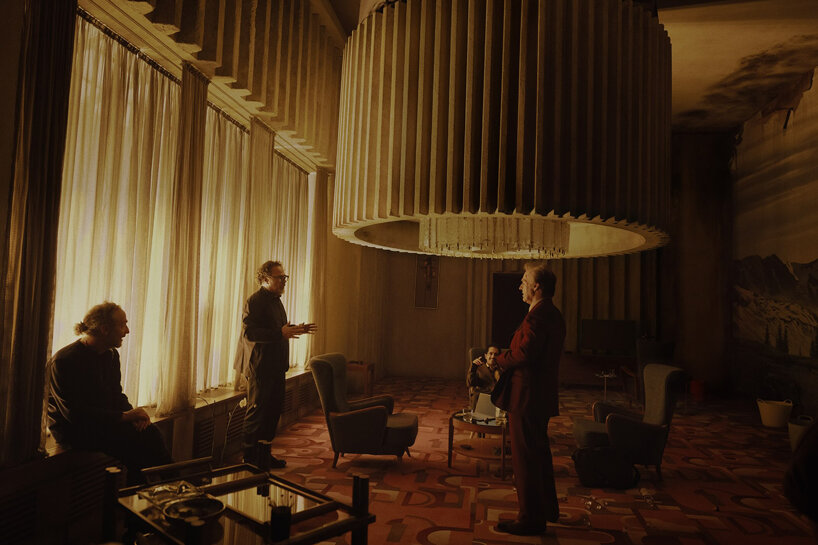
The color palette reinforces this thematic argument. In interviews discussing the film, Iñárritu pointed to master painters like Vermeer and Danish artist Vilhelm Hammershøi for color inspiration, alongside Edward Hopper and Rembrandt for stark contrast. Hammershøi’s influence is unmistakable on screen, characterized by a career spent painting nearly empty grey interiors, interrupted only by sparse notes of color and doorways opening endlessly into further doorways.

Iñárritu describes this pervasive grey as an active instrument rather than a passive mood, noting that as Digger takes over the narrative, color steadily vanishes. Consequently, the theatrical stage looks drained and austere, while the chaotic backstage area buzzes with life, offering a contrast that feels almost physically reassuring. Grey represents the realm of fiction, while color signifies reality—and for a time, reality appears to hold its ground.
A Multi-Tiered Cinematic Plot Twist
The third major narrative reveal strips away this comforting alibi. Fossil Fools is not merely an invented piece of theater; Digger Rockwell was a real historical figure, the catastrophic disaster genuinely occurred, and the character bankrolling the current stage production turns out to be Rockwell’s own nephew, staging his family’s dark legacy for a paying public. While the physical set design remains unchanged, its fundamental meaning shifts radically.

The austere grey chamber where Digger addresses a tribunal of European politicians—with council members dressed in matching tones that cause them to nearly blend into the background walls—stops reading as political caricature and begins to function as chilling testimony. The visible seams on the miniature models no longer signal a cheap play; instead, they evoke a museum diorama, serving as an explicit model of a horrific event that genuinely took place.
This structural complexity explains why Iñárritu spent roughly a decade developing the project. During the lengthy screenwriting and pre-production process, the fictional ecological disasters conceived by the writers frequently manifested in the real world. When early drafts were put to paper, massive ice shelf detachments and atmospheric methane spikes were largely technical concepts rather than daily headlines. As the director noted in interviews, reality was actively chasing fiction and ultimately surpassing it.
Fiction and Reality Collide in the Final Act

The play concludes with Digger dramatically diving from his drilling rig to his death. The fictional theater audience within the film rises to its feet in rapturous applause, a curtain call ensues, and an overhead intercom suddenly announces a "Level 4" emergency. Instantly, every actor and spectator inside the film’s theater reaches for a breathing mask, filing out past emergency debris and wrecked machinery into a flooded, militarized street—stepping directly into the very apocalyptic world the play had spent the evening describing. Melanie’s haunting 1970 recording of What Have They Done to My Song, Ma plays them out.
Viewers soon realize that the backstage color was never true reality; it was simply a slightly advanced stage of the exact same systemic collapse. Approximately ninety seconds into the actual cinema credits, the "Level 4" announcement sounds once more, echoing directly through the speakers of the movie theater where the real audience is sitting.
Stepping out of the theater afterward into an ordinary afternoon sun produces an abrupt sense of gratitude, followed instantly by a sobering awareness of how thin the margin is between that peaceful day and the flooded streets depicted on screen. That realization encapsulates the entire thesis of the film, proving why inventive production design remains just as vital as the screenplay itself.
As Iñárritu has noted regarding the film’s bleak outlook, Digger is fundamentally a disaster movie in which the disaster is humanity itself. Yet, the director insists there is hope if we can all manage to gather in the same room, acknowledge the same reality, and understand precisely where we stand within the global narrative. Across two hours, four distinct sets and four shifting distances achieve precisely that goal, leaving viewers in the same room, confronting the same reality, and asking them to recognize the ground they stand upon.