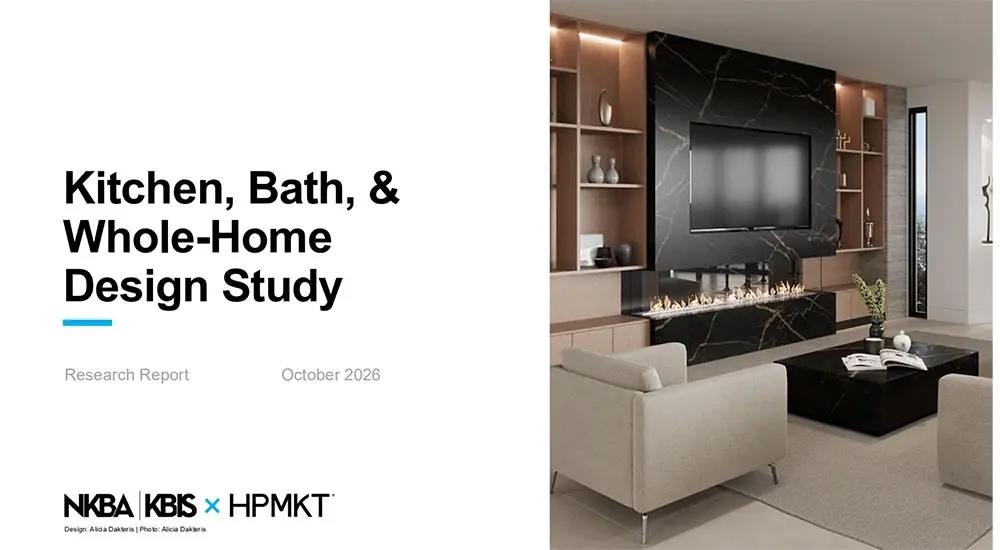
The High Point Market Authority (HPMA) and the National Kitchen & Bath Association (NKBA) have officially unveiled the pivotal findings of their jointly produced 2026 Whole-Home Design Study. The unveiling took place during the HPMA Fall Market Keynote Series event, held at the High Point Theatre on Saturday, October 17, drawing industry professionals, designers, and trade leaders eager to understand the evolving landscape of residential architecture and interior design.
The flagship keynote presentation, appropriately titled “Evolution of the Home: The Consumer Shifts Reshaping Design & What It Means for Your Business,” featured a dynamic, live discussion between Bill Darcy, NKBA Global President and CEO, and Tammy Covington, HPMA President and CEO. The conversation was expertly moderated by Kaitlin Petersen, Editor-in-Chief of Business of Home, who guided the panelists through the complex data and practical implications highlighted in the newly released research report.
According to the leaders, the collaborative study delves deep into how shifting consumer habits and expectations are fundamentally altering the traditional boundaries of residential design.
“Our joint Whole-Home Design Study reveals how whole-home design is reshaping the designer’s role,” said Bill Darcy during the keynote event. “As project scope expands, designers coordinate more broadly and increasingly tap into specialized expertise.”
The presentation of these findings marks a major milestone in the ongoing partnership between HPMA and NKBA. Both organizations share a unified strategic goal: to identify critical growth opportunities for professionals in the field while addressing the rapidly changing demands of today’s homeowners. By pooling their resources and industry insights, the two independent trade associations have managed to capture a comprehensive snapshot of where the residential design market stands today and where it is heading in the immediate future.
A core revelation of the 2026 study is that residential design is shifting decisively away from isolated, single-room projects toward comprehensive, multi-room, and whole-home engagements. The data shows that 61% of current residential projects already encompass multiple rooms or an entire home. Furthermore, nearly half of all surveyed designers report that project scopes typically expand organically once work begins. Looking toward the horizon, the appetite for larger projects is exceptionally strong: 66% of NKBA designers and a striking 76% of High Point Market designers explicitly express a desire to take on more projects that extend across multiple rooms or address the entire home ecosystem.
Despite the growing prevalence of whole-home projects, the kitchen continues to serve as a vital gateway to larger residential transformations, though its dominance varies depending on the designer’s primary professional background. Among NKBA designers, 78% identify the kitchen as the typical starting point for a comprehensive home project. In contrast, designers who primarily frequent the High Point Market are nearly evenly split between initiating projects in the kitchen, at 40%, and launching them in living and entertainment spaces, at 39%.
The study highlights that client trust in the designer is a primary catalyst for this scope expansion. When homeowners develop a strong working relationship with their designer on an initial space, they are significantly more likely to entrust them with adjacent areas. Additionally, clients frequently realize that adjacent rooms feel outdated or visually and functionally disconnected by comparison, prompting a broader redesign effort that encompasses the entire living environment.
This expansion toward whole-home design is inherently broadening the daily role and responsibilities of the modern designer. Managing a whole-home project requires intricate coordination across multiple spaces and demands collaboration with a much broader network of specialized professionals than ever before. To execute these comprehensive visions successfully, NKBA designers report working with an average of 10 distinct types of professionals on whole-home projects, while High Point Market designers report collaborating with an average of 12 different specialist categories.
As independent trade organizations working collaboratively, another primary aim of the whole-home study was to accurately qualify the evolving relationship between kitchen and bath professionals, traditional interior designers, and the broader home furnishings industry.
“The partnership between HPMA and NKBA is a strategic one,” stated Tammy Covington during the discussion. “When we work together to reduce friction for our stakeholders, everyone wins. This study greatly emphasizes the critical and central role designers play in a project. The findings also highlight areas of opportunity for designers looking to potentially expand their services or reach.”
The research underscores that while interior designers, kitchen and bath specialists, and home furnishings manufacturers operate in interconnected spheres, they often serve distinct professional communities. The study’s demographic and awareness data reveals fascinating insights into the overlap and separation between the respective memberships of HPMA and NKBA.
For instance, awareness between the two organizational bases is notably high in certain areas but leaves substantial room for cross-pollination. Specifically, 78% of High Point Market respondents report being aware of the NKBA, while 66% of NKBA respondents report familiarity with the High Point Market or HPMA.
However, actual event attendance and formal membership metrics tell a more nuanced story about the distinctiveness of each community. Only 27% of High Point Market respondents have attended the Kitchen & Bath Industry Show (KBIS), while just 22% of NKBA respondents have made the trip to attend the High Point Market. Most strikingly, only 5% of High Point Market respondents are currently official members of the NKBA, underscoring the reality that while the two communities share overlapping professional interests, there is a remarkably limited degree of administrative and organizational duplication between them.
This lack of heavy duplication presents a powerful opportunity for both associations. By understanding the unique composition of their respective audiences, HPMA and NKBA can better foster meaningful connections that bridge the gap between furniture sourcing, whole-home interior design, and specialized kitchen and bath planning.
“No single designer can do it all, so building a strong network of specialists is essential,” added Bill Darcy. “That intersection is where NKBA and HPMA align, and High Point Market is the perfect place to foster those connections.”
Ultimately, the key takeaways from this landmark collaboration reinforce the foundational premise that the NKBA and the HPMA serve distinct yet deeply complementary communities. By highlighting these dynamics, the 2026 Whole-Home Design Study provides valuable roadmap data for professionals looking to navigate the changing consumer landscape, expand their professional networks, and capture new avenues of business growth in an increasingly integrated residential design market.
Industry professionals interested in reviewing the findings can access a summary report highlighting the key metrics directly on the official High Point Market website. Furthermore, the complete, comprehensive research report is available free of charge to active NKBA members, and it is available for purchase by non-members by visiting the research section of the official NKBA website.