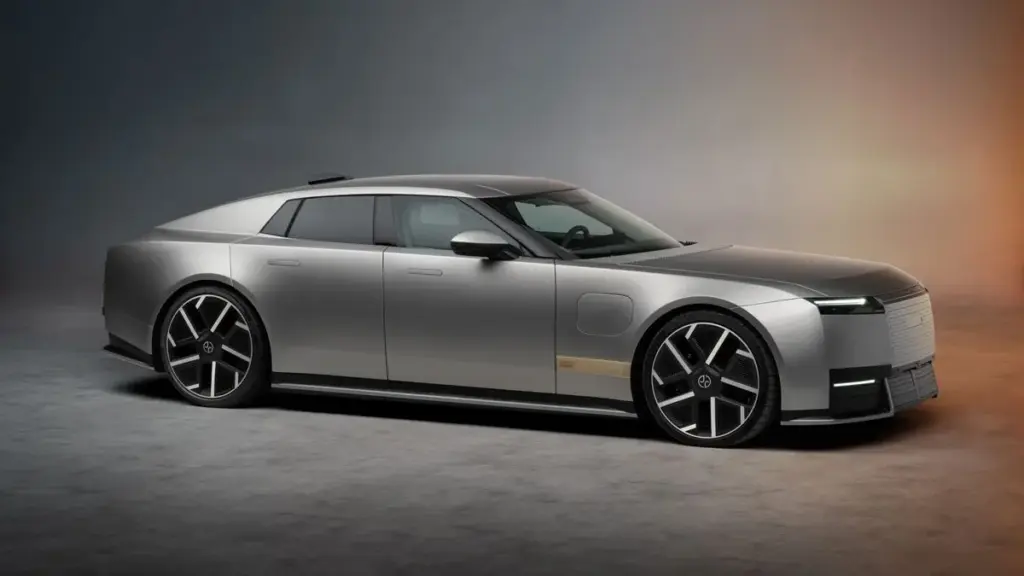
When Jaguar unveiled the iconic E-Type to a stunned world in 1961, it redefined automotive design and cemented the British marque’s legacy of breathtaking aesthetics. Fourteen years later, when the XJS broke cover in 1975, the global reaction was far more contentious, sparking fierce arguments among purists and critics alike. Today, stepping out into the spotlight in New York, the brand-new Jaguar Type 01 is prepared to be judged by those exact same historic standards. With debates already swirling across the automotive landscape, Jaguar is once again putting its entire future firmly on the line.

The Type 01 represents the first production vehicle to emerge from the brand’s comprehensive reinvention, standing tall as the most powerful, most aerodynamic, and most technologically advanced automobile Jaguar has ever manufactured. Configured as a striking four-door grand tourer, the vehicle harnesses a sophisticated three-motor layout—deploying two electric motors at the rear and a single motor up front—to unleash a staggering output of more than 1,000 horsepower. This formidable powertrain allows the grand tourer to surge from zero to 60 miles per hour in a claimed 3.1 seconds. Built upon an advanced 850-volt electrical architecture, the Type 01 promises an impressive driving range of up to 400 miles on a full charge, alongside ultrafast charging capabilities that can replenish up to 200 miles of range in as little as 13 minutes when plugged into a high-speed charger.
For Jaguar, this dramatic leap forward is not merely about launching a new model; it is an existential correction. "Iteration is easy," Rawdon Glover, Jaguar’s managing director, remarked during an exclusive preview for journalists, explaining why the historic marque needed to craft a vehicle fundamentally unlike anything it had ever built before. Over recent years, Jaguar’s traditional customer base had been steadily aging, while its core competitors—long established brands like BMW, Mercedes-Benz, Lexus, and Audi—were rapidly shifting their focus toward electrification. "It was very clear that we didn’t need to make incremental steps," Glover said. "It was time for a much bolder change of direction."

That decisive change of direction inevitably brings a significant shift in market positioning and price. Glover noted that Jaguar’s average U.S. transaction price historically hovered around $60,000 to $70,000, whereas the new Type 01 will command a starting price of $130,500. "If we double the price point, the expectation is going to double in terms of how you treat this individual," he explained. In practical terms, this elevated tier of luxury means Jaguar intends to reinvent the ownership and test-drive experience, bringing a test vehicle directly to a prospective customer’s private doorstep or exclusive country club rather than relying solely on traditional showroom visits.
To achieve the car’s striking visual presence, Jaguar’s designers penned a silhouette defined by long, exceptionally low proportions that remain entirely unique within its competitive segment. Realizing such a distinct stance required the development of a completely new vehicle foundation. "We realized it actually didn’t work on any of our architectures," Glover said, reflecting on the initial phases of the project. "We looked at everybody else’s architectures, and it didn’t work on theirs either." The resulting Jaguar Electric Architecture provides the grand tourer with a near-perfect 50/50 weight distribution and yields the structurally stiffest chassis in the company’s storied history.

The genesis of the Type 01 involved an intense internal design competition known as Project Renaissance, which initially yielded 18 full-size models before a single winning design was chosen. Andy Wheel, who led the exterior design efforts, understood from the outset that the car would represent a radical departure from the past—a polarizing move that the design team actively sought. Wheel vividly remembers watching the debut of the controversial XJS as a child. "Try and do something that meets all requirements and you tend to end up with something which is vanilla," Wheel said, referencing a German idiom brought forward by one of his designers regarding the impossible pursuit of a "wooly egg-laying milk pig"—a metaphorical creature built to do everything that ultimately cannot exist.
Before finalizing the design, Jaguar sought feedback from thousands of prospective buyers. According to Glover, the vehicle naturally elicited polarizing reactions, drawing more ratings at the absolute extremes—such as ones and twos out of ten—than the company typically encounters, alongside a surge of nines and tens. "Great design should have the confidence to polarize," Glover noted. "These purchases are not about need, they’re about desire. We’re not interested in sixes, sevens, and eights." Demonstrating early market interest, more than 50,000 individuals have formally registered their interest in the Type 01, with an impressive 78 percent of those prospective buyers being entirely new to the Jaguar brand.

For the engineering team, operating with a completely blank slate was a dual sensation of professional exhilaration and underlying apprehension. Jon Darlington, a chief engineer who has spent decades with the company, recalled having to confront a daunting question during the development process: "Do I want to be the one who tells them they can’t do it?" Ultimately, he chose to embrace the challenge. "This was a true, true clean sheet of paper," Darlington said. "In 31 years, that’s the first time that’s ever truly been the case."
Tom Holden, the chief designer for interiors, explained that the core design team began with just over a dozen people who held rigorous brainstorming sessions every Friday for a full year. They would print out a life-sized section of the car, spread the schematics across a large table, and meticulously refine the details using marker pens during meetings that routinely stretched for five or six hours. The validation for all those grueling hours arrived roughly two and a half years into the program, when Darlington presented an early prototype to the corporate board. "I actually got a hug off a couple of board members going, ‘This is going to be amazing,’" he recalled.

Despite the immense corporate pressure, the project retained an infectious sense of destiny among the staff. "I have worked on projects that have started and then stopped," said Mary Crisp, Jaguar’s chief materiality designer. "This one never felt like that." Alexey Andreev, an exterior designer, recalled a poignant phone call received in the middle of the pandemic when the team was briefed on the sheer ambition of what they were about to attempt: "You will never get this chance again in your life. Not even in your career—in your life."
The ultimate test for Jaguar will be whether high-end luxury buyers embrace this bold new identity, with the automaker openly acknowledging that it is wagering its corporate future on the gamble. "This was the biggest moment since the Jaguar name was born in 1935," the automaker stated. "Jaguar is back." Official order books for the Type 01 are scheduled to open early next year, with the very first customer deliveries anticipated to begin rolling out in the second half of 2027.