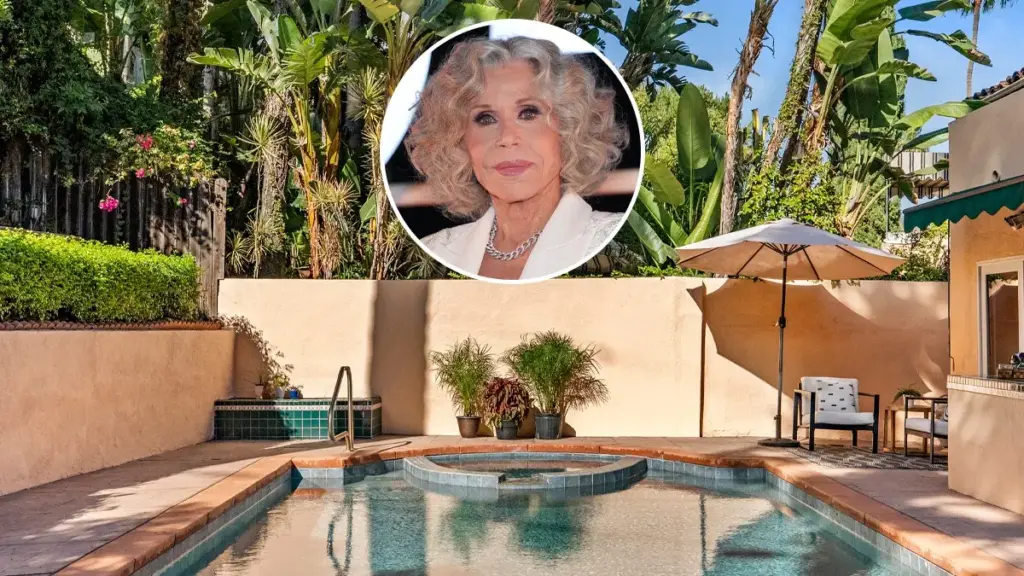
Long before it was listed on the modern Los Angeles real estate market, a charming Mediterranean Revival-style villa nestled in the Hollywood Hills served as the private residence of cultural icon Jane Fonda during one of the most turbulent and politically charged chapters of her life. The historic property, located at 2001 Holly Hill Terrace, has now officially been placed on the market for $1.995 million, offering a rare tangible connection to an era defined by counterculture movements, cinematic milestones, and intense government surveillance.
Represented by Edward Piechocki of Douglas Elliman, the peach-hued stucco residence spans approximately 4,200 square feet across three distinct levels. Tucked quietly away at the end of a private cul-de-sac on a lushly landscaped lot of less than a quarter-acre, the home sits securely within the prestigious Whitley Heights Historic Preservation Zone. Its storied past, architectural charm, and unique historic protections make it a fascinating piece of Hollywood real estate history, carrying echoes of both the glamour of the silver screen and the relentless turbulence of 1960s and 1970s American politics.

Originally constructed in 1924, the multi-level dwelling witnessed Fonda through her first two high-profile marriages. The home served as her residence during her union with French director Roger Vadim, following her international superstardom in the 1968 psychedelic sci-fi film Barbarella, which Vadim directed. The movie quickly transformed into a massive cultural flashpoint, thrusting Fonda into global prominence while fueling contemporary debates surrounding the era’s sexual liberation movement, government censorship, and the cinematic objectification of women.
As the years progressed and the 1960s bled into the politically fraught atmosphere of the 1970s, Fonda’s focus expanded from acting and entrepreneurial endeavors to fervent anti-war activism. During the height of her involvement in the peace movement opposing the conflict in Vietnam, Fonda made a fateful visit to Hanoi, North Vietnam, in 1972. During the trip, she was photographed laughing while sitting on a North Vietnamese anti-aircraft gun—a weapon utilized to shoot down American aircraft. The image sparked immense national outrage, permanently embedding the moniker “Hanoi Jane” into public discourse and alienating large segments of the American public for decades to follow.
Long before her controversial journey to Hanoi, however, Fonda’s vocal opposition to the war had already drawn the aggressive attention of the United States federal government. While renting the Mediterranean Revival villa in the Hollywood Hills, the actress became the direct target of covert domestic espionage. The Federal Bureau of Investigation (FBI) tapped her private phone lines, while the Central Intelligence Agency (CIA) covertly intercepted and opened her personal mail, monitoring her communications and associations from the very rooms that are now being offered to a new generation of buyers.

Following Fonda’s tenure, the property changed hands in 1985, selling for roughly $234,000 to the late character actors Bryan and Jo Deodato Clark. In a fascinating twist of historic irony, Bryan Clark was widely recognized in the entertainment industry for portraying Fonda’s ultimate ideological rival, President Ronald Reagan, in several theatrical and television productions throughout his career.
Today, the residence retains much of the architectural integrity and character that made it an appealing retreat nearly a century ago. Accessible via two separate street-side entrances, the layout balances historic character with modern conveniences. Among the standout interior features is a welcoming fireside living room that flows seamlessly into a cozy family room. This space opens directly outward to a canyon-view patio featuring a classic red-brick surface, providing an ideal vantage point for taking in the surrounding natural topography of the Hollywood Hills.
Adjacent to the living spaces is a formal dining room defined by an antique-style hanging pendant light and multi-paned French doors framed by striking stained-glass sidelights. This room transitions naturally into a thoroughly remodeled kitchen that carefully blends warm wood cabinetry with sleek, modern stainless-steel appliances. The kitchen also includes a functional breakfast bar accompanied by a casual seating area complete with built-in banquette seating, offering a warm and intimate space for daily meals.

The home’s flexible floor plan includes five bedrooms and five bathrooms spread across its three levels. A private guest suite situated on the lower level operates as a semi-autonomous living space, featuring its own dedicated entrance, a private laundry area, and a fully equipped kitchen, making it well-suited for visiting family members, long-term guests, or staff.
Occupying the uppermost floor is an expansive primary retreat designed as a quiet sanctuary away from the rest of the home. The master suite features a small private balcony overlooking the verdant landscape, alongside a separate flexible space that can easily be utilized as a private home office, reading room, or studio. The en-suite bathroom serves as a tranquil focal point, anchored by a freestanding oval soaking tub set artfully over a bed of natural river rocks.
Outdoors, the terraced hillside grounds make full use of the Southern California climate. The property boasts a freeform swimming pool and an integrated spillover spa, all wrapped by a spacious tiled sundeck. An elevated lounging deck provides additional space for relaxation and outdoor entertaining, complemented by a built-in barbecue grill, manicured gardens, and a selection of mature fruit trees that enhance the private, secluded feel of the canyon setting.

Adding to the long-term value and preservation of the estate, the property is safeguarded by important historic and tax-incentive programs. In addition to being covered by a Los Angeles Conservancy easement that legally protects the architectural integrity of its historic façade, the residence falls under the provisions of the Mills Act. This California state law offers significant property tax savings to owners of qualified historic structures in exchange for a formal commitment to the continuous preservation, maintenance, and restoration of the property’s historical character.