The Volcano Room and the Spirit of New York’s Legendary Bohemian Haven
For more than thirty years, the historic Hotel Chelsea has stood as an enduring symbol of New York City’s bohemian past, weathering real estate booms, luxury conversions, and shifting cultural tides. Within its legendary walls, filmmaker and producer Steve Willis has maintained a continuous residency since 1994, transforming a pair of facing studio spaces into a sprawling, densely layered personal archive. Living amidst the ghosts of the building’s storied past, Willis has preserved not only the physical layout of his iconic quarters—once home to rock royalty like Janis Joplin—but has also curated a living museum of thrifted treasures, theatrical set pieces, and mementos gathered over a lifetime in the arts.
Willis first arrived at the Chelsea in 1994, moving into a one-bedroom apartment complete with a private balcony and an original fireplace. Long before he settled in, however, that very room had been inhabited by Janis Joplin during the height of her countercultural fame. The connection to the legendary blues-rock singer remains palpable in the space today, where Willis still uses Joplin’s original soap dish and toothbrush holder.
The historical weight of the apartment is underscored by the memories shared with other cultural icons who frequented the halls. "Patti Smith told me she was in this room when Kris Kristofferson sang ‘Me and Bobby McGee’ to Janis for the first time," says Willis. Over the course of his career, Willis has crossed paths with numerous legends, directing music videos for prominent artists such as Patti LaBelle and Mary J. Blige. Today, his creative pursuits extend into unexpected realms, including the choreography of elaborate, large-scale fountain shows for prestigious hospitality destinations like the Bellagio in Las Vegas—a project he documented in a film titled Wet Dreams, created alongside actress Rebecca Romijn.
From No-Man’s-Land to Cultural Landmark
When Willis first took up residence in the mid-1990s, the surrounding Chelsea neighborhood bore little resemblance to the high-end arts and residential district it is today. The property itself was in a state of rough-around-the-edges disrepair, mirroring the gritty reality of New York City during that era.
"Chelsea was sort of a no-man’s-land. It wasn’t the gay neighborhood yet. There was almost nothing. It had Rawhide," Willis recalls, referencing the neighborhood’s long-shuttered, notorious dive bar. "When I moved in, there was bulletproof glass at the front desk and you had to get buzzed in."
Willis’s entry into the building came by way of the music industry. Having previously lived and worked in Los Angeles, he first found himself at the Hotel Chelsea while producing the music video for Mariah Carey’s "Anytime You Need a Friend." Stanley Bard, the building’s legendary long-time owner and manager, suggested that Willis take a room rather than continuing to pay for traditional hotel accommodations.
"He was sort of the casting director for the building," Willis explains of Bard. "We were all invited to live here."
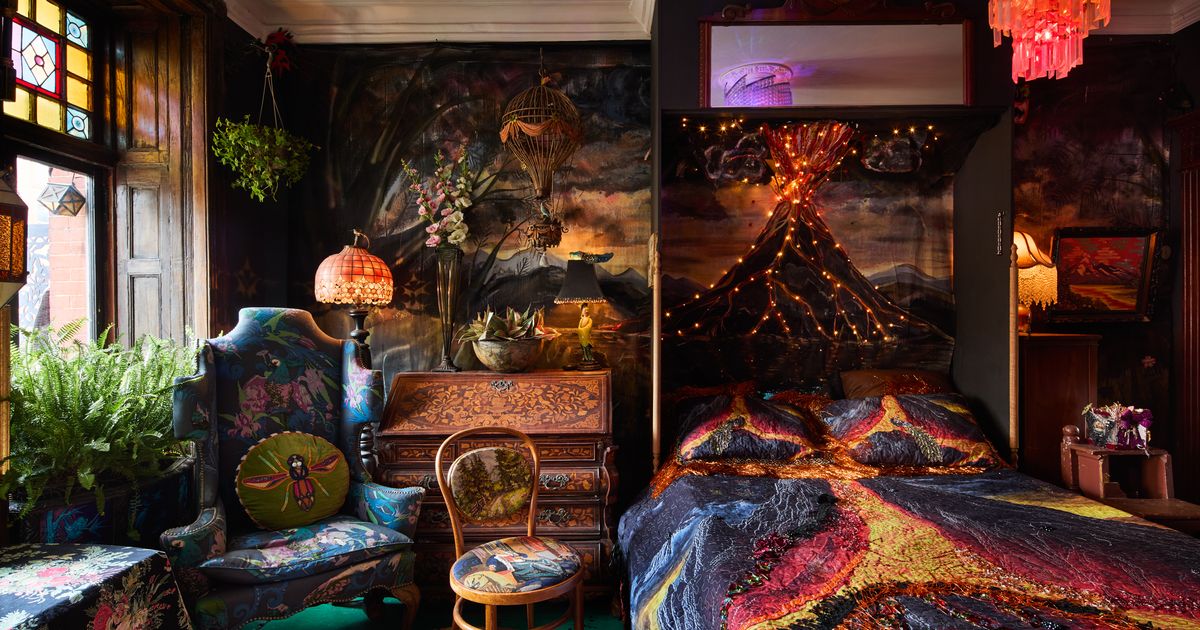
At the time, the apartment was heavily worn, featuring dilapidated carpeting and thick layers of white paint concealing the building’s original dark woodwork. Rather than looking for a turnkey modern renovation, Willis embraced the challenge of restoration. He meticulously stripped back the paint, bringing the historic wood back to life, and began populating the space with an eclectic mix of street finds, antiques sourced from the Chelsea Flea Market, and surplus set pieces from his professional film and video productions.
"The basement here also had furniture, and I could pilfer that. Stanley was really easygoing about stuff," Willis notes.
Expanding the Archive Across the Hall
As the years progressed, Willis’s footprint within the building expanded. In 1996, the studio apartment directly across the hall became vacant, prompting him to rent it as well, effectively creating a dual-sided enclave of curated memories.
He initially lined the walls of the second studio with a metallic patterned wallpaper that appeared to hail from the 1960s, though he later swapped it out for a rare 19th-century French wallpaper discovered on eBay. Much like his primary residence—which was eventually reconfigured from a one-bedroom into a studio layout—the second space quickly filled up with foraged goods, artistic projects, and items salvaged from his family’s history.
"I keep everything. I’m a pack rat. I have become my family’s archivist," he says.
Aside from a single painting of Dolly Parton, virtually every piece of furniture, art, and decor across both of Willis’s apartments has a previous life, a distinct provenance, or a personal story attached to it. "Well, the mattress, the sheets, and the towels," he clarifies with a laugh.
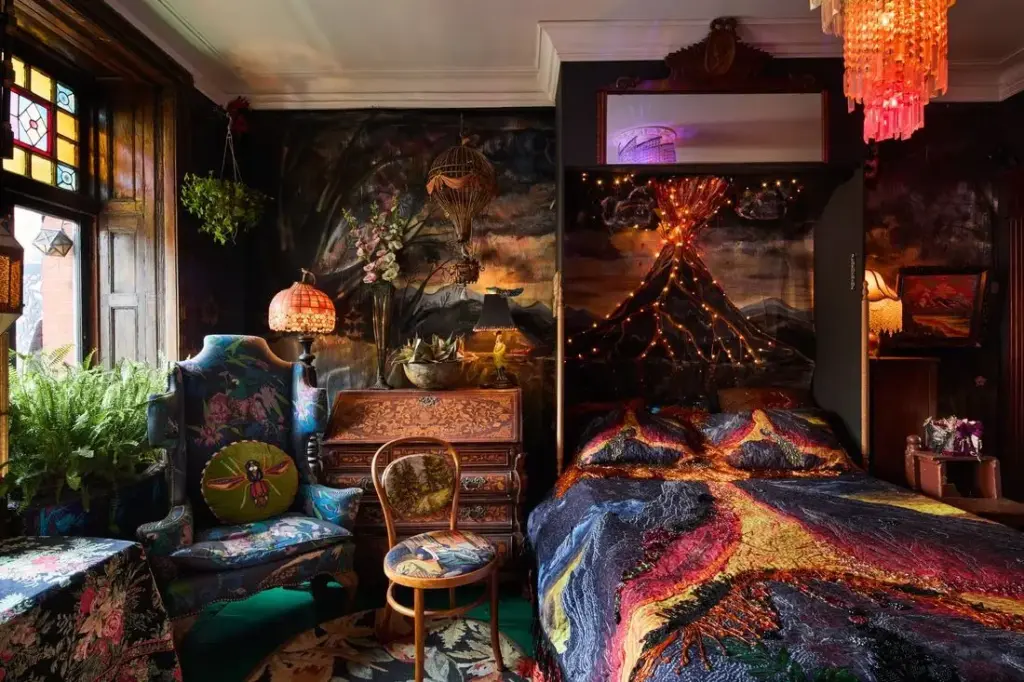
Every corner of the apartments tells a distinct story of artistic collaboration and serendipitous acquisition. In what Willis calls "The Volcano Room," a hand-painted mural decorates the wall behind his Murphy bed—a piece he originally created for an Off-Broadway show about the Peruvian soprano Yma Sumac. He also designed the custom bedspread that rests upon it. Nearby, a cafe chair gifted by actress Rebecca Romijn sits quietly in the room. "She finds embroideries on eBay and makes these chairs," Willis explains, noting that the inlaid desk nearby was sourced directly from the City Opera Thrift Shop.

In the living areas, the juxtaposition of history and personal intervention is striking. A lacquer chest from Japan harks back to the years Willis’s family lived abroad in the 1970s. Surrounding portraiture, acquired from various flea markets and antique shops, received a custom "drag makeover" by the filmmaker himself. Vintage chandeliers have been retrofitted with colored lightbulbs to cast a theatrical glow, while a 1960s elephant statue once owned by his mother stands alongside an original mantel mirror.
In the bathroom, a Victorian wall unit functions as an elaborate door frame, paired with artwork from the Chelsea Flea and custom bedspread trim sourced from Hai Trim & Feathers in the Garment District. "It’s a fantasyland inside," Willis says of the immersive environment he has built.
Preserving the Spirit of an Era
The lounge area features a sofa that was famously discovered still wrapped in its original protective plastic. "When I took it off, I knew some old lady in heaven was having a fit. It felt almost sacrilegious to remove it," Willis admits. Paired with a marble-top coffee table from Goodwill and lamps and a chaise lounge secured via eBay, the room has drawn humorous comparisons from visitors. "Someone said, ‘You know your apartment looks like Freud’s study?’ And I thought, Is that bad?"
Among his most recent creations is a newly completed portrait finished in September, part of what he refers to as his personal shrine. The space incorporates a trompe-l’œil-painted mantel from a thrift store, porcelain faces rescued from the Chelsea Flea, a decorative screen from eBay, and a side chair found on Facebook Marketplace. Even the bedroom utilizes unorthodox design solutions, with the original apartment radiator ingeniously repurposed as a bedside table, flanked by walls and lampshades draped in rich fabrics found in the Garment District.
Stepping out onto the balcony—the very perch once used by Janis Joplin—Willis remains a steadfast custodian of a bygone New York City. Through decades of creative output, massive urban transformation, and the changing guard of the Hotel Chelsea itself, his dual studios remain a vibrant, eccentric capsule of artistic history, preserved entirely through the lens of a dedicated archivist and storyteller.