For more than three decades, filmmaker and producer Steve Willis has maintained a front-row seat to bohemian history from inside the legendary Hotel Chelsea. Moving into the iconic West 23rd Street landmark in 1994, Willis initially settled into a one-bedroom apartment complete with a balcony and a fireplace—historic quarters that had once been home to rock icon Janis Joplin. Decades later, the physical traces of that rock-and-roll legacy remain deeply embedded in his daily life, down to the small, mundane details. He still owns and uses Joplin’s original soap dish and toothbrush holder, tangible artifacts from a bygone era of American counterculture.
Willis recalls hearing tales of the room’s storied past from those who lived through it. "Patti Smith told me she was in this room when Kris Kristofferson sang ‘Me and Bobby McGee’ to Janis for the first time," says Willis, whose own career spans directing music videos for legendary R&B and hip-hop artists like Patti LaBelle and Mary J. Blige. In addition to his work in music and film, Willis has carved out a unique niche choreographing elaborate, large-scale fountain shows for major hospitality destinations, including the Bellagio in Las Vegas. His work on these monumental water displays even inspired a documentary titled Wet Dreams, created in collaboration with actress Rebecca Romijn.
When Willis first arrived at the Hotel Chelsea more than thirty years ago, both the building and the surrounding neighborhood looked vastly different from the polished, gentrified Manhattan of today. Chelsea was a starkly different landscape in the mid-1990s. "Chelsea was sort of a no-man’s-land. It wasn’t the gay neighborhood yet. There was almost nothing. It had Rawhide," he says, gesturing to memories of the neighborhood’s gritty past and referencing the long-shuttered dive bar. "When I moved in, there was bulletproof glass at the front desk and you had to get buzzed in."
Willis’s arrival in New York City and subsequent residency at the hotel came by way of Los Angeles, initially bringing him to the East Coast to produce a music video for Mariah Carey’s track "Anytime You Need a Friend." During the production, Stanley Bard, the legendary longtime owner and manager of the property, suggested that Willis take a room in the building rather than running up hotel bills elsewhere. Bard operated the historic hotel with a distinct, hands-on philosophy that helped cultivate its legendary creative community. "He was sort of the casting director for the building," Willis recalls. "We were all invited to live here."
When Willis first took possession of the apartment, the space was in severe disrepair. The interior featured worn-out carpeting and layer upon layer of thick white paint smothered over the building’s original, rich dark woodwork. Rather than accepting the rundown conditions, Willis rolled up his sleeves. He stripped the apartment down to its structural bones and began filling the rooms with an eclectic mix of street finds, antique treasures hunted down at the Chelsea Flea Market, and discarded set pieces scavenged from his professional production work. "The basement here also had furniture, and I could pilfer that. Stanley was really easygoing about stuff," Willis notes, reflecting the permissive, bohemian environment that defined Bard’s tenure.
The expansion of Willis’s domestic footprint occurred just two years later, in 1996, when the studio apartment directly across the hall became vacant. He promptly rented that space as well, effectively creating a two-part creative compound within the historic walls of the hotel. Initially, he lined the walls of the second studio with a metallic-patterned wallpaper that appeared to hail from the 1960s. He later replaced it with a rare, 19th-century French wallpaper discovered on eBay. True to form, he filled the second studio with the same discerning eye for foraged and salvaged goods that defined his primary residence.
Over the years, this relentless collecting habit has transformed both studios into living museums of personal history, theatrical design, and rescued Americana. "I keep everything. I’m a pack rat. I have become my family’s archivist," he acknowledges. Step inside either of Willis’s facing apartments, and aside from a painting of Dolly Parton, practically every piece of furniture, art, and decor has a previous life. "Well, the mattress, the sheets, and the towels," he clarifies.
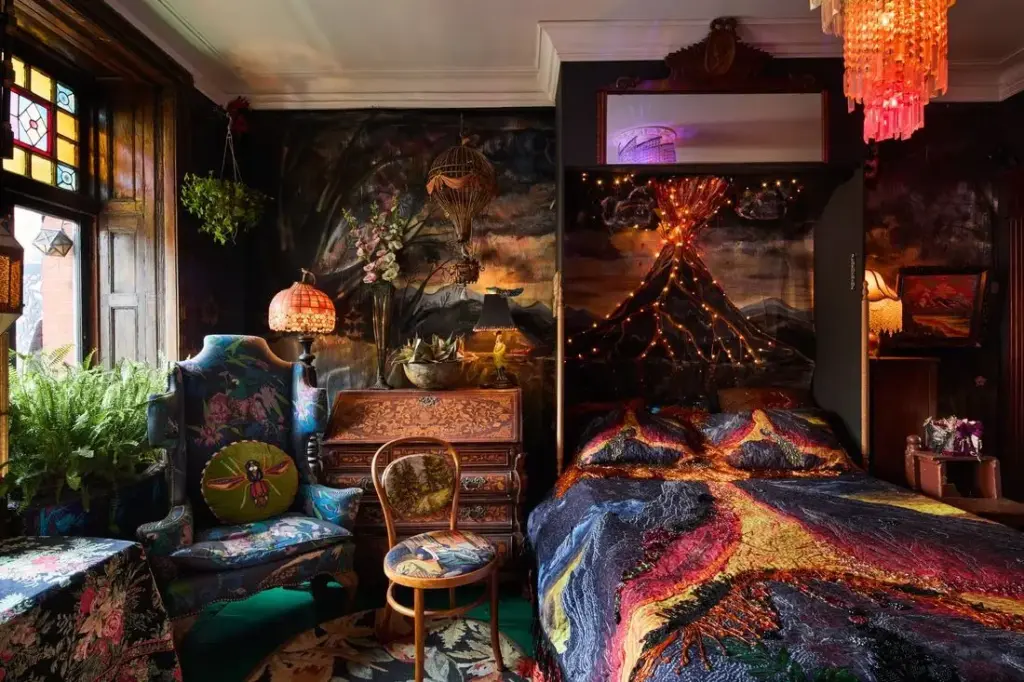
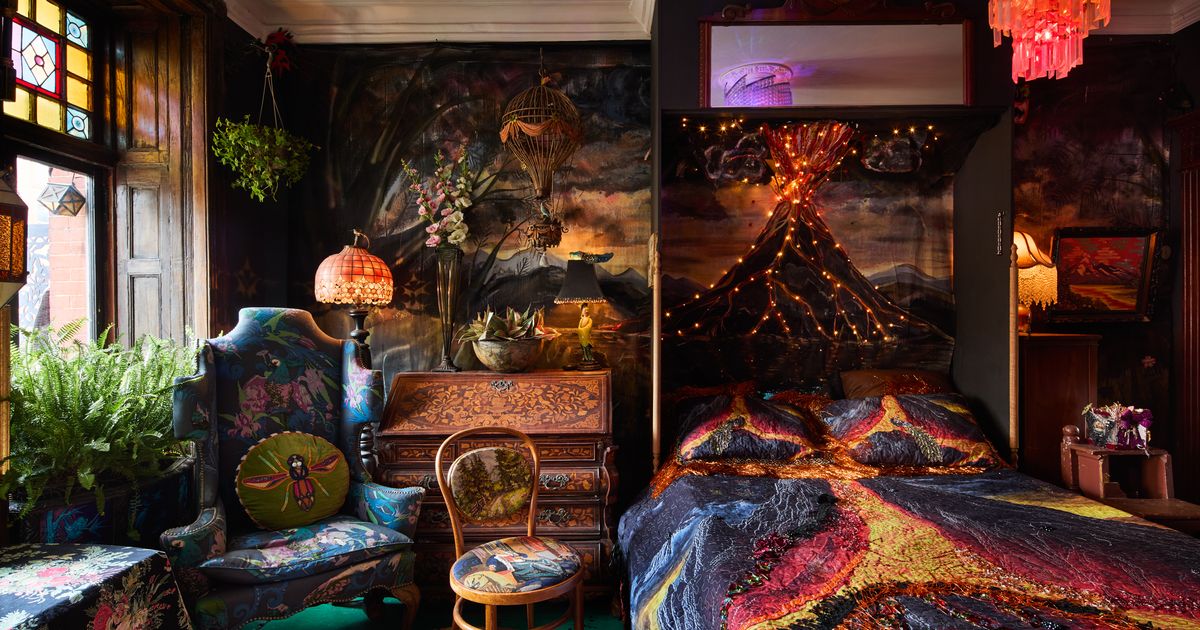
The interior spaces are dense with visual texture and theatrical flair. In what is known as the Volcano Room, Willis painted a vibrant mural on the wall directly behind his Murphy bed—a piece originally created for an Off-Broadway show he produced about the legendary Peruvian soprano Yma Sumac. He also personally designed the coordinating bedspread. Nearby sits a café chair gifted to him by actress Rebecca Romijn. "She finds embroideries on eBay and makes these chairs," he explains, pointing out the inlaid desk he acquired at the City Opera Thrift Shop.
The fireplace mantle serves as another focal point for Willis’s curatorial eye. A sleek lacquer chest sits nearby, an artifact from Japan where Willis’s family lived for a few years during the 1970s. The walls are lined with portraits gathered from flea markets and antique shops, which Willis humorously repurposed by giving them a drag makeover. He added vibrant colored lightbulbs to a vintage chandelier, while a 1960s elephant statue that once belonged to his mother stands guard near the original mirror.
The bathroom and lounging areas continue this immersive, theatrical narrative. The doorway is framed by a Victorian wall unit, accented by artwork sourced from the Chelsea Flea Market. In the bedroom, the trim and oversized tassels on the bedspread were sourced from Hai Trim & Feathers in the Garment District. "It’s a fantasyland inside," Willis says of the dense visual layering.

In the main lounging area, a vintage sofa originally arrived encased in its factory-fresh plastic protective wrapping. "This sofa was covered in plastic. When I took it off, I knew some old lady in heaven was having a fit. It felt almost sacrilegious to remove it," Willis admits. Paired with a marble-top coffee table from Goodwill and lamps and a chaise lounge tracked down on eBay, the room has drawn distinct comparisons from visitors. "Someone said, ‘You know your apartment looks like Freud’s study?’ And I thought, Is that bad?"
Among the most recent additions to his sprawling collection is a dedicated shrine area. Willis points out a portrait he finished painting himself in September, noting that he is currently pitching Dollywood on a prospective fountain design project. The trompe-l’œil-painted mantel was rescued from a thrift store, its surround decorated with porcelain faces found at the Chelsea Flea. A decorative screen from eBay and a side chair acquired via Facebook Marketplace round out the vignette.
In the bedroom, the walls and lampshades are enveloped in rich fabric discovered in the Garment District, while the room’s original cast-iron radiator has been cleverly repurposed to function as a bedside table. A nude painting bought at a thrift store hangs nearby, a gift from a close friend.
Stepping out onto the wrought-iron balcony—the very same outdoor perch where Janis Joplin once took in the sights and sounds of West 23rd Street—Willis surveys the city below. After more than thirty years inside the Hotel Chelsea, he remains firmly anchored in the building’s storied past, living among the memories, materials, and remnants of the artists and divas who shaped New York’s cultural history.