For more than three decades, filmmaker and fountain-show choreographer Steve Willis has called one of New York City’s most mythic cultural landmarks home. Moving into the Hotel Chelsea in 1994, Willis initially took up residence in a one-bedroom apartment complete with a balcony and a fireplace—a space with a storied past as the former home of rock icon Janis Joplin. Decades later, Willis still retains everyday artifacts from Joplin’s tenure, including her personal soap dish and toothbrush holder, serving as an accidental custodian of rock-and-roll history.
Willis’s journey into the legendary bohemian bastion began not as a permanent resident seeking sanctuary, but as a music video producer. Having lived in Los Angeles, he first arrived at the Chelsea while producing the music video for Mariah Carey’s “Anytime You Need a Friend.” Stanley Bard, the legendary longtime owner and manager of the property who frequently acted as an unofficial casting director for the building, suggested that Willis take a room rather than continually paying for traditional hotels.
"We were all invited to live here," Willis recalls of an era when the building functioned as a haven for artists, musicians, and creatives of all stripes.
A Rough-Around-the-Edges Neighborhood
When Willis first moved into the property in the mid-1990s, the surrounding neighborhood bore little resemblance to the hyper-gentrified, gallery-dense Chelsea of today. The area was a far cry from a polished destination, functioning more like a gritty urban frontier.
"Chelsea was sort of a no-man’s-land. It wasn’t the gay neighborhood yet. There was almost nothing. It had Rawhide," he says, referencing the long-shuttered local dive bar. The hotel itself reflected the gritty reality of the block. "When I moved in, there was bulletproof glass at the front desk and you had to get buzzed in."
The physical condition of the apartment matched the rough-hewn charm of the neighborhood. The space was severely rundown, featuring worn-out carpeting and layers upon layers of heavy white paint smothering the original dark woodwork. Rather than calling in contractors for a modern overhaul, Willis rolled up his sleeves and stripped the interior down to its historic bones, embarking on a decades-long mission to pack the space with street finds, antiques sourced from the Chelsea Flea Market, and discarded set pieces from his professional creative projects.
"The basement here also had furniture, and I could pilfer that," Willis notes, praising Stanley Bard’s famously laissez-faire management style. "Stanley was really easygoing about stuff."
Expanding the Domain
The creative footprint expanded in 1996 when the studio apartment directly across the hall became available. Willis rented the second unit, effectively creating a dual-studio sanctuary across the hotel corridor.
Initially, he covered the walls of the second studio with a metallic patterned wallpaper that appeared to hail from the 1960s. He later replaced it with a rare 19th-century French wallpaper discovered on eBay. Much like his primary residence, the studio was steadily filled with a lifetime of foraged goods, flea-market acquisitions, and personal creations.
"I keep everything. I’m a pack rat. I have become my family’s archivist," Willis explains.
Aside from a single painting of Dolly Parton, neither of Willis’s apartments contains a stitch of newly manufactured furniture or contemporary decor. The sole exceptions are strictly utilitarian: the mattresses, sheets, and towels.
A Living Museum of Memory and Divas
Over the years, Willis’s dual studios have absorbed the lore of the building’s legendary occupants. He frequently trades stories drawn from the bohemian ghosts of the Chelsea, including recollections shared by contemporaries like Patti Smith.
"Patti Smith told me she was in this room when Kris Kristofferson sang ‘Me and Bobby McGee’ to Janis for the first time," Willis says.
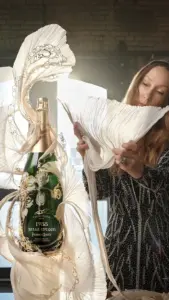
The apartments themselves operate as theatrical sets, heavily influenced by Willis’s expansive career in entertainment. Beyond his early work directing music videos for major R&B acts like Patti LaBelle and Mary J. Blige, Willis carved out a unique niche as a creator of elaborate, large-scale fountain shows for hospitality giants such as the Bellagio in Las Vegas. His work on the colossal water spectacles even became the subject of a documentary titled Wet Dreams, directed in collaboration with actress Rebecca Romijn.
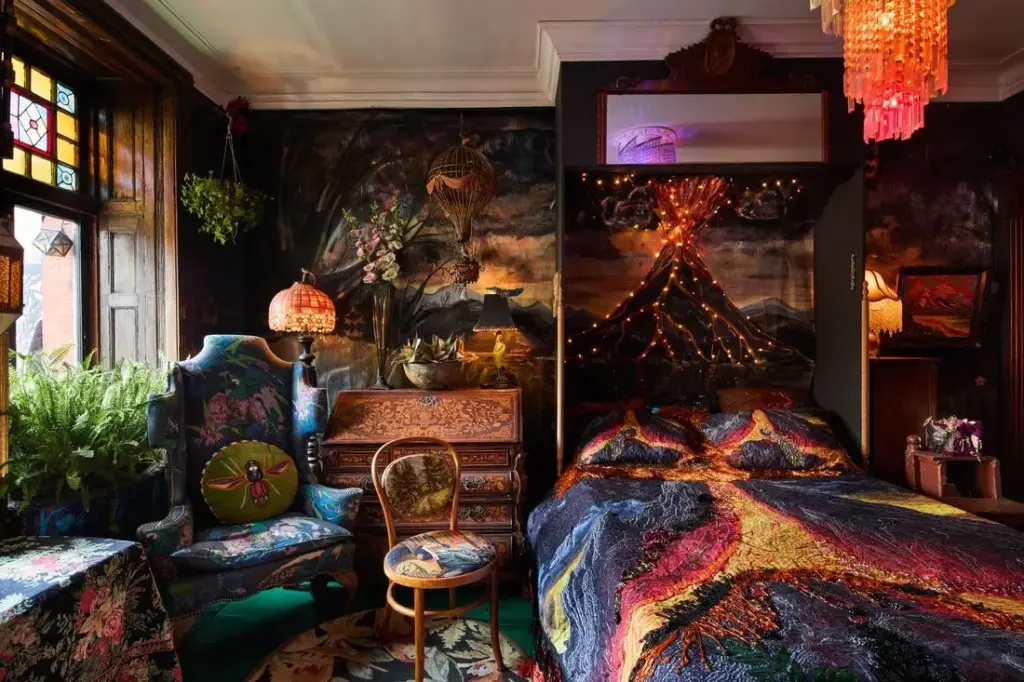
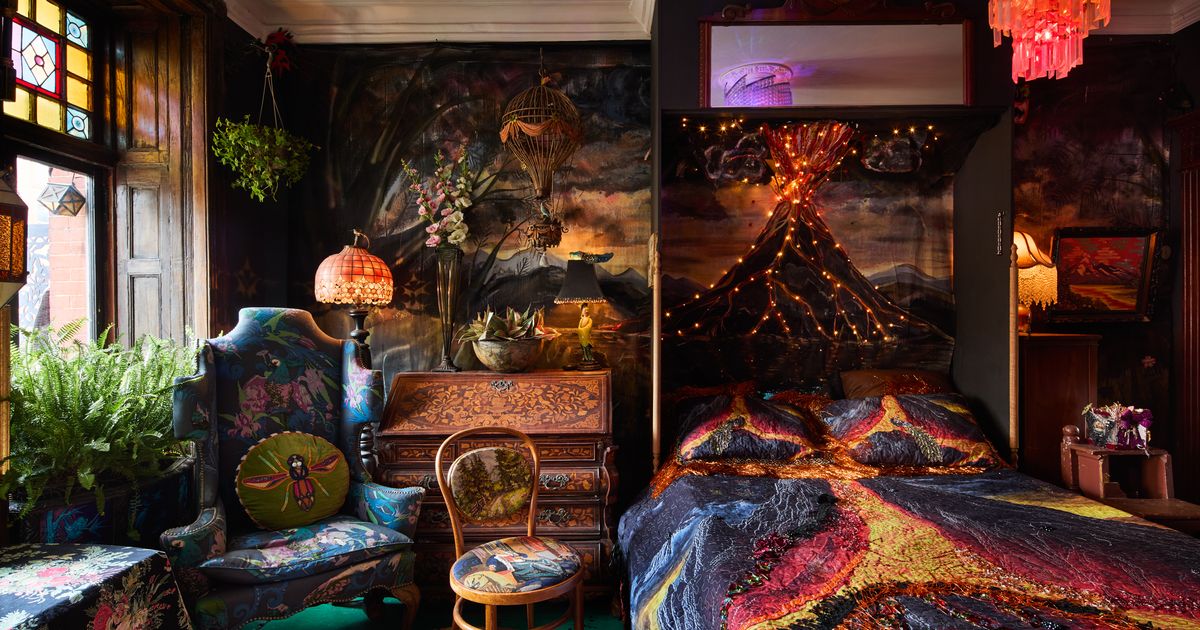
That same theatricality bleeds into the interior design of his living spaces. In "The Volcano Room," Willis hand-painted a vibrant mural on the wall behind his Murphy bed specifically for an Off-Broadway show he produced about the legendary Peruvian soprano Yma Sumac. The bedspread was custom-designed by Willis himself, while a nearby café chair was gifted to him by Rebecca Romijn, who hunts down vintage embroideries on eBay to embellish furniture. An inlaid desk situated in the room was salvaged from the City Opera Thrift Shop.
The surrounding decor is a dense tapestry of personal history and salvaged treasures. A lacquer chest near the fireplace originates from Japan, where Willis’s family lived during the 1970s. Portraits found at antique markets were given playful drag makeovers by Willis’s own hand, while a vintage chandelier was outfitted with vibrant colored lightbulbs to cast a theatrical glow across the room. A 1960s elephant statue once belonged to his mother, standing alongside the building’s original architectural mirror.

The Details of a Pack Rat’s Paradise
In the bathroom, a Victorian wall unit functions as an elaborate door frame, complemented by artwork sourced from the Chelsea Flea Market. The bedspread features custom trim and oversized tassels procured from Hai Trim & Feathers in Manhattan’s Garment District—a tactile excess that prompts Willis to describe the interior simply as "a fantasyland inside."
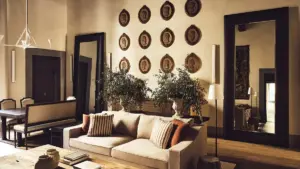
The lounging area features a sofa that famously spent years encased in original protective plastic. Removing the heavy vinyl felt like a momentous, almost transgressive act to the long-term resident.
"This sofa was covered in plastic. When I took it off, I knew some old lady in heaven was having a fit. It felt almost sacrilegious to remove it," Willis says.
Paired with a marble-top coffee table from Goodwill, lamps and a chaise lounge sourced from eBay, the room has drawn distinct comparisons from visitors.
"Someone said, ‘You know your apartment looks like Freud’s study?’ And I thought, Is that bad?"
More recently, Willis has continued adding to his visual archive. He completed a new portrait in September, part of a growing shrine that features a trompe-l’oeil-painted mantel acquired from a thrift store, porcelain faces sourced from the Chelsea Flea, a decorative screen from eBay, and a side chair picked up via Facebook Marketplace.
Across the hall, the bedroom continues the textile-heavy aesthetic, with lampshades and walls wrapped in fabric discovered in the Garment District. An original radiator has been cleverly repurposed as a bedside table, accompanied by a nude thrift-store painting gifted by a friend.
Through decades of shifting neighborhoods, architectural renovations, and changing cultural landscapes in New York City, Steve Willis remains firmly anchored in his facing studios at the Hotel Chelsea. Surrounded by the salvaged relics of thrift stores, the ghosts of 1960s rock legends, and the memories of the divas who shaped his life and career, he continues to curate a deeply personal monument to an increasingly rare era of bohemian New York.