For decades, the global real estate and construction sectors have relied on a familiar, standardized set of metrics to determine the value of architecture. Traditional evaluations focus almost exclusively on hard numbers: construction budgets, ongoing energy performance, tenant occupancy rates, and short- or long-term return on investment. Yet, despite the precision of these financial formulas, one of the most powerful and influential elements that brings any built environment to life is routinely left out of the calculations entirely: architectural lighting.
Traditionally, lighting has been treated as a finishing touch—an afterthought applied late in the design process to ensure visibility and meet basic building codes. However, as modern urban planning and architectural design evolve, it is becoming increasingly clear that lighting is far more than mere decoration. Instead, it serves as a crucial strategic tool capable of shaping human experiences, defining places, influencing public behavior, supporting local economies, and reinforcing civic identity long after the sun goes down. The fundamental question facing the industry is no longer whether illumination matters, but whether we can accurately measure the often-overlooked value it creates for communities and investors alike.
A recent impact analysis conducted by Color Kinetics, examining four distinct illuminated public spaces across the United States, provides compelling, data-driven evidence that thoughtful architectural lighting delivers measurable returns that extend far beyond simple aesthetics. The comprehensive report, titled “Lighting Public Spaces – Impact and Analysis,” investigates projects ranging from major civic landmarks to large-scale public art installations. The study’s findings reveal that intentional architectural lighting generates a wide spectrum of economic, social, and cultural benefits that easily stretch far beyond the scope of the initial capital investment.
Beyond Lumens and Energy Savings
Lighting professionals and facility managers have long been adept at quantifying technical metrics such as energy consumption, maintenance cost savings, and operational carbon reductions. While these engineering figures are essential for compliance and sustainability reporting, they tell only a fraction of the broader story. The Color Kinetics report takes a more holistic view, examining lighting’s profound effects on community engagement, regional tourism, local economic development, nighttime visibility, strategic partnerships, environmental sustainability, and public wellbeing.
By treating illumination as core infrastructure rather than a decorative accessory, cities can better understand how light fundamentally shapes how urban areas function and how communities connect. As modern architecture increasingly prioritizes human interaction, psychological wellbeing, and distinctive local identity, lighting has emerged as a central component in delivering those critical outcomes.
When Buildings Become Destinations
Perhaps the most striking evidence of lighting’s tangible value lies in its unique ability to transform familiar, purely functional places into memorable, iconic destinations. A prime example is the Daniel Hoan Memorial Bridge in Milwaukee. Once considered little more than a piece of utilitarian transport infrastructure designed to move vehicles across a gap, the bridge has been radically altered through dynamic architectural lighting. Today, it stands as a brilliant visual icon that vividly reflects the city’s cultural identity.
By bathing the structure in programmable light, urban planners have successfully reconnected both residents and visitors to the local waterfront in an entirely new way, turning a once-overlooked thoroughfare into one of the most recognizable landmarks in the region. Furthermore, the bridge now serves as a vibrant canvas, hosting community and civic events, raising awareness for important causes, and anchoring annual festivals throughout the calendar year.
The way a piece of architecture looks and performs at night can also exert a massive influence on its digital presence. For the Hoan Bridge, this visual transformation has driven millions of online impressions, fueled tourism marketing campaigns, and generated widespread media coverage, effectively positioning the structure as an ambassador for the city itself. Through lighting, standard infrastructure has been successfully converted into cultural infrastructure. This distinction is vital for modern municipalities. Success is no longer measured solely by how well a physical structure performs its primary engineering function, but by how successfully it contributes to the broader narrative and identity of a place.
The Economics of Experience
Architectural lighting also generates economic value in ways that traditional procurement models and financial feasibility studies routinely struggle to capture. The Color Kinetics report estimates that the four featured lighting projects collectively generated nearly $30 million in total economic impact through direct capital investment, supply chain activity, and broader macroeconomic ripples. However, the indirect impacts on local communities may be even more significant over the long term.
In West Sacramento, the revitalization of a venue known as The Barn demonstrates how thoughtful, connected lighting can directly support successful placemaking. Originally conceived as a local event and dining venue, the integration of deliberate lighting helped establish the site as the undisputed focal point of a rapidly growing mixed-use district. The space now regularly attracts concerts, festivals, sporting events, and grassroots community gatherings, all while helping to activate and draw foot traffic to the surrounding waterfront.
In the wake of this activation, approximately ten residential developments have either been built or are currently under construction nearby, highlighting the profound catalytic role that quality public spaces and nighttime lighting can play in broader urban regeneration. The value created by these initiatives extends far beyond basic construction economics. Visitors tend to stay significantly longer, local businesses benefit directly from increased footfall, and the location develops a distinct identity that encourages repeat visits, civic pride, and sustained outside investment. These kinds of outcomes are rarely captured in traditional lighting specifications, yet they arguably represent the greatest long-term return on investment for a city.
Lighting as a Civic Platform
One of the most compelling insights to emerge from the report is that architectural lighting is increasingly functioning as a dynamic form of public communication. Philadelphia City Hall serves as a textbook example of this phenomenon. By utilizing programmable, highly adaptable lighting systems, the historic building can respond almost instantly to national celebrations, charitable campaigns, and critical civic events. This capability transforms a static piece of architecture into a living, breathing expression of the city’s collective identity. Whether celebrating a major sporting victory or illuminating the facade to mark an important social cause, the building ceases to be merely a passive backdrop and instead becomes an active participant in daily public life.
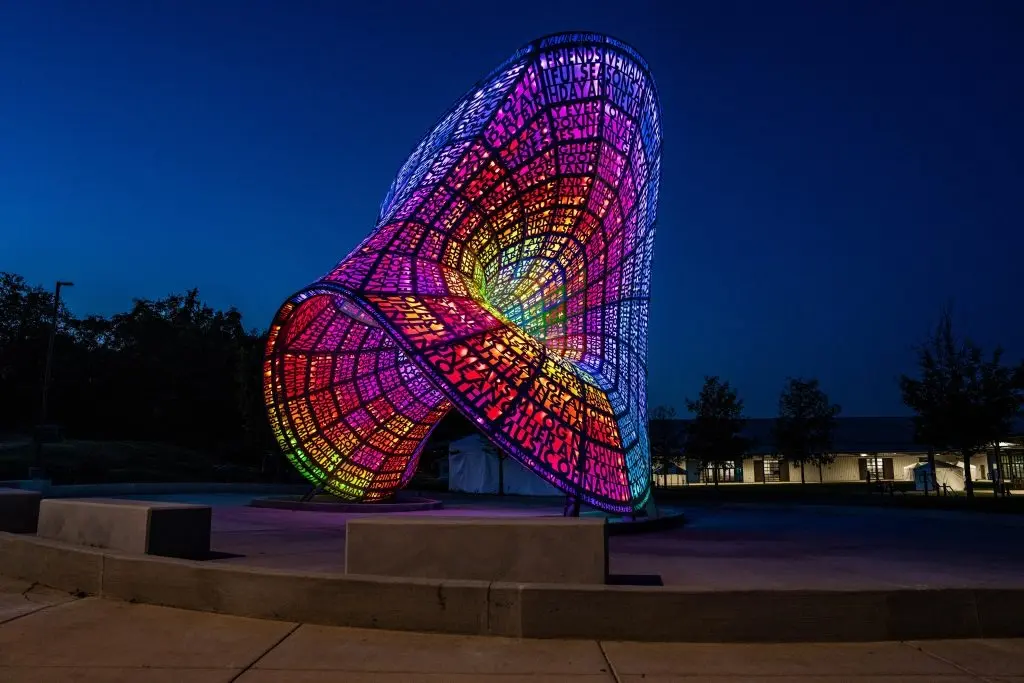
Similarly, Nashville’s public art installation, Loqui, demonstrates how illuminated public art can amplify community voices and foster a deep sense of belonging. Working in tandem with the sculpture’s innovative and unique physical geometry, the lighting design was intentionally developed to personify the words and experiences of local residents, inviting personal stories in and projecting them outward for the public to share. The installation incorporates specific words and narratives contributed by more than 400 local residents, resulting in a permanent public artwork shaped directly by the people it represents. In this context, lighting does not merely serve to illuminate the artwork; rather, the lighting becomes an integral, inseparable part of the artistic experience itself.
Projects like these suggest that good lighting is no longer just about ensuring basic nighttime visibility or satisfying safety requirements. Increasingly, it is about fostering active public participation.
Towards Better Measures of Good Design
The ongoing challenge for architects, specialized lighting designers, and their clients is that many of these valuable qualitative benefits remain completely absent from conventional project evaluation frameworks. Standard business cases tend to focus narrowly on initial installation costs, ongoing operational savings, and predictable maintenance cycles. While these financial metrics remain important for basic budgeting, they systematically overlook critical questions regarding how a lit environment influences human behavior, civic pride, and cultural engagement.
Outcomes such as stakeholder engagement, digital reach, tourism activity, and community participation may be inherently more difficult to quantify than simple kilowatt-hour reductions, but they are no less valuable to the health and vibrancy of a city. By incorporating qualitative indicators alongside traditional economic modeling, decision-makers can achieve a much more comprehensive and accurate understanding of lighting’s true contribution to the built environment.
Designing for Lasting Value
As cities around the world continue to invest heavily in urban regeneration, climate resilience, and the creation of healthier public environments, public and professional expectations of architecture will inevitably continue to evolve. Buildings and public spaces are increasingly judged not only by how efficiently they operate from an engineering standpoint, but by how effectively they succeed in creating meaningful, memorable experiences for the people who use them.
Architectural lighting is uniquely positioned to support that overarching ambition. It has the distinct capacity to extend the usable lifespan of public spaces well after dark, strengthen local cultural identity, encourage spontaneous social interaction, and help transform ordinary municipal infrastructure into iconic landmarks. When thoughtful lighting is integrated from the earliest conceptual stages of a design project, it transitions from being a superficial aesthetic upgrade into a highly strategic investment.
Ultimately, this may well serve as the true measure of good design: not simply how beautifully a building happens to be lit, but how effectively that light helps human beings connect with architecture, with one another, and with the places they call home. If the ultimate goal of architecture is to generate lasting value for society, then lighting deserves to be measured not as an optional enhancement, but as one of its most powerful and indispensable contributors.