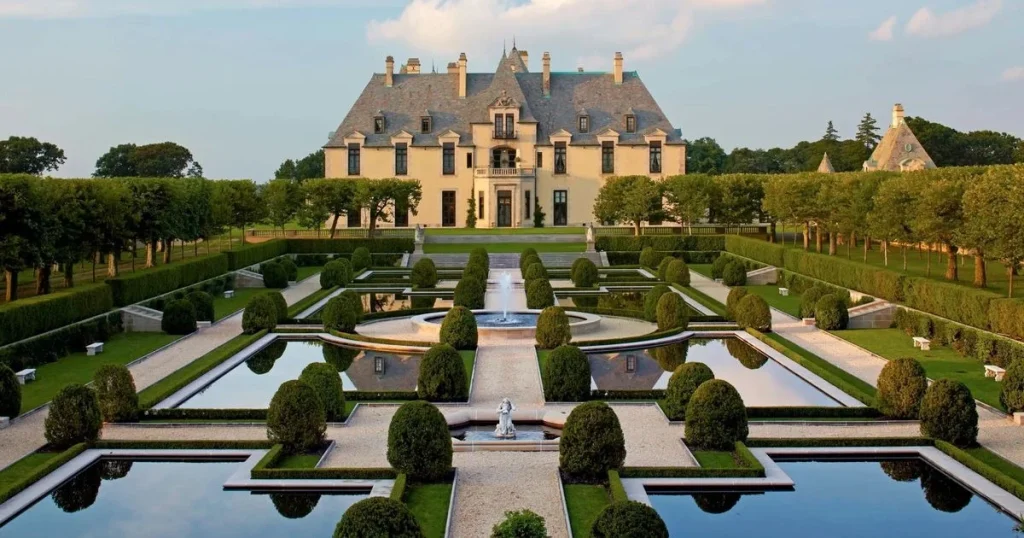
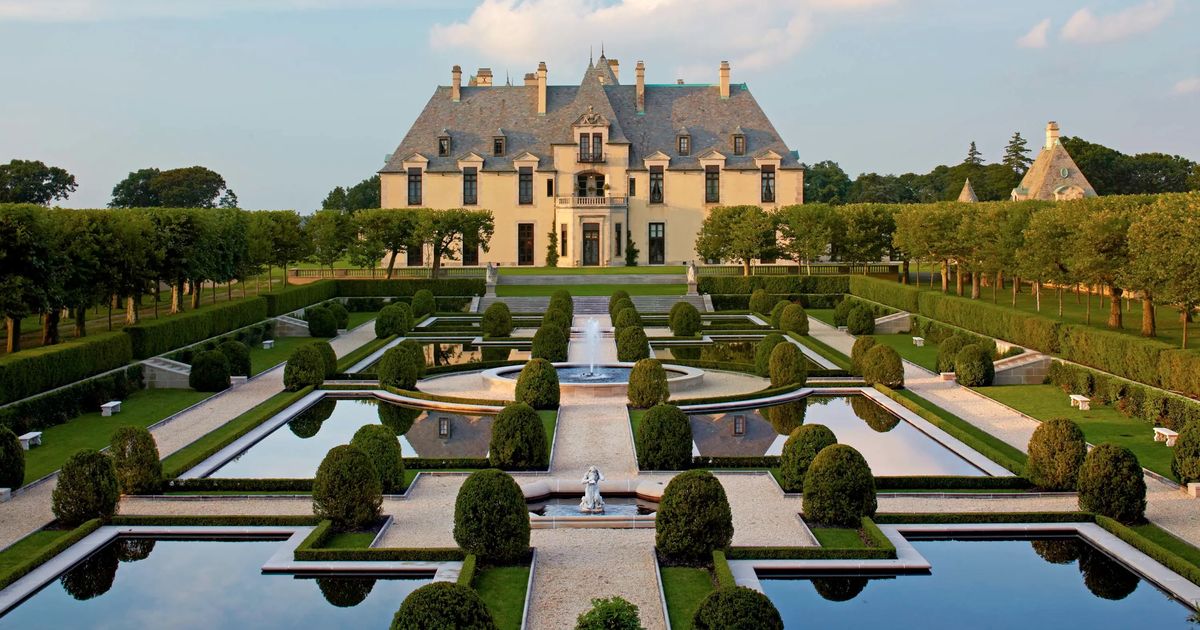
Featuring 127 rooms, a 72-foot-long ballroom, 110,000 square feet of interior space, and nine reflecting pools, the historic estate is heading to the auction block without a minimum bid. The property is scheduled to be auctioned on October 27 through Concierge Auctions, with high-profile broker Adam Modlin of the Modlin Group handling the offering alongside the auction house.
The forced sale follows bankruptcy proceedings initiated by developer Gary Melius, who spent decades and millions of dollars restoring the monument to Gilded Age excess. Oheka Castle has long occupied a unique space in American culture, serving as the physical embodiment of unbridled wealth, architectural ambition, and historic preservation drama. Over the past century, it has functioned not only as a private home, but also as a military training compound, a boarding school, retirement housing for municipal workers, a luxury hotel, and a ubiquitous backdrop for high-society weddings, political media events, and pop-culture phenomena.
The estate’s cultural footprint is vast. It famously stood in for Xanadu in Orson Welles’s cinematic masterpiece Citizen Kane, hosted Taylor Swift in jodhpurs for her high-budget “Blank Space” music video, and provided the dramatic setting for the wedding of Huma Abedin and Anthony Weiner. More recently, television viewers recognized its cavernous interiors and grand staircases in episodes of the hit HBO series Succession, where it anchored the tense corporate-retreat scene featuring the infamous “boar on the floor” exercise.
Beneath its glamorous modern associations lies a history defined by ambition, social exclusion, and political maneuvering. The estate was constructed on the eve of the Jazz Age by Otto Kahn, a German-born investment banker and financier who immigrated to the United States and rose to prominence as a partner at Kuhn, Loeb & Co. Kahn was a towering figure in New York society, known as a passionate patron of the arts and a financial savior of the Metropolitan Opera.
Despite his immense wealth and cultural contributions, Kahn faced severe antisemitism from the established American elite, most notably being blocked from joining exclusive country clubs. Refused entry into the inner sanctums of high society, Kahn decided to build his own equivalent. He purchased massive acreage on the highest point of Long Island’s North Shore in Cold Spring Harbor and commissioned the renowned architectural firm Delano & Aldrich to design a sprawling, European-style palace.
Kahn engaged in a direct architectural rivalry with the Vanderbilts to construct the largest private home in the United States, though Cornelius Vanderbilt II’s sprawling Biltmore estate in Asheville, North Carolina, ultimately won the title by a narrow margin. The estate was named “Oheka” as an acronym derived from Otto Hermann Kahn’s name.
The grounds of the estate were originally designed by the legendary Olmsted brothers, the landscape architecture firm founded by the sons of Frederick Law Olmsted. The formal gardens featured meticulous hedges, geometric pathways, and nine reflecting pools that mirrored the grandeur of European royalty.
Kahn’s estate also nearly fell victim to the aggressive infrastructure projects of master builder Robert Moses. When Moses sought to run the Northern State Parkway directly through the property, Kahn allegedly intervened by paying off the powerful bureaucrat to reroute the highway. A sharp, unnatural curve in the parkway remained the only visible evidence of the financial negotiation until historian Robert Caro uncovered the lurid tale decades later in his definitive biography of Moses.
Otto Kahn died in 1934, and just five years later, his heirs unloaded the estate. Thus began a fragmented and tumultuous chapter in the castle’s history. Over the subsequent decades, the grand residence was sliced up and repurposed to serve various institutional needs. It operated as a training compound for the Merchant Marine during World War II, later served as a military academy, and eventually became a sanitarium and retirement residence for sanitation workers from New York City. During these decades of institutional neglect and piecemeal alteration, the once-glorious interiors suffered from vandalism, fire damage, and general decay. By the early 1980s, the property was abandoned, overgrown, and seemingly destined for demolition.
The modern era of Oheka Castle began in 1984, when developer Gary Melius purchased the derelict estate and embarked on what is widely considered one of the most expensive private restorations in U.S. history. Overcoming staggering structural challenges, Melius poured an estimated $40 million into reviving the property. Artisans painstakingly restored hand-painted faux bois wood graining on the library walls, repaired the soaring plaster ceilings, and replanted the historic gardens based on original Olmsted blueprints.
To make the massive upkeep financially viable, Melius transformed the castle into a luxury hotel featuring 34 guest suites, a restaurant, a bar, and banquet rooms. It quickly became one of the premier wedding venues in the Northeast, hosting hundreds of lavish ceremonies each year. For couples vying for a date in the sprawling ballroom, the venue commanded staggering fees, with quotes reaching $150,000 for peak weekend bookings.
Despite its success as a hospitality and events venue, maintaining an 110,000-square-foot palace proved to be an immense financial burden. Melius attempted to generate additional revenue and offset maintenance costs by securing approval from the Town of Huntington to subdivide five acres of the estate’s land to construct 95 luxury condominiums. According to listing details from Adam Modlin’s team, the upcoming auction will include this valuable development lot alongside the primary castle structure.
The auction places Oheka Castle in the hands of a luxury brokerage team accustomed to moving ultra-high-end, historically significant properties. Adam Modlin has previously handled some of the most sensitive and high-profile real estate transactions in New York City, including finding a buyer for Jeffrey Epstein’s notorious Upper East Side townhouse and negotiating a $47 million deal for Ronald Perelman’s expansive townhouse after it sat on the market for six years.
Yet, Oheka Castle dwarfs those urban properties in both scale and historical weight. Modlin has described the estate on social media as a "real-life Gatsby estate," noting its status as a direct inspiration for F. Scott Fitzgerald’s legendary novel The Great Gatsby, which captured the reckless opulence and architectural grandeur of Long Island’s North Shore during the same era.
The upcoming auction presents a rare opportunity for a buyer with deep pockets and a vision for the property’s future. The winning bidder could choose to continue operating the estate as an exclusive luxury hotel and wedding destination, expand its commercial capacity, or embark on another near-bottomless financial investment to transform the historic landmark back into a private residential palace. Alternatively, the new owner may move forward with the approved subdivision plans to develop the attached condominium parcels, altering the footprint of the historic estate for the first time in modern history.
As the October 27 auction date approaches, the future of Long Island’s grandest architectural monument remains open-ended, marking the end of one tumultuous chapter for a property that has weathered decades of shifting fortunes, social change, and pop-culture fame.