PARIS — The world of international art and culture found itself on high alert this week as widespread civil unrest, nationwide protests against social inequality, and violent clashes with law enforcement rippled across France, casting a heavy shadow over the launch of Art Basel Paris.
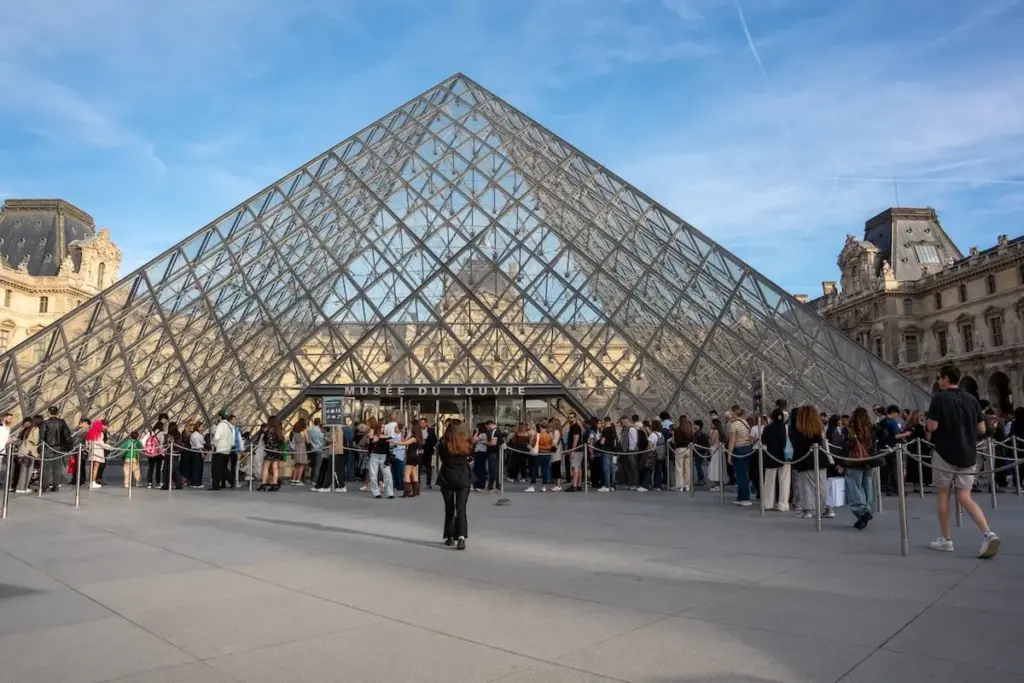
The cascading crisis reached the doorstep of the city’s most famous cultural institutions on Monday, when roughly 50 protesting arts and culture students converged on the Louvre, temporarily blocking access to its iconic glass pyramid entrance. The demonstration fell on the exact one-year anniversary of a brazen, high-profile jewelry heist at the world-renowned museum.
While the protesters were ultimately unable to breach the structure and no structural damage or security breaches were reported at the Louvre, the museum’s official website posted a stark advisory noting that, due to ongoing student strikes, the facility was temporarily closed to the public. According to reports from the Agence France-Presse (AFP), the demonstrators—who included students from affiliated institutions such as the École du Louvre—gathered to express intense anger over the heavy-handed police response to demonstrations in recent weeks. They also sought to voice solidarity with students and citizens demanding sweeping improvements to public school conditions and relief from the spiraling cost of living.
The dramatic scenes at the Louvre were part of a broader wave of turmoil that began with massive, nationwide demonstrations on Saturday. What started as organized protests against mounting social inequalities—particularly visible within the country’s public education system—quickly spiraled into violent street clashes with police, widespread rioting, and chaotic scenes that continued to a lesser degree into Sunday evening.
Authorities estimated that over 500,000 people gathered in city centers across France during the height of the weekend demonstrations. In the chaos, thousands of shops were looted on the sidelines of the protests, while public buildings, including a historic 19th-century town hall in Limoges, suffered severe fire damage. Police and security forces struggled to contain the multi-front disorder, leading to nearly 2,400 arrests nationwide.
The breakdown in public order prompted a profound political crisis. France’s interior minister publicly conceded that law enforcement had entirely "lost control" of certain urban areas during the peak of the riots and subsequently offered to resign. However, French President Emmanuel Macron rejected the resignation, vowing instead to implement swift, severe repercussions for looters and ordering a comprehensive review of police operational methods. Meanwhile, Prime Minister Sébastien Lecornu announced that the government was prepared to institute local curfews as early as Monday night to protect commercial districts from further plunder.
For the international art community, the timing could not have been more precarious, arriving directly on the eve of Art Basel Paris. The convergence of transit disruptions, closed streets, shuttered subway lines, and violent skirmishes involving tear gas and burning barricades transformed the French capital into a logistical maze for collectors, curators, dealers, and artists arriving from around the globe.
In response to the escalating crisis, organizers of Art Basel issued a formal statement on Sunday afternoon aimed at calming anxious international visitors and exhibitors. The fair reassured stakeholders that the event was "proceeding as planned" and detailed a significant scale-up of security measures. Organizers confirmed that additional security personnel had been deployed to patrol the perimeter of the fairgrounds on a 24-hour basis.
This expanded deployment supplements what fair representatives described as extensive protocols already in place to guarantee the safety of all guests, exhibitors, and staff, alongside the absolute security of the priceless artworks on display. These precautions include the installation of heavy anti-ram barriers surrounding the Grand Palais and rigorous, thorough security screening protocols for all incoming visitors. The fair emphasized that it is coordinating closely with a private security firm and the Paris police department wherever necessary.
Despite the heavy atmosphere, the broader Parisian art scene attempted to press forward over the weekend. Most gallery openings and scheduled cultural events went ahead, albeit under exceedingly difficult circumstances. Many attendees found themselves navigating thick clouds of tear gas and smoke from street barricades just to reach gallery doors. Faced with transportation shutdowns and safety concerns, numerous visitors opted to hire private cars to navigate the city, while a notable wave of hotel reservations was canceled.
Several prominent institutions chose to shut their doors preemptively to safeguard staff and the public. At the Jeu de Paume, the highly anticipated opening of Stan Douglas’s exhibition Parallax was canceled on Sunday out of an abundance of caution, particularly because the surrounding Tuileries gardens were closed by authorities for the same safety reasons, a museum spokesperson told ARTnews. Similarly, Hauser & Wirth closed its gallery space in the fashionable 8th arrondissement on Saturday, with a representative explaining in an email that the closure was enacted to protect the team, visitors, and staff.
Elsewhere in the city, however, resilience prevailed among art crowds. At the Marian Goodman Gallery in the Marais, an exhibition opened featuring a compelling new film by Bruce Nauman and Tacita Dean. Despite having to navigate burning barricades and breathe in residual tear gas, the majority of invited guests managed to arrive for the opening dinner. During the gathering, Dean publicly thanked attendees for braving the hazardous conditions to show their support.
The festive spirit inside, however, stood in stark contrast to the chaos unfolding just outside. Later that same night, journalists witnessed adult male looters bolting from shops along rue du Temple in the Marais, their arms laden with stolen merchandise as law enforcement stretched thin across the city.
The juxtaposition of high culture and urban unrest was a recurring theme throughout the weekend’s events. At the Sunday night opening of Jenny Holzer’s major exhibition at the Musée d’Orsay, titled J’ai Vue (I Saw), guests mingled and discussed both their harrowing personal journeys through the protests and the striking timeliness of Holzer’s conceptual work, which directly confronts global conflict. (Holzer herself was unable to attend in person due to illness.)
Emerging artists and organizers also grappled with the surreal reality of mounting exhibitions amid civil strife. Artist Kendalle Getty noted that the process of preparing her new exhibition, L’Identification Avec L’Autre (Identification with the Other), located on rue Bleue in the 9th arrondissement, was severely hampered by weeks of disruptions tied to the ongoing student movement. Beyond the logistical hurdles, Getty admitted she now harbored deep concerns that her large-scale mirror works—which were directly inspired by the legendary Hall of Mirrors at Versailles—might be vulnerable to opportunistic looting if the disorder spread further.
Shauna Torres, who coordinated and installed Getty’s exhibition, recalled getting caught directly in a cloud of tear gas on Saturday afternoon. Despite the stressful ordeal, Torres maintained a philosophical and remarkably upbeat perspective on the historic moment unfolding outside the gallery walls.
"We’re living in history," Torres said, "and sometimes that smells like fires and tear gas and champagne, but I’m just happy to be here."
As Paris braces for the days ahead, local residents, cultural leaders, and international visitors alike are looking toward upcoming school holidays in the hope that a break in the academic calendar will help defuse tensions, restore public order, and allow the city to safely host one of the premier events on the global art calendar.