Physicists at the University of Oxford have helped demonstrate that one of quantum physics’ strangest phenomena, quantum entanglement, can persist even among some of the heaviest and shortest-lived particles ever produced. The finding, achieved in collaboration with an international team using CERN’s powerful Large Hadron Collider, has been published in the prestigious journal Physical Review Letters.
Quantum entanglement occurs when two particles share properties in such a way that measurements of one can reveal information about the other, even when the particles are separated by significant distances. This interconnectedness stands as one of the most counterintuitive features of quantum mechanics and has continuously challenged physicists’ and philosophers’ understanding of objective reality for decades.
Albert Einstein famously called the phenomenon "spooky action at a distance," skeptical of the implications of a universe bound by such instantaneous correlations. In the decades since his skepticism, scientists have successfully observed the effect in various controlled systems involving photons, electrons, and trapped ions. Furthermore, entanglement has transitioned from a purely theoretical curiosity into the cornerstone of several emerging technologies, including quantum computers, ultra-secure quantum communication networks, and advanced precision sensors. In the architecture of quantum computing, for example, entanglement allows multiple qubits to be manipulated collectively rather than sequentially, making it possible to carry out complex calculations simultaneously and at unprecedented speeds.
Testing Quantum Entanglement at Extreme Energies
What remained less clear to the scientific community was whether this delicate quantum connection could survive under far more extreme conditions. Specifically, researchers wanted to know if entanglement could persist within the violent, high-energy particle collisions produced at facilities like CERN.
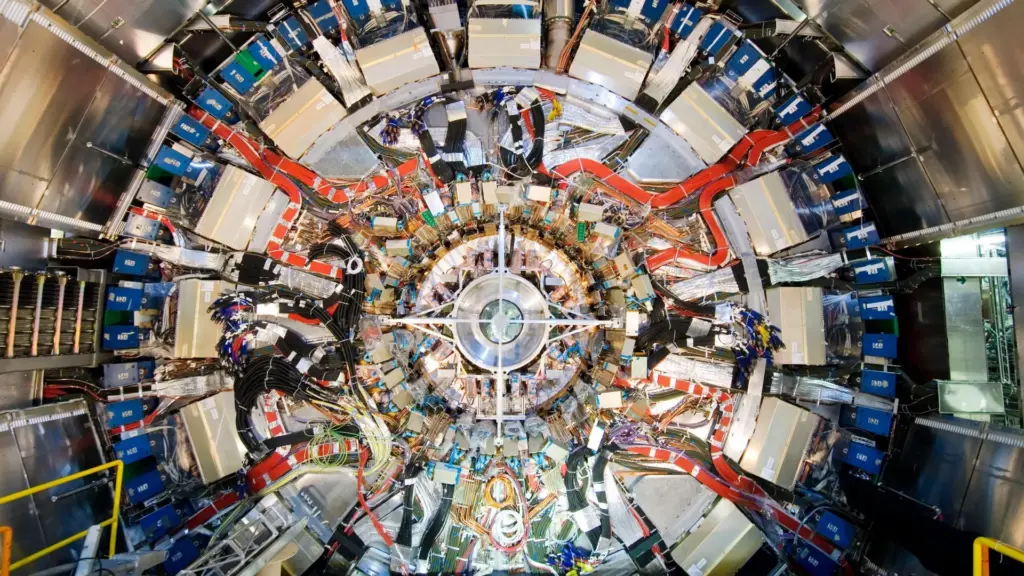
To investigate that question, an international team utilized the ATLAS experiment at CERN’s Large Hadron Collider, situated deep underground near Geneva, Switzerland. Instead of studying photons or other relatively long-lived quantum systems traditionally used in laboratory settings, the researchers searched for entanglement between pairs of Z bosons. These are massive, fundamental particles that exist for only a tiny fraction of a second before decaying into other matter.
The Z bosons examined in the groundbreaking experiment originated from the decay of a Higgs boson, the famous particle discovered at the LHC back in 2012. Under specific collision parameters, a Higgs boson can briefly materialize and then decay into two Z bosons, which in turn rapidly decay into pairs of electrons or muons. The Higgs bosons themselves are generated when protons, propelled through the vast accelerator ring, travel at 99.99% the speed of light and smash into one another at colossal energy levels reaching thirteen trillion electron volts.
Fleeting Z Bosons Leave Quantum Clues Behind
Although Z bosons disappear almost immediately after they are created, vanishing into decay products almost as fast as they form, the massive ATLAS detector is capable of tracking and accurately measuring the electrons and muons produced by their dissolution.
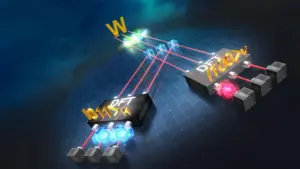
Researchers analyzed the precise spatial angles at which those resulting particles emerged from the collision point. By working backward from this trajectory data, the team was able to reconstruct the spins of the original Z bosons. That sophisticated mathematical reconstruction allowed the team to determine whether the two parent Z bosons displayed the precise correlations expected from quantum entanglement.
The resulting measurements provided strong evidence that they did. This landmark result represents one of the highest energy confirmations of quantum entanglement ever achieved in experimental physics, pushing the boundaries of where and how this quantum property can be observed.
Study co-author Professor Alan Barr, a researcher at Oxford’s Department of Physics, was among the first scientists to suggest that high-energy particle colliders could be successfully deployed to investigate quantum entanglement at energy scales far beyond those utilized in traditional, low-energy quantum optics experiments.
Professor Barr, who was directly involved in the monumental effort to build the LHC, recognized long ago that the enormous subterranean collider could serve scientific purposes far beyond the standard search for new fundamental particles. His visionary theoretical concepts helped inspire a preceding 2023 ATLAS experiment that successfully demonstrated entanglement between pairs of top quarks, which hold the distinction of being the heaviest known elementary particles in the universe.
Reflecting on the broader implications of the new findings, Professor Barr said: "We’re used to thinking of entanglement as something delicate, seen in laboratory experiments with single photons. Finding it alive and well among particles as heavy and short-lived as Z bosons, created in some of the most violent collisions we can produce on Earth, shows just how fundamental and robust this quantum effect really is. It’s a nice reminder that the same strange rules of quantum mechanics that may one day power quantum computers are at work everywhere in nature, even at the extreme energies of the Large Hadron Collider."
Quantum Computing Ideas Meet Particle Physics
The work forms a critical part of a broader, ongoing scientific effort to integrate concepts originating from quantum information science—the multidisciplinary field powering the development of quantum computing—into the domain of high-energy particle physics.
By applying theoretical ideas originally developed for delicate quantum systems to the enormous, complex data sets produced by high-energy particle colliders, researchers hope to forge more sensitive ways of detecting subtle patterns in subatomic debris. Those innovative analytical techniques could eventually reveal hidden physical effects that do not fit neatly within physicists’ current theoretical framework of the universe, potentially offering vital clues about physics beyond existing models, such as dark matter or supersymmetric particles.
At Oxford University, Professor Barr co-leads a major interdisciplinary project focused explicitly on exploring the foundational principles of quantum mechanics at high energies. The project is actively testing quantum behavior at extremely small spatial scales and extraordinarily high energy thresholds, while simultaneously examining the profound philosophical questions raised by such experiments, including what these observations may ultimately reveal about the underlying nature of reality itself.
Weighing in on the collaborative nature of the initiative, project co-Principal Investigator Professor Chris Timpson from Oxford’s Faculty of Philosophy noted: "Entanglement is both the most promising and the most puzzling aspect of quantum reality; these collider experiments detecting entanglement present a new frontier in investigations of the foundations of quantum mechanics."
CERN Prepares for Even Deeper Quantum Tests
Looking toward the future, scientists at the University of Oxford are also actively contributing to the ongoing, comprehensive upgrade of the ATLAS detector infrastructure. Coupled with CERN’s upcoming High-Luminosity Large Hadron Collider, these technological improvements are expected to deliver vastly larger data sets to researchers worldwide. This influx of data will give physicists unprecedented new opportunities to investigate quantum phenomena under even more extreme energetic conditions.
The anticipated accumulation of additional data could also empower researchers to apply increasingly sophisticated quantum information and machine-learning techniques to particle physics data analysis, potentially driving a significant increase in the sensitivity of future searches for previously unknown subatomic phenomena.
Highlighting the institution’s ongoing commitment to fundamental research, Professor Daniela Bortoletto of the Department of Physics at the University of Oxford, who serves as the UK coordinator for producing the silicon modules for the upgraded ATLAS detector’s pixel system, emphasized the collaborative success behind the milestone.
"This measurement demonstrates the scientific power of the ATLAS collaboration and the unique capabilities of CERN’s Large Hadron Collider," Professor Bortoletto said. "Oxford researchers have played a leading role in developing these new approaches to studying quantum phenomena at the highest energies, and we are proud to contribute to an international effort that is opening new ways to explore the fundamental laws of nature."
The comprehensive study, titled "Measurements of Z-boson pair entanglement in decays of Higgs bosons at the ATLAS experiment," has been published in Physical Review Letters.