The groundbreaking work, which was published on September 23 in Nature Physics, illustrates how trapped-ion quantum computers are rapidly evolving into powerful instruments capable of probing some of the most profound and elusive questions in fundamental physics. By orchestrating a controlled simulation of string breaking—a complex physical process in which two connected fundamental building blocks of matter are pulled apart until accumulated energy sparks the spontaneous creation of new particles—the researchers have opened a fresh window into the subatomic realm.
"Quantum computer simulations provide the best platform to investigate complex questions like matter formation, short of having witnessed the Big Bang itself," said Christopher Monroe, the Gilhuly Family Presidential Distinguished Professor of Electrical and Computer Engineering and Physics at Duke University, who led the research initiative. "These findings signal a marked development in the quantum science field and open new avenues for us to understand string-breaking dynamics."
The study was born from a broad international collaboration that united researchers from the University of Maryland (UMD), Oxford University, the California Institute of Technology, Cornell University, and KU Leuven. Intriguingly, these findings appeared alongside two other independently published studies from separate research teams that successfully reproduced similar physical phenomena using entirely different types of quantum computing hardware, signaling a synchronized leap forward across the broader quantum computing landscape.
Why Quarks Cannot Simply Be Pulled Apart
To understand the significance of the experiment, one must look at the behavior of quarks, which rank among the most fundamental known building blocks of matter. Residing deep inside composite particles such as protons and neutrons, quarks are roughly a billion times smaller than a standard atom. Under normal physical conditions, scientists cannot directly observe isolated quarks because they stubbornly remain tightly bound together by the strong force, a phenomenon known in physics as quark confinement.
A useful, intuitive way to picture this subatomic confinement is to imagine two tiny charged particles connected to one another by a tightly stretched elastic string. As these two particles are pulled farther and farther apart, the physical distance grows, and a tremendous amount of tension—and consequently energy—is stored directly within the invisible connection linking them.
Eventually, this stretching reaches a critical threshold. Rather than snapping cleanly with the energy dissipating into empty space, the accumulated energy becomes so dense that, in accordance with Albert Einstein’s famous mass-energy equivalence equation, $E=mc^2$, new matter condenses out of the vacuum. New particle-antiparticle pairs effectively pop into existence, snapping the original connection and leaving behind newly formed pairs rather than isolated constituents.
In nature, such dramatic processes require astronomical amounts of energy and normally occur only under the most extreme conditions imaginable. These include the ferocious environments generated inside high-energy particle accelerators like the Large Hadron Collider, or the blistering primordial temperatures and pressures believed to have existed mere fractions of a second after the Big Bang. Recreating and studying these dynamics in a controlled laboratory setting has long presented an immense challenge for experimental physicists.
Recreating String Breaking in a Quantum Machine
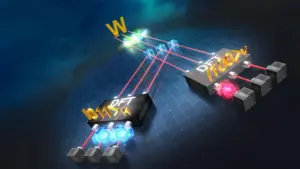
To circumvent the limitations of observing these fleeting events in nature or high-energy colliders, the Duke-led team turned to a trapped-ion quantum platform to reproduce analogous string-breaking behavior. Quantum simulators are uniquely tailored for this kind of advanced scientific exploration because they afford researchers unprecedented, precise control over their internal parameters. This enables scientists to program the systems to imitate complex physical processes that naturally occur at atomic and subatomic scales, translating abstract theoretical models into observable laboratory phenomena.
"Working at the intersection of quantum simulation and high-energy physics is incredibly exciting," said Arinjoy De, the first author on the paper, a former PhD student in Monroe’s lab, and currently the production machine lead at QuEra Computing. "By simulating quark confinement and string-breaking phenomena in a controlled lab environment, we’re opening up new pathways for experimental investigations into the behavior of matter at its most fundamental level."
To construct the simulation, the researchers systematically encoded a theoretical string-breaking model into a linear chain of 13 individual trapped ions. By utilizing carefully calibrated and modulated laser beams, the team adjusted the quantum states and interactions among the ions with extreme precision. These meticulously tuned interactions allowed the researchers to govern the system’s internal energy in a manner that closely mirrored the stretching, tension accumulation, and eventual breaking of a particle-like string.
Watching the Quantum System Evolve
Once the quantum simulator was properly configured, the researchers prepared the system in a deliberate out-of-equilibrium state and meticulously tracked how it evolved and changed over time. This temporal observation enabled them to detect the emergence of effective charges within the system and successfully reconstruct the complex dynamics associated with the simulated string-breaking process.
To rigorously verify the validity of their experimental data, the team also modeled the identical physical process using a classical computer. The results produced by the classical calculations showed strong agreement with the experimental data generated by the quantum simulator, confirming that the quantum device had accurately captured the targeted physics.
While classical computers are still fully capable of performing these calculations for simulations operating at this relatively modest scale, the researchers anticipate a future threshold. As future experiments scale up in size and complexity, quantum computers will inevitably reach a domain where they can solve critical versions of these high-energy physics problems that entirely outstrip the capabilities of classical machines.
The trapped-ion achievement arrives alongside similar milestones reached by other prominent research groups utilizing alternative hardware architectures. Teams led by Google and QuEra Computing recently succeeded in recreating related string-breaking models using superconducting circuits and neutral atoms, respectively. Because each of these hardware paradigms comes with its own unique set of strengths and operational limitations, the concurrent successes offer valuable comparative metrics for the scientific community.
"These are the three platforms leading the charge in quantum computing, so it’s a nice benchmark and comparison for the quantum community," Monroe noted.
Toward Simulations Beyond Supercomputers
The successful trapped-ion simulation represents another vital step forward on the path toward quantum simulations that transcend the limits of even the world’s most powerful conventional supercomputers. As quantum systems continue to scale up in qubit count and fidelity, researchers hope to eventually deploy them to investigate questions that remain exceptionally difficult or fundamentally impossible to reproduce directly in standard laboratory environments. This includes shedding light on the enigmatic ways matter behaved and evolved shortly after the birth of the universe.
"As a physicist, it is incredibly exciting to investigate the conditions of the early universe in an atomic-level computing machine," said Zohreh Davoudi, an associate professor of physics at the University of Maryland who was part of the collaborative research team. "Even the slightest insights from an out-of-equilibrium physics model will guide us in the future."
The research was supported by funding from the Department of Energy under grant numbers DE-SC0020312, DE-SC0025341, DE-SC0019040, DE-SC0024220, and DE-SC0020271, as well as the National Science Foundation under grant OMA-2120757. Additional support was provided by the Air Force Office of Scientific Research, the Defense Advanced Research Projects Agency, and Amazon Web Services.