The announcement of his passing was made public by El Museo del Barrio, the prominent New York museum that played a pivotal role in cementing his legacy later in his life. In a statement released following his death, the museum commemorated Ferrer as “a groundbreaking artist whose singular and influential practice challenged boundaries” across a vast and eclectic range of disciplines. Throughout his long and storied life, Ferrer defied easy categorization, shifting fluidly between avant-garde conceptual art, process art, assemblage sculpture, and expressive painting, all while maintaining an artistic philosophy deeply rooted in the improvisational spirit of jazz.
Long before he gained renown in the international visual arts community, Ferrer’s creative life began behind a drum kit. He initially worked as a jazz drummer, an experience that would indelibly shape his psyche and his overarching approach to creativity. His transition into the visual arts was sparked in 1954 during a transformative trip to Paris, where he encountered the works, ideas, and personalities of Surrealist artists and writers. Inspired by this exposure, Ferrer returned to his native Puerto Rico and pursued formal studies in painting under the exiled Spanish Surrealist artist Eugenio Fernández Granell at the University of Puerto Rico.
Despite his formal training in painting, musical improvisation remained a defining, guiding influence throughout his artistic journey. Ferrer’s practice was remarkably unusual in its sheer diversity of styles, mediums, and materials. Refusing to be boxed into a single aesthetic or medium, his work spanned a massive spectrum, moving effortlessly from conceptual installations to intricate assemblage sculptures and vibrant paintings.
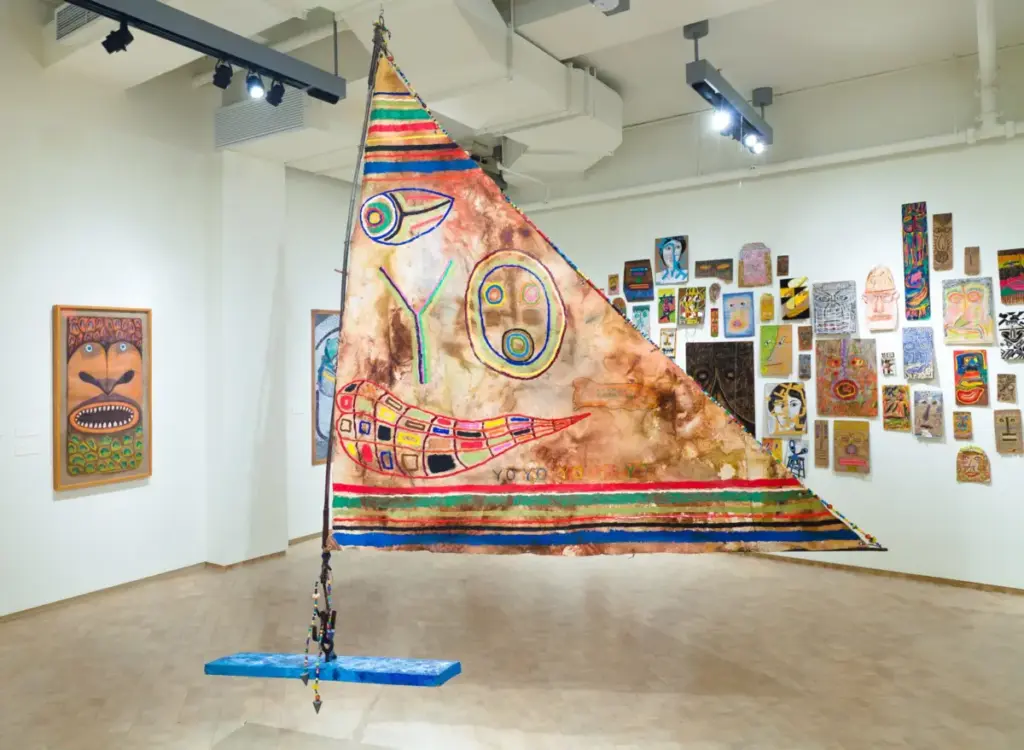
His choice of canvas and material was equally iconoclastic. Ferrer famously utilized humble, everyday, and discarded materials, turning paper bags and blackboards into canvases. He incorporated calabash gourds and garbage can lids into hanging, Dada-inspired sculptures. For his ambitious installations, he bypassed traditional art supplies in favor of organic and ephemeral materials such as straw, dried leaves, and even ice. This radical embrace of unconventional materials established him as a major figure in the Process art and conceptual movements of the 1960s and 1970s, earning him critical acclaim and a reputation as a fearless avant-garde innovator, particularly in Puerto Rico and through exhibitions at major mainland institutions like the Whitney Museum of American Art.
One of the most famous breakthroughs leading into that period of acclaim occurred in 1968, when Ferrer executed a memorable guerrilla action. Demonstrating his penchant for anti-establishment interventions, he loaded 87 bushels of autumn leaves into a pickup truck, drove them from Philadelphia to New York, and scattered them directly in front of major art institutions.
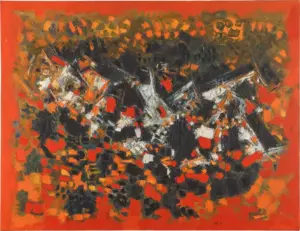
However, the unusual variety inherent to his practice and his refusal to remain static would eventually create friction with the traditional art world. This constant reinvention became a source of confusion for a critical art market that historically favored predictability and branding. Beginning in the 1980s, when Ferrer shifted gears and returned to painting—often working in a faux naïve, modern expressionist style—his career noticeably quieted. The art market, accustomed to artists producing a signature, easily identifiable product, struggled to keep pace with an artist who viewed stylistic consistency as anathema to true creativity.
Ferrer was acutely aware of how the art world and the market reacted to his stylistic evolution. Reflecting on this dynamic in a 2013 interview with The Brooklyn Rail, he offered a sharp critique of commercial expectations. “The psychology of the art world and the art market are so ingrained with repetition, making a steady, absolutely, consistently identifiable product much like the auto industry,” Ferrer said. “That has never been the impetus of my work. I have always believed that the doing is what is exciting. My earlier life as a musician created in my psyche a sense that what you do is dictated by the needs of the moment, all within a repertoire.”
Despite the market’s temporary confusion and the years his career spent being overlooked, Ferrer’s work always possessed a clear, conceptual through-line. As he explained in the same interview, his return to painting was never a departure from his core inquiries, but rather a continuation of them. “When I returned to painting, believe me, those paintings were all about spaces—my attraction to odd spaces with weird light and strange people,” he noted.
These portraits of “strange people,” whom he also affectionately referred to as his neighbors, were born out of genuine human connection. Describing his process, Ferrer explained that “there is a mutual curiosity expressed in conversation, a back and forth I have with them.” He added, reflecting on his perpetual need for artistic stimulation, “The most problematic thing is familiarity. If I’m totally familiar with something, it’s no longer interesting.”
Fortunately, neither art nor music ever grew too familiar to him. Throughout his life, he continued to paint while listening to records, finding endless nourishment in the two disciplines. “Curiously, when I look at art or when I listen to music, I never seem to exhaust the endless revelations that make both things a continual source of inspiration,” he observed.
The art world’s long-standing oversight of his career was belatedly corrected in 2010, when El Museo del Barrio mounted a major solo museum retrospective. Titled “Retro/Active: The Work of Rafael Ferrer,” the comprehensive exhibition featured approximately 100 works that surveyed Ferrer’s dynamic practice across five decades. The exhibition brought much-deserved, long-overdue attention to his monumental life’s work. In a review for The New York Times, critic Roberta Smith famously declared that the retrospective was “almost criminally overdue.”
The success of the El Museo del Barrio exhibition opened the floodgates for a succession of additional solo exhibitions that re-established his prominent place in contemporary art history. These included celebrated shows at Guild Hall in East Hampton in 2011, the Lancaster Museum of Art in 2012, and the Museum of Contemporary Art Chicago in 2015.
Over the course of his illustrious career, Ferrer’s contributions to contemporary art were recognized with prestigious accolades, including a Guggenheim Fellowship in 1975 and a Pew Fellowship in the Arts in 1993. Today, his visionary works are held in the permanent collections of major museums and cultural institutions around the world, securing the legacy of an artist who steadfastly refused to stand still.