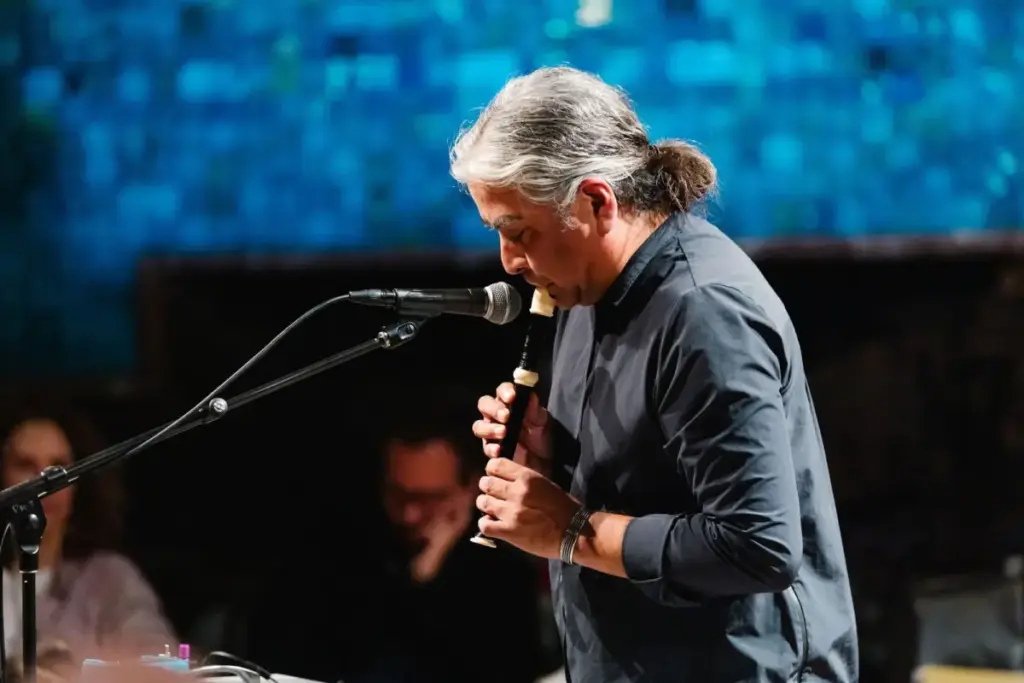
On a crisp October evening in Manhattan, the ornate and historic Veterans Room at the Park Avenue Armory transformed into an intimate laboratory of sound, memory, and geography. At the center of the room sat an unassuming table covered in an eclectic array of noise-making objects: sound mixers, synthesizers, looping pedals, speakers, whistles, a turkey call, and a ceramic horn. This deliberately curated collection of instruments served as the physical stage for Raven Chacon, the prolific Diné composer, performer, and visual artist, during his hour-long improvisation sessions for the Armory’s prestigious 2026 Artists Studio series.
For audiences attending the performances on Wednesday and Thursday nights, the intimate setting offered a rare, unfiltered opportunity to watch the Pulitzer Prize-winning artist at work, manipulating soundscapes in real time. Chacon’s October 8 performance, in particular, showcased his distinct ability to use everyday and unconventional objects to elicit surprising, deeply atmospheric, and frequently discomfiting sonic reactions.
Throughout the hour, Chacon moved fluidly between electronic manipulation and acoustic intervention. At one point, he rigorously blew a whistle directly into a microphone, capturing the breathy vibration, looping it live, and layering it atop a slowly rising, hypnotic electronic drone. He would intermittently cut the drone to make space for the isolated electronic transmission of the breath he had recorded just moments earlier.
As the performance evolved, Chacon began mixing sharp, piercing screeches over the steady cadence of the whistles. Gradually, he transformed these discordant noises into an oscillating, metallic hum that felt startlingly redolent of extraterrestrial signals broadcast in a classic science fiction film. Yet, whenever the composition threatened to drift too far into purely speculative or ethereal abstraction, Chacon possessed a remarkable knack for snapping the audience back to reality. He anchored the avant-garde performance with clear, occasionally frightening sonic reminders of the tangible world existing just beyond the walls of the armory.

The climax of the session came when Chacon concluded by playing field recordings of howling wind through a hyperdirectional speaker. Rather than leaving the speaker stationary, he physically carried it, moving in a deliberate circle around himself. With each slow turn, he swept the sound of the wind across a different quadrant of the Veterans Room. In doing so, he transmitted the vast geography of alternative worlds—landscapes vastly less violent than those sounded by the aggressive rush of cars blaring up and down Park Avenue immediately outside the building’s historic facade. Yet, as Chacon’s performance subtly argued, the continued existence of those quieter, alternative worlds depends entirely upon our willingness to pause and choose to listen.
Speaking over the phone between his rigorous performance schedule at the Armory, Chacon reflected on the complex role of location in his work, his intentional repurposing of tools and materials historically associated with colonial violence, and his ongoing turn toward science fiction themes for an upcoming, highly anticipated exhibition at the San Francisco Museum of Modern Art.
When asked about how site-specificity operates within an entirely improvised format, particularly given his recent work incorporating local naturalist histories and Lenape culture in New York, Chacon laughed, admitting the limits of strict geographical synchronization.
"I wish I could say I was responding to the Armory," Chacon noted. "When I’m playing in the city, I tend to bring in more field recordings of the outdoors, of wind and other sounds from other places. A lot of these were gathered where I’m from in New Mexico. While not site-specific to the Armory in this case, I find myself incorporating those more indoors, amongst the other things that encroach upon the interior of the space. It’s unavoidable that we might hear sirens and traffic outside, and those usually become part of the soundtrack of what I’m working with."
The interplay between indoor performance spaces and exterior urban environments creates a dynamic tension that shifts depending on the host city. Reviewers of Chacon’s broader exhibition history have frequently noted how his sonic interventions absorb local geologic and cultural anxieties. For instance, a recent group exhibition at the Hammer Museum featured a sound piece by Chacon that a critic likened to a "California earthquake"—a specific, seismic resonance and cultural weight inherently tied to the West Coast, and one that carries an entirely different valence than the sounds produced in Manhattan.
Discussing that particular installation, Chacon explained that the geographic and physical context was an intentional consideration from the outset. The installation was situated strategically at the entry point of the gallery, immediately greeting visitors who were simultaneously encountering works by artists like Edgar Calel and Ana Mendieta—creators whose practices deeply engage with soil, earth, and physical ground.
"I wanted to reference that with that piece," Chacon said, describing his desire to sonically echo the foundational materials present in the gallery. As viewers moved deeper through the exhibition, they encountered varied interactions with different physical materials and visual concepts, creating a cohesive dialogue between the visual arts and Chacon’s immersive acoustic interventions.
Through his performances at the Park Avenue Armory, Chacon once again demonstrated his mastery over sound as both a physical medium and a historical record. By weaving together the natural winds of the American Southwest, the mechanical hum of synthesizers, and the unavoidable intrusion of New York City traffic, the Diné artist created a temporary sanctuary within the Veterans Room—a space where listeners were invited to confront the history of the land, the noise of the modern metropolis, and the quiet possibility of alternative futures.