VIENNA — After decades of painstaking research and theoretical development, an international scientific collaboration has achieved a major milestone in the quest to build an entirely new paradigm of timekeeping. A research team anchored in Vienna has successfully developed and demonstrated the world’s first self-stabilizing nuclear clock, a groundbreaking device that could eventually eclipse the precision of today’s most advanced atomic clocks and transform the field of metrology.
Unlike earlier conceptual prototypes and traditional laboratory setups, the newly engineered nuclear clock maintains its own stability autonomously, without relying on an external, conventional atomic clock for correction. In initial demonstrations, researchers proved that the system can operate steadily and independently for more than 24 hours without human intervention or external calibration adjustments.
This achievement represents a monumental leap forward in precision measurement. By harnessing atomic nuclei instead of electron clouds as exceptionally stable frequency references, nuclear clocks hold the ultimate potential to allow scientists to measure time, space, and other fundamental physical quantities with levels of accuracy that existing technologies simply cannot reach. The development marks the transition of nuclear clocks from theoretical physics to functional, self-sustaining hardware.
Why Thorium Holds the Key to Nuclear Clocks
The foundation of this breakthrough relies on a uniquely rare and advantageous property of thorium atomic nuclei—a characteristic that physicists have investigated and debated for decades.
In standard atomic physics, atomic nuclei can exist in various distinct energy states, but transitioning between these states typically demands enormous quantities of energy, usually requiring high-energy gamma rays. Thorium, specifically thorium-229, stands as a rare exception to this rule. Within its nucleus, two specific energy states are separated by an unusually small energy gap. This minute gap is small enough that it can be precisely bridged and triggered using laser light, a feat that is generally impossible for the atomic nuclei of almost other elements.
This unique property is crucial because it gives researchers direct optical control over the quantum energy state of a nucleus using standard laser technology. By shining a laser tuned to the exact frequency required to induce the transition, scientists can manipulate the thorium nucleus and utilize this ultra-sharp quantum transition as an impeccably stable reference for measuring time.
The path to this realization has been fraught with technical hurdles. A massive breakthrough came in April 2024, when a team of researchers led by Prof. Thorsten Schumm at the Institute of Atomic and Subatomic Physics at TU Wien, working in close collaboration with a team led by Prof. Ekkehard Peik at the Physikalisch-Technische Bundesanstalt (PTB) in Braunschweig, successfully identified the long-sought nuclear transition experimentally. For the very first time, they demonstrated conclusively that ultraviolet laser beams could directly excite thorium nuclei embedded within a solid material.
Further progress unfolded swiftly in the fall of 2024. Building on their initial excitation, the researchers connected their thorium excitation apparatus to a conventional optical atomic clock. This phase of the research demonstrated that the thorium nuclei could indeed serve as a highly reliable and precise timekeeping reference.
Although this verified the fundamental operational principle of a nuclear clock, one essential capability was still missing before the technology could be considered practical: the ability to maintain its own absolute accuracy and stability independently, without being tethered to a secondary reference clock.
Scientists Build a Nuclear Clock That Stabilizes Itself
"What you really want is a self-stabilizing nuclear clock," explains Prof. Thorsten Schumm, describing the overarching design philosophy of the project. "The basic idea is simple: you have a laser and you have thorium. The laser changes the energy state of the thorium nuclei, and the thorium nuclei are used to stabilize the frequency of the laser."
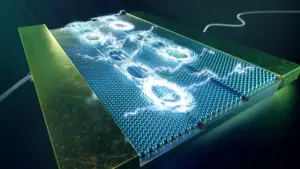
To bring this concept to life, the Vienna researchers engineered a sophisticated system built around a specialized crystal containing a high concentration of thorium atoms, custom-manufactured directly at TU Wien. In this setup, a laser shines continuously onto the crystal, interacting directly with the embedded thorium nuclei.
The fundamental mechanism of any clock relies on a steady, repeating rhythm—in the case of lasers, light oscillating at a particular frequency. However, even the most advanced laser systems are vulnerable to minute environmental disturbances. Tiny shifts in temperature, acoustic vibrations, or subtle pressure changes in the surrounding laboratory environment can interfere with that rhythm, causing the laser’s frequency to drift.
"The oscillation of this laser light can be used for timekeeping, but the laser frequency can shift slightly from time to time, for example due to temperature fluctuations," Prof. Schumm elaborates. "For high-precision measurements, you therefore need a mechanism to keep the laser frequency exactly stable, so that the clock continues to tick with precisely the same rhythm."
Traditional atomic clocks solve this persistent drift problem by using the energy transitions of electrons in atoms—such as cesium or strontium—as a stable external reference to continually correct the laser. The Vienna team has now conclusively demonstrated that the atomic nuclei of thorium atoms can perform this exact same stabilization function, but with vastly superior intrinsic advantages.
The self-regulating feedback mechanism works because thorium nuclei absorb laser light only when that light vibrates at precisely the correct, resonant frequency. If environmental disturbances cause the laser to begin drifting away from that exact frequency, the amount of light absorbed by the thorium nuclei drops noticeably.
The system’s internal sensors detect this fluctuation in absorption and automatically apply a correction to the laser, pulling its frequency back to the precise point of resonance. This continuous, closed-loop feedback keeps the clock operating at a perfectly consistent rate, entirely bypassing the need for a conventional atomic clock to maintain its stability. For the first time in history, scientists have successfully demonstrated a self-regulating nuclear clock that functions autonomously.
A Clock With an Error of Just One Second in 30 Million Years
The extraordinary potential advantage of nuclear clocks stems directly from the fundamental physics of atomic nuclei, which differ vastly from the electron shells utilized in standard atomic clocks.
"The great advantage of the new nuclear clock in Vienna is that, if you use atomic nuclei rather than atoms, much higher precision is possible in principle," notes Prof. Schumm.
To put the scale into perspective, atomic nuclei are more than 10,000 times smaller than entire atoms. Because of their incredibly compact size, they are remarkably insulated from external environmental influences—such as electromagnetic fields, collisions, and stray thermal radiation—that frequently disrupt the delicate electron states used in precise atomic measurements.
This profound resistance to environmental disturbances makes nuclear energy transitions exceptionally promising for the future of ultra-precise timekeeping.
To evaluate the real-world performance of their newly developed prototype, the researchers measured its operational stability and precision over the course of a full day. The nuclear clock achieved a relative precision of approximately $10^-15$, an astonishing metric that is mathematically equivalent to an operational error of roughly one second over a span of 30 million years.
Researchers emphasize that this figure describes the clock’s measured short-term precision and theoretical extrapolation rather than an actual physical test lasting millions of years. Nevertheless, it vividly illustrates the remarkable accuracy that the team has already managed to extract from an early, first-generation prototype.
While this performance is already exceptionally high, the new device is not yet quite as precise as the world’s absolute leading optical atomic clocks, which currently represent the undisputed gold standard for high-performance global timekeeping.
"This is not yet at the level of the world’s best optical atomic clocks, but for a first prototype it is a fantastic result," says Prof. Schumm, contextualizing the achievement within the broader landscape of modern metrology.
The Next Step Toward Even More Precise Timekeeping
Looking ahead, the research team is confident that their newly demonstrated nuclear clock possesses substantial room for technological improvement. By integrating more powerful and stable laser systems, refining optical cavities, and developing even higher-quality thorium-doped crystals, the scientists hope to dramatically increase the precision of the device in the coming years.
These upcoming hardware upgrades and engineering refinements could eventually allow nuclear clocks to decisively outperform existing atomic clocks, establishing an entirely new, higher standard for measuring time on a global scale.
Beyond simply constructing a more accurate clock for standard timekeeping and telecommunications synchronization, the implications of this technology extend deep into fundamental physics. More accurate timekeeping directly translates into more sensitive measurements of other physical quantities, providing physicists with unprecedentedly sharp tools to investigate the fundamental constants of nature, test theories of relativity, and search for elusive phenomena such as dark matter.
For now, the successful demonstration by the Vienna research team proves that a long-pursued scientific theory can operate as a fully functional, self-sustaining timekeeping system. With the world’s first self-stabilizing nuclear clock now up and running independently, researchers have crossed a major threshold toward a future where time can be measured with unprecedented fidelity.