SEOUL — In a breakthrough that could reshape how everyday materials are manufactured, scientists have identified a previously overlooked chemical factor that dictates the success or failure of critical reactions. By exerting precise control over microscopic changes in acidity near electrodes, researchers at Seoul National University dramatically improved the production of valuable chemical ingredients, boosting the proportion of the desired product from a meager 16% to an astonishing 97%.
The achievement, spearheaded by Professor Jaeyune Ryu and his team at the university’s Department of Chemical and Biological Engineering, promises to make chemical manufacturing significantly safer, cleaner, and more efficient. By harnessing oxygen and electricity rather than hazardous external agents, the newly developed method produces essential compounds utilized in the creation of plastics, medicines, adhesives, and a wide array of everyday commercial goods.
At the core of the discovery is a phenomenon known as "local pH"—the distinct acidity or alkalinity that forms within the immediate microscopic surroundings of an electrode. By completely redesigning their chemical reactor to govern the physical distance between electrodes and optimize the flow of liquid through the system, Professor Ryu’s team devised an effective strategy to manage these conditions and elevate the overall performance of the chemical process.
The team’s findings, which focus heavily on the synthesis of two major chemical families known as lactones and epoxides, were recently published in the Journal of the American Chemical Society (JACS), a flagship publication of the American Chemical Society. Lactones serve as critical starting blocks for biodegradable plastics and polyurethanes, while epoxides are vital to the production of high-performance adhesives, protective surface coatings, and the epoxy resins heavily relied upon in the electronics industry. Both families also play indispensable roles in synthesizing pharmaceuticals and other fine chemicals.
The Hidden Chemistry That Can Make or Break a Reaction
The research builds upon organic electrosynthesis, an innovative technique that leverages electrical energy to drive chemical reactions and produce carbon-based compounds. This methodology has steadily gained traction within the scientific and industrial communities because it curtails or eliminates the need for traditional chemical oxidizing and reducing agents. While these traditional agents facilitate reactions by donating or accepting electrons, many are hazardous to handle, volatile, and notoriously prone to generating massive quantities of unwanted chemical waste.
Until now, optimization efforts within organic electrosynthesis have primarily focused on familiar parameters, such as electrical voltage, the composition of the reaction liquid, and the specific materials chosen for the electrodes. However, the Seoul National University researchers suspected that a vital piece of the puzzle was being missed altogether: the microscopic chemical environment directly adjacent to each electrode surface.
This thin boundary layer is where molecules actively exchange electrons and undergo transformative chemical changes. Although the broader solution filling a reactor may appear uniform and stable, the conditions within this minuscule region can diverge wildly. Chief among these fluctuating conditions is pH, a fundamental measure of acidity and alkalinity.
During electrochemical processes, hydrogen ions—commonly referred to as protons—are frequently generated or consumed right at the electrode interfaces. If these protons are produced or removed faster than they can physically diffuse through the surrounding liquid, the local pH near the electrode can become drastically different from the bulk pH measured across the rest of the solution.
The research team observed that these localized discrepancies can dictate multiple critical aspects of a reaction. They can alter how reactive oxygen species are formed, modify the chemical behavior of starting materials, and even dictate whether newly formed products remain stable or prematurely degrade. Consequently, a chemical reaction can routinely fail even when the macro-scale solution appears to be operating under theoretically ideal conditions.
An Overlooked Problem May Affect Many Chemical Reactions
To assess the broader implications of their hypothesis, the investigators conducted a comprehensive review of more than 600 scientific papers dedicated to organic electrosynthesis published over the past decade and a half. Their analysis revealed that roughly 89% of those studies involved reactions occurring at one or more electrodes where both electrons and protons were actively transferred.
Because proton movement inherently alters local acidity, this widespread prevalence suggests that overlooked pH variations near electrodes likely influence a massive swath of electrochemical reactions rather than remaining isolated to a few specialized experiments.
Furthermore, the team measured the extreme limits these local pH shifts can reach. Even when the bulk solution maintained a neutral state, mathematical and electrochemical estimations indicated that conditions near the cathode—the electrode where reduction reactions occur—could surge to approximately pH 11, creating a strongly alkaline environment. Conversely, the region surrounding the anode, where oxidation takes place, could plunge to approximately pH 2.5, establishing a intensely acidic micro-climate.
These severe shifts trigger severe consequences. Under such extreme local conditions, the reactive oxygen species required to drive chemical transformations may become depleted, foundational starting materials can change their chemical structures, and newly minted products can break down prematurely. Simply adjusting the overall pH of the entire liquid bath, therefore, proves insufficient; true control requires managing the immediate environment where the chemistry unfolds.
Making Valuable Chemicals With Oxygen and Electricity
To validate their theoretical model, the scientists investigated a well-known chemical process called Baeyer-Villiger oxidation. This specific reaction inserts a single oxygen atom into an organic molecule known as a ketone, effectively converting it into an ester or a cyclic lactone.
Conventionally, Baeyer-Villiger oxidation relies on highly reactive oxidizing chemicals such as peroxyacids. While undeniably effective, these substances introduce significant safety hazards during storage and handling, create difficult disposal challenges, and generate troublesome byproducts.
The Seoul National University researchers bypassed these hurdles by developing an alternative method. Instead of externally supplying chemical oxidants, they utilized electrical current to activate oxygen gas directly at an electrode surface. This electrochemical activation produced reactive oxygen species capable of transferring oxygen atoms straight into the targeted organic molecules.
Through precise isotope-tracing experiments, the team definitively confirmed that the oxygen incorporated into the final products originated directly from oxygen gas rather than from water molecules in the solvent. Furthermore, the scientists discovered a synergistic cooperation between the two electrodes. At the cathode, the reduction of oxygen generates reactive oxygen species that initiate the oxygen-transfer reaction, while hydrogen peroxide produced along the way can be recycled back into reactive oxygen species at the anode, thereby sustaining a steady supply of essential chemical intermediates.
A Simple Reactor Redesign Boosts Selectivity From 16% to 97%
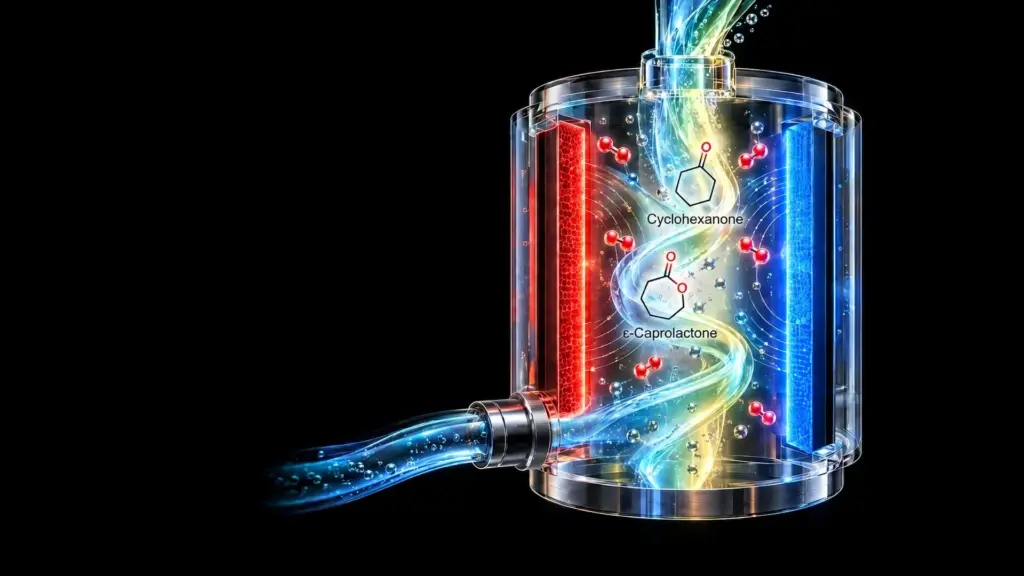
Armed with a deep understanding of local pH dynamics, the researchers turned their attention to reactor engineering. Utilizing advanced computer simulations alongside precise electrochemical measurements, they engineered a novel reactor layout that positions the electrodes in close physical proximity while actively forcing the electrolyte solution—the conductive liquid carrying the reactants—to flow continuously between them.
The primary objective of this architecture was to prevent extreme local acidity gradients from establishing themselves. Because the anode region naturally turns acidic while the cathode zone becomes alkaline, narrowing the gap between them and circulating the liquid effectively neutralizes and counterbalances these opposing forces.
The resulting performance leap was dramatic. Under unoptimized conditions where local pH variations went unchecked, roughly 16% of the products formed consisted of the desired target compound. With the implementation of the new flow reactor design, that selectivity soared to approximately 97%. This massive jump means the reaction became vastly more proficient at yielding the intended substance while largely suppressing unwanted side products.
Moreover, manipulating the flow rate of the electrolyte exerted a profound influence on productivity. Across the tested flow rates, the volume of product generated per unit of time increased by roughly 14-fold from the lowest flow rate to the highest. Shortening the physical distance between the electrodes from 20 millimeters down to 4 millimeters further accelerated production by a factor of 2.2.
Most tellingly, when the electrolyte liquid was deliberately kept static and prohibited from flowing, the production of the desired target compound plummeted to virtually zero, despite the applied voltage and bulk solution composition remaining identical. This stark contrast underscored that successful electrosynthesis depends heavily on reactor design and microscopic environmental control, operating far beyond the baseline ingredients and electrical settings.
Applications for Biodegradable Plastics, Medicines, and Electronics
Seeking to demonstrate the versatility of their strategy, the researchers expanded their experiments to manufacture a diverse array of useful chemical products. Utilizing their optimized electrochemical conditions, they successfully synthesized lactones from 18 distinct ketone compounds.
A standout achievement was the successful synthesis of ε-caprolactone with an 82% yield. This specific compound serves as a foundational monomer for polycaprolactone, a biodegradable polymer widely utilized in demanding medical applications, including surgical sutures and advanced drug-delivery systems.
In addition to lactones, the team applied their local pH management strategy to the production of epoxides, successfully obtaining high-purity products from six different alkene starting materials. Epoxides remain vital building blocks for industrial adhesives, surface coatings, and the specialized epoxy resins critical to modern electronics manufacturing, as well as acting as essential intermediates for the pharmaceutical sector.
These comprehensive trials demonstrated that controlling the microscopic environment surrounding electrodes is not a localized trick, but rather a versatile methodology capable of upgrading the production of numerous commercially important chemicals.
Toward Cleaner and More Sustainable Chemical Manufacturing
One of the most appealing features of the new electrochemical technique is its reliance on clean electricity and ambient oxygen, completely eliminating the need for externally introduced peroxide oxidants. Furthermore, the reactions proceed smoothly at room temperature and under normal atmospheric pressure, removing the energy-intensive requirement for specialized heating or pressurization equipment.
These operational traits simplify chemical processing and drastically enhance workplace safety. Because electricity serves as the primary driver, the process holds immense potential for integration with renewable energy sources, paving the way toward genuinely sustainable chemical manufacturing.
Specialty chemicals and pharmaceutical ingredients stand out as particularly promising candidates for future commercial adoption. These high-value sectors demand rigorous control over reaction parameters and strict safety protocols, areas where electrochemical methods offer distinct advantages by reducing reliance on hazardous oxidizing reagents and enabling synthesis within compact, modular equipment.
Nevertheless, the technology remains in the laboratory phase. Further optimization, scaling studies, and rigorous pilot testing will be mandatory to determine whether these laboratory milestones can be translated into economically viable, reliable commercial manufacturing operations.
A New Way to Think About Chemical Reactions
Beyond its immediate industrial applications, the research offers a philosophical and structural shift in how electrochemical systems are conceptualized and designed. Traditionally, chemists have concentrated their efforts on selecting optimal starting materials, catalysts, electrode compositions, applied voltages, and bulk solution mixtures.
The Seoul National University team’s findings argue that engineering the microscopic environment where molecules actually undergo transformation is equally critical. As Professor Ryu noted, the study effectively transitions local pH from a hidden, unpredictable variable into a deliberate and controllable design principle.
"To improve the efficiency of organic electrosynthesis, we need to design not only the reaction substrates and catalysts, but also the environment in which the molecules actually react," Professor Ryu said.
The research team believes this principle will unlock new pathways for improving a wide spectrum of electrochemical processes, particularly those governed by the coupled movement of electrons and protons. Rather than treating local acidity as an unavoidable nuisance, future chemical reactors can be intentionally engineered to maintain micro-environments that favor target reactions.
The study was co-authored by Seonghyeon Min and Junghoon Lee, both master’s students in the Department of Chemical and Biological Engineering at Seoul National University, alongside integrated master’s and doctoral student Hanju Kim. Financial support for the research was provided by Seoul National University, the National Research Foundation of Korea, and the Institute for Basic Science. Min and Lee intend to pursue further investigations into local reaction environments, aiming to extend the methodology to an even broader spectrum of chemical syntheses and industrial manufacturing applications.