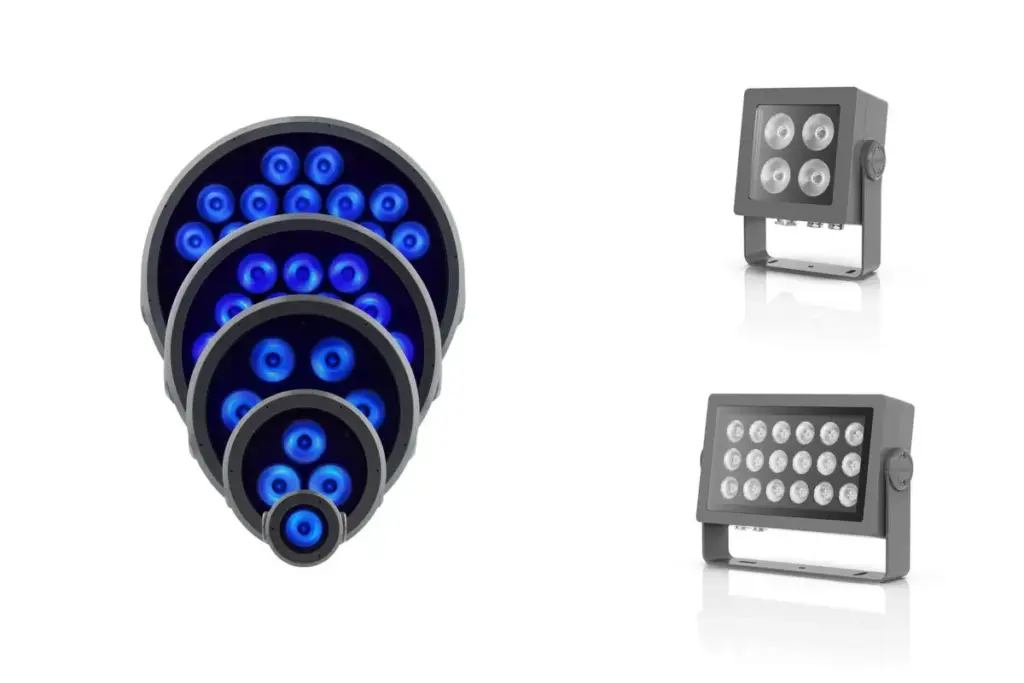
One of the first major product lines to emerge from SGM since its acquisition by Golden Sea in 2025 is the POI range of outdoor architectural luminaires. Developed entirely from scratch in a remarkably compressed timeframe of just 12 months, this comprehensive product family marks a striking new chapter for SGM’s architectural lighting division. Lighting designer and industry analyst David Morgan recently took a closer look at the technology, engineering, and background behind this significant release.
Corporate histories rarely follow a straight line, and companies often navigate a complex maze of ownership models, structural reorganizations, and geographic relocations over the course of their operational lives. While some enterprises remain under steady family-based ownership across multiple generations, others pass rapidly through a diverse variety of corporate parents and international locations.
SGM firmly belongs to the latter category of companies that have continuously evolved through strategic transitions. Founded in Pesaro, Italy, back in 1975, the enterprise initially forged its market reputation on a vibrant and colorful catalogue of disco-era products. During those early decades, the brand became widely known for specialized entertainment offerings such as illuminated dance floor modules, atmospheric smoke machines, and dedicated lighting controllers.
Following a change in Italian ownership in 2009, the enterprise underwent a major strategic restructuring in 2012. This phase was spearheaded by former Martin Professional founder Peter Johansen, who relocated the company to Aarhus, Denmark, and relaunched it under the corporate identity SGM A/S. This decisive move shifted the brand’s core focus away from its legacy disco roots and toward advanced, high-performance entertainment and architectural lighting solutions.
The company’s next major corporate turning point arrived in August 2024, when it was acquired by Golden Sea, a prominent Chinese lighting manufacturer. This acquisition deal conveniently coincided with SGM’s landmark 50th anniversary in 2025. Under the stewardship of Golden Sea, SGM has successfully retained its traditional Aarhus headquarters, its dedicated research and development team, and its distinct Danish operational identity. At the same time, the brand now benefits significantly from the robust financial backing, extensive supply chain networks, and global manufacturing resources of a much larger corporate group.
Golden Sea commands impressive group sales in the region of $170 million and employs approximately 1,600 people worldwide. The broader manufacturing group also encompasses Ayrton, the renowned French entertainment lighting company that was acquired by Golden Sea in 2017 as a relatively small enterprise and has since grown steadily under its parent company’s long-term ownership.
Today, SGM is guided by a new management team headed by industry veteran Jessie Lilly. Lilly brings a wealth of relevant experience to the role, having previously worked for Martin Professional, Speirs Major Light Architecture, and Lumenpulse. Under this refreshed leadership structure, SGM has carefully rationalized both its entertainment and architectural product portfolios while actively developing brand-new and thoroughly revamped luminaires for both target markets.
Within this framework, Willem De Plus takes direct responsibility for architectural product management. The initial stages of all new product development are undertaken in Denmark, maintaining the brand’s high design standards. Once the foundational design approach is fully resolved and validated, the engineering teams at Golden Sea take over the subsequent phases of production engineering, scaling the concepts smoothly through to final commercial launch.
The first tangible result of this comprehensive operational revamp is the POI—standing for Permanent Outdoor Installations—range tailored specifically for the global architectural market. Developed completely from scratch within a tight 12-month window, the speed and scale of this rollout stand as an impressive technical achievement that highlights the substantial engineering resources available within the wider Golden Sea group.
The comprehensive POI range comprises wide wash luminaires, narrow beam fixtures, and linear grazers. All of these variants are built around a standardized set of core optical and electrical components, including 45mm diameter color mixing lenses, multi-chip LED RGBW light engines, and sophisticated driver systems. While some of these specialized lenses have been meticulously developed in-house by the engineering team, others utilize reliable, industry-standard components sourced from LEDiL.
The wash light luminaires all share a robust rectilinear aluminium die-cast construction. They are currently available in five distinct sizes, ranging from a compact single 15W light engine housed in a square 88x88mm format up to a high-output 250W model in a rectangular 280x470mm format that incorporates 32 individual light engines. Furthermore, company documentation indicates that two even larger sizes are currently under development. The largest of these upcoming luminaires is slated to deliver an 850W output, utilizing active cooling systems and incorporating 36 light engines.
Performance metrics for the wash series are equally versatile. Beam angles range from a tight 10 degrees up to a wide 100 degrees, alongside specialized elliptical distribution options of 10 by 60 degrees and 60 by 10 degrees. Total lumen output scales from 421 lumens—measured with all LEDs operating at full power—for the smallest 15W model, up to a powerful 11,822 lumens for the 250W variant.
In comparison, the narrow beam luminaires feature a distinct circular profile, also constructed from durable die-cast aluminium. This family likewise spans five physical sizes, starting with a compact single 15W light engine featuring a 90mm diameter and extending up to a high-power 250W size with a 372mm diameter that packs in 30 light engines.
The standard native beam angle for these fixtures is a sharp 7.5 degrees. However, installers can utilize an external optical film accessory to modify the standard beam angle up to 80 degrees, as well as to achieve elliptical distributions of 7.5 by 40 degrees and 7.5 by 60 degrees. Lumen output for the beam fixtures ranges from 407 lumens for the 15W version up to 10,192 lumens for the 250W model when all LEDs run at full power. It is worth noting that utilizing the add-on beam-shaping film introduces a minor light reduction of 10 to 12 percent, depending on the specific optical film variant selected.
The linear grazers within the POI lineup represent a thorough redesign of the i1 Linear luminaires that David Morgan previously reviewed back in 2023. These updated fixtures now incorporate the exact same 45mm color mixing lenses and multi-chip light engines found across the wash and beam variants. By contrast, the original legacy versions relied on single-color light engines paired with non-color-mixing lenses.
The smallest linear grazer in the updated range operates at 25W utilizing five light engines, built within an 87x84mm aluminium extrusion profile finished with die-cast aluminium end caps. The largest current size operates at 100W, delivering up to 3,630 lumens with all LEDs driven at full power, and spans a length of 1,220 millimetres. Available beam angles for the linear range span from 10 degrees up to 60 degrees, complemented by a dedicated 10 by 60-degree elliptical lens option.
Physical and optical testing of sample units provided for evaluation reveals strong overall performance. The luminaires produce well-blended, uniform color light outputs smoothly across the visible spectrum, despite exhibiting some minor color separation when viewed at very close range. The hardware itself is exceptionally well-detailed and robustly constructed. Notably, up to 60 percent of the ADC 12 aluminium utilized in the die-cast housings is sourced from recycled material. In line with modern environmental expectations, SGM luminaires are intentionally designed for easy dismantling at the end of their operational lifecycle, allowing them to integrate seamlessly into a circular economy model.
While the Beam and Wash variants within the POI range do not project an aggressively unique visual identity—sharing a clean, utilitarian design language common among many high-quality architectural lighting brands—the fixtures distinguish themselves through a collection of genuinely innovative technical features.
Perhaps the most intriguing technical incorporation is a patented active dehumidification system branded as DryTech. This system actively removes any moisture that manages to find its way inside the luminaire housing through an electrolysis-based dehumidifier. The mechanism relies on a solid-state polymeric ionic membrane positioned between a porous anode and a porous cathode, safely purging internal humidity.
Equally impressive is the factory-calibration process applied to each luminaire. Every unit utilizes an advanced algorithm designed to produce highly consistent white light and color mixes across multiple luminaires in an installation. When multiple fixtures are set to a specific color or color temperature, the system automatically adjusts the color mix to ensure visual matching without requiring manual, on-site calibration of individual levels. Although the RGBW array natively offers specific 3000K and 4000K white options, SGM’s control software allows the mixed white color temperature to range dynamically from a warm 2000K all the way up to a cool 10,000K via standard DMX control.
Additional technical features, while also available through select other high-end manufacturers, further enhance the fixtures’ operational efficiency. These include a dynamic thermal control system and an integrated color boost system. The latter dynamically maximizes light output based on the specific blend of whites or colors requested, pushing performance right up to the maximum thermal and electrical capacity of the luminaire hardware—a capability also supported by some advanced drivers on the current market.
The rapid and successful development of the POI range stands as a remarkable technical and organizational achievement for SGM under its new ownership structure. Industry professionals and specifiers alike will watch closely to see how these advanced lighting tools perform in architectural projects in the years ahead.
David Morgan runs David Morgan Associates, a London-based international design consultancy specializing in luminaire design and development, and also serves as the Managing Director of Radiant Architectural Lighting.