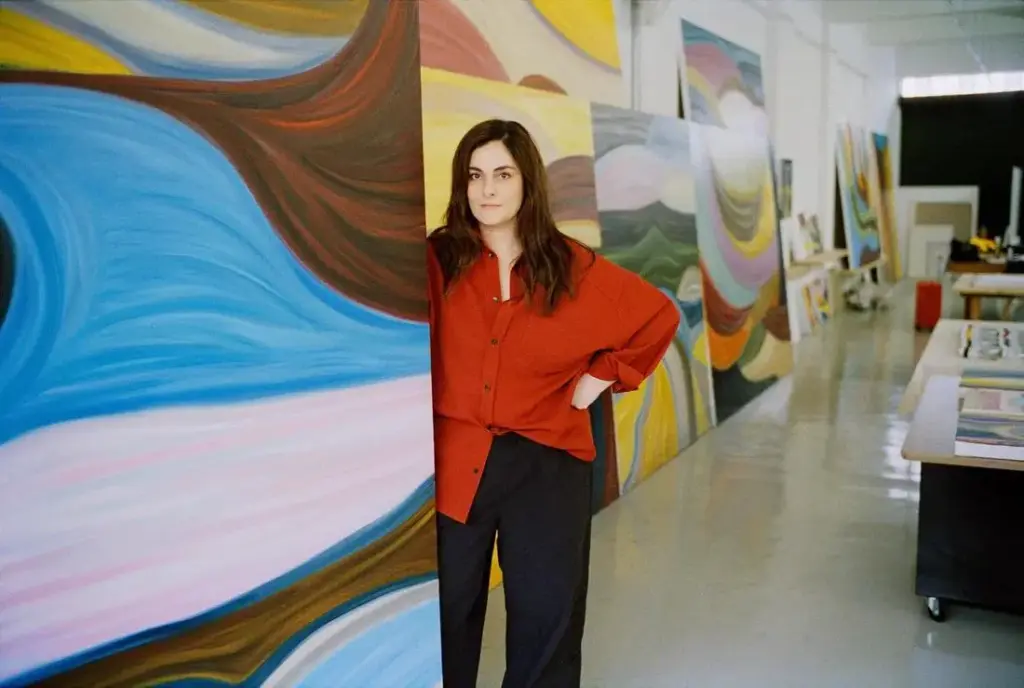
For her presentation with Pace Gallery, the São Paulo-based artist has created a tightly focused body of work consisting of 11 new canvases divided into three primary color categories: three in blue, three in gray, and five in magenta. The booth itself is laid out in the distinctive shape of the letter X. Within this geometric footprint, two blue paintings hang on either side, anchored by a central gray painting, with the remaining works positioned symmetrically throughout the structure. Visitors can enter the immersive space either through the central corridor or from the flanking sides, creating a journey of discovery that shifts depending on the point of entry.
"The structure is super open and closed at the same time, but there’s also a sense of discovery depending on which side you walk through," Simão told ARTnews during an interview from her studio in São Paulo.
The physical configuration of the booth is central to the artist’s intention: she wants viewers to slow down, take in the canvases, and get remarkably close to the surfaces of her work. Rather than presenting easily decipherable imagery, Simão describes her paintings as "more or less vague descriptions of strange worlds." Each individual artwork, she notes, possesses its own distinct "nature and behaviors."
While the canvases are entirely abstract, they are deeply tethered to the expansive visual vocabulary of the natural world. "It’s abstract yet it has so many elements of landscape," Simão explained. "Nature is a big, complex, and vast organism that we don’t fully understand how it works; art is a way to approach these things that are difficult to explain."

By bringing this meditative atmosphere to the bustling floor of Frieze London, Simão is also pushing back against the increasing digitization of the contemporary art experience. She wants to remind viewers that engaging with a painting is, at its core, a deeply physical, tactile experience. In an era dominated by screens and algorithmic curation, the subtleties of traditional media can easily be flattened or lost entirely.
"We see so many images through Instagram and digital platforms, which is fine, but we can’t forget that when you get close to a painting, there are different layers and textures," she said. To preserve this tactile honesty, Simão intentionally avoids varnishing her paintings, leaving the raw surface exposed so that viewers can observe the subtle imperfections and material qualities inherent in her process.
When she began working on this new series of paintings at the beginning of the year, Simão felt a natural, organic development taking place within her broader artistic practice, though the exact trajectory remained somewhat inexplicable to her at the time. Historically, Simão’s paintings have been celebrated for their rich, high-contrast, and vibrant color palettes—compositions where bright sky blues might sit directly atop lush grass greens, or intense reds might be paired dynamically with saturated oranges.
However, her newest works represent a deliberate shift toward cooler, more restrained tonalities. For this series, she drew direct inspiration from the melancholic introspection of Pablo Picasso’s Blue and Rose Periods, as well as the luminous, transcendent usage of the color pink found in the works of the Early Renaissance painter Fra Angelico.
Working with pink presented its own distinct set of artistic hurdles, particularly given its heavy cultural baggage. "Pink is a difficult color because when you look at mass culture, there’s Barbie pink, bubblegum pink, and cotton candy pink. I didn’t want all these industrial pinks and their associations," Simão noted. To sidestep these commercial connotations, she ultimately settled on magenta, discovering that the hue could be manipulated and layered in ways that closely mimic complex color variations found in nature.

Blue proved to be an even more formidable challenge in the studio. Simão worked with the color straight from the tube because the pigment is inherently overpowering, occasionally relying on only a modest dash of white for tinting. To achieve depth and variation, she experimented by combining different blues—mixing cobalt and cerulean, for example—to subtly transform them into complex, greenish undertones.
The resulting blue canvases are notoriously difficult to capture through mechanical means. "The blue paintings are almost impossible to photograph," Simão explained, noting the practical complications they presented during documentation. "We had to do three sessions of photographing as the pigments change so much."
The gray paintings in the booth occupy a conceptual and visual middle ground, ingeniously combining magenta and blue. In the foundational first layers of these canvases, Simão embeds subtle, hidden hints of yellow and ocher. This underpainting technique creates a luminous, atmospheric effect reminiscent of the hazy, diffused glow of sunlight passing through a dense bank of fog. Reflecting on the emotional temperature of the palette, Simão suggests that her blue paintings evoke the warmth of summer, while her pink paintings capture the crisp cold of winter, together forming a cohesive, abstract representation of the changing seasons.
This deep dive into a more restricted and moody color range is part of an ongoing evolution in Simão’s career. She first began experimenting with darker, more somber hues in 2024 during her solo exhibition "Solanaceae" at Pace in Los Angeles. The title of that exhibition was inspired by Solanaceae, the scientific family name for nightshade plants, and those paintings featured emerging fragments of darkness and shadow. That same mysterious silhouette later reappeared in a presentation at Mendes Wood DM’s Paris gallery later that same year.
"I’ve been thinking about working with a limited color range [for a while] because color in my work is super important, and I wanted to study tonalities and limit myself, I’m always evolving," Simão said.

Preparing for the rigorous demands of her presentation at Frieze London fundamentally altered Simão’s daily studio routine. In the lead-up to the fair, she systematically cleared her workspace of anything that featured even an ounce of conflicting color, returning to her familiar, contemplative working position: painting away from the main door, tucked quietly beside a small terrace with a window.
For Simão, the physical act of creation is inseparable from the final object, requiring total bodily investment and endurance.
"I paint standing up and in my socks. I don’t use chairs and sometimes I sit on the ground," Simão said, reflecting on the demanding physical labor behind her immersive booth. "These paintings required my body to be engaged."