As the global design industry looks toward the future of architecture and interior spaces, ceramic tile is taking on an increasingly expansive and sophisticated role in the built environment. Driven by a careful balance of advanced materiality, traditional craftsmanship, and cutting-edge technology, the latest movements in surface design are reshaping how residential and commercial spaces are conceptualized. This evolution was on full display at Cersaie 2026, the International Exhibition of Ceramic Tile and Bathroom Furnishings held in Bologna, Italy, where more than 70 ceramic tile manufacturers representing the vibrant Spanish sector gathered to introduce their newest collections and explore the macro design forces set to define the year ahead.
Spain’s robust presence at the international trade fair reflected an industry successfully bridging the gap between high-tech industrial production and a renewed cultural appreciation for tactile expression, handmade qualities, and material authenticity. As the second-largest exhibiting group following the host country of Italy, Spanish manufacturers leveraged the global stage to showcase how modern digital and manufacturing technology can expand the creative potential of ceramic. By pushing the boundaries of what surfaces, formats, and structural applications can achieve, these brands demonstrated that tile is no longer merely a functional background finish, but a primary protagonist in contemporary spatial design.
From warmer color palettes and deeply expressive textures to supersized formats and contemporary reinterpretations of historic design movements, the latest collections from exhibiting Spanish brands reveal a design language that is simultaneously deeply rooted in heritage and boldly forward-looking. Curated insights and trends identified by Tile of Spain highlight the core ideas and technical innovations emerging from Spain’s dynamic ceramic sector, offering a clear roadmap for the aesthetic directions that will shape interior architecture and design for 2027.
Warmed-up Neutrals
One of the most significant shifts taking place in interior architecture is the departure from the cool whites and stark grays that dominated contemporary design for over a decade. Looking ahead to 2027, warm, earthy hues are stepping in to form the foundational palettes of ceramic collections worldwide. Spanish manufacturers are spearheading this transition by embracing deep creams, rich chestnut browns, and ruddy ochres that instantly infuse residential and commercial spaces with a profound sense of comfort, warmth, and spatial depth.
Rather than relying on high-contrast, clinical aesthetics, these warmer foundations are complemented by softened whites, gentle grays, and muted blacks that serve as layered accents. Crucially, this movement toward a warmer color spectrum is anything but subdued or monotonous. Manufacturers are introducing saturated moments of rich forest greens and deep ocean blues into these earth-toned schemes, resulting in environments that feel thoroughly grounded, emotionally expressive, and invitingly tactile. This sophisticated handling of color allows designers to create layered rooms that respond to the human desire for spaces that feel protective, natural, and emotionally resonant.
Design Through the Ages
Nostalgia, historical reverence, and a renewed respect for craftsmanship are also inspiring a powerful wave of interest in design genres of the past. At Cersaie 2026, Spanish collections prominently featured mid-century modernism, bold seventies-inspired forms, elegant Art Deco geometry, and flowing Art Nouveau curves, all reinterpreted through a contemporary lens. By filtering historical motifs through modern production techniques, manufacturers are offering designers a way to connect past eras with modern sensibilities.
Simultaneously, handmade aesthetics continue to gain commercial and critical momentum. Glazed ceramics, Mediterranean-inspired finishes, and Victorian-inspired subway tile are being utilized to inject an artisanal, human character into modern spaces. Furthermore, natural material references are evolving beyond simple imitation. Collections showcased cross-cut travertine, delicately veined limestone, and raw-finish wood looks that draw heavily from the clean, minimalist principles of Scandinavian and Japanese design. This cross-pollination of cultural aesthetics and historical periods ensures that tile design remains dynamic, versatile, and deeply layered.
Supersized Formats
On the structural and dimensional front, large-format tile continues its rapid, uninterrupted expansion across both residential and commercial applications. Traditional proportions are steadily giving way to expansive dimensions, with 24-by-48-inch formats becoming a standard choice for floors and walls. Beyond these large modules, gauged porcelain slabs and oversized panels are gaining substantial traction as fabrication methods improve and installation expertise becomes more widespread among contractors and tile setters.
These massive panels are unlocking entirely new architectural possibilities, allowing for seamless surfaces across floors, vertical walls, exterior building facades, and integrated architectural countertops. Yet, in an interesting paradox, small-format tile remains an enduring favorite among designers seeking intricate detail. The ongoing resurgence of Zellige-inspired aesthetics is driving renewed interest in compact square formats and artisanal compositions, proving that the market demands both the grand scale of porcelain slabs and the intimate scale of handcrafted small tiles.
The Tactile Surface
Surface treatment is rapidly becoming a critical component of the sensory experience associated with ceramic tile. High-gloss finishes, once ubiquitous, are increasingly giving way to matte, honed, and satin surfaces that yield a softer, more nuanced visual language while actively inviting physical touch. Soft-touch glazes and complex three-dimensional reliefs—including architectural fluting, precision carving, and subtle surface rippling—transform tile from a flat wall or floor covering into a multisensory architectural element that reacts dynamically to changing light throughout the day.
Technological advancements are playing a pivotal role in this tactile revolution. Modern digital printing and structuring technologies allow surface texture and graphic detail to work in absolute harmony. This synergy creates highly realistic wood and stone looks where the visual pattern and the physical, topographical texture align with remarkable, nearly indistinguishable precision. Additionally, on flooring surfaces, innovative micro-textured treatments are adding a vital layer of performance by significantly enhancing slip resistance without ever compromising the refined design integrity of the product.
Soft Metallics
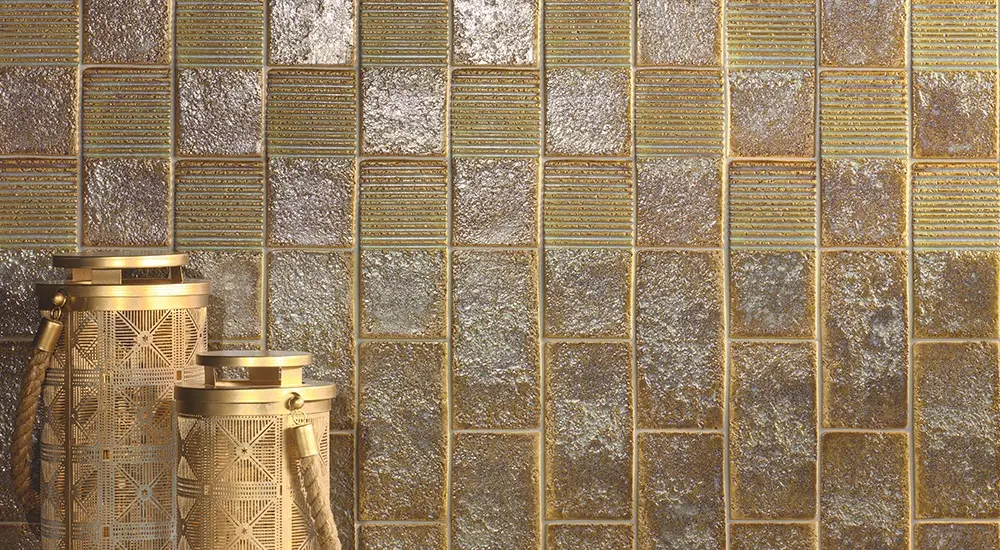
As ceramic color palettes trend warmer, the accompanying hardware, fixtures, and decorative elements are shifting in tandem. Burnished and brushed golds and brass are emerging as the preferred metallic accents over cooler, industrial finishes such as polished chrome and brushed nickel, appearing widely across plumbing fixtures, architectural lighting, and furniture design.
Spanish ceramics are directly echoing this sophisticated shift through subtle golden details integrated right into the tile bodies. These range from warm, golden veining threading through marble-look porcelain to delicate metallic chips embedded within terrazzo designs and warm golden grains running through wood-inspired surfaces. Together, these complementary materials create a cohesive, harmonious visual language throughout a project, allowing ceramic surfaces and metal hardware to reinforce and elevate one another across every corner of a space.