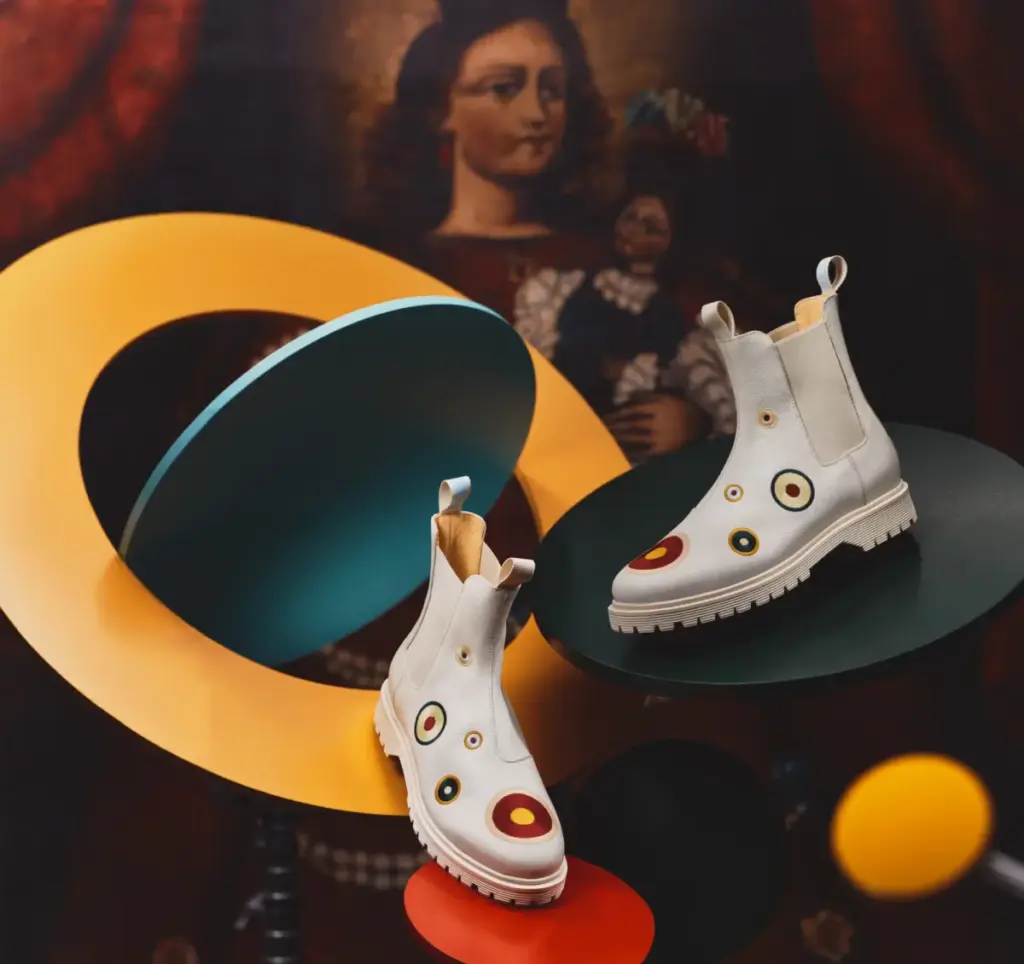
Renowned Austrian graphic designer Stefan Sagmeister is taking his signature data visualizations out of the traditional gallery ecosystem and onto the pavement. In an unexpected and conceptually driven collaboration with Frankfurt-based sustainable footwear brand EKN, Sagmeister has developed a distinct pair of sneakers and leather boots that translate complex global statistics regarding renewable electricity generation and street homelessness into tangible, wearable objects.
The two footwear designs serve as physical extensions of Sagmeister’s upcoming solo exhibition, titled Finally, Something Good., which is scheduled to open at La Gaîté Lyrique in Paris on October 15, 2026. Rather than simply applying static reproductions of existing digital or painted artworks onto the surface of a shoe, the cross-disciplinary project merges contemporary graphic design with traditional, artisanal shoemaking techniques. According to EKN founder Noel Klein-Reesink, the initiative was born out of a mutual curiosity about the intersection of disparate creative disciplines. In an exclusive interview, Klein-Reesink noted that the partnership was fundamentally about exploring what happens when Sagmeister’s analytical and visually striking mindset collides with EKN’s rigorous approach to manufacturing and material sourcing.
For Sagmeister, the primary allure of the collaboration lies in its unprecedented capacity to reach an audience completely removed from the insular art world. While fine art is typically sequestered inside museums and galleries—spaces populated exclusively by individuals who have made a conscious decision to enter—footwear inhabits the public sphere. As the designer points out, a shoe is observed on the street by passersby who decided nothing of the sort, making the pavement an open-air gallery for socio-economic commentary.
This partnership extends Sagmeister’s ongoing body of work centered on long-term social progress, human betterment, and historical data visualization, themes he has previously examined through historic canvases, public installations, and everyday domestic items. Klein-Reesink highlights that EKN was immediately drawn to this methodology because of Sagmeister’s unique ability to distill vast, complicated sets of global information into immediate, arresting visual formats. Through this collaboration, the artwork is liberated from waiting for visitors to purchase a ticket; instead, it confronts the public directly during the ordinary rhythms of daily life.
Renewable Energy and Street Homelessness Shape Two Distinct Shoe Designs
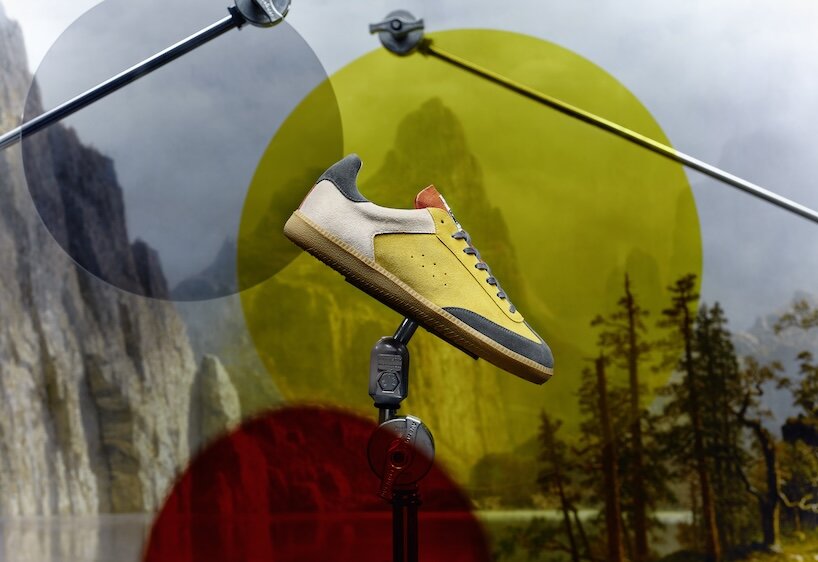
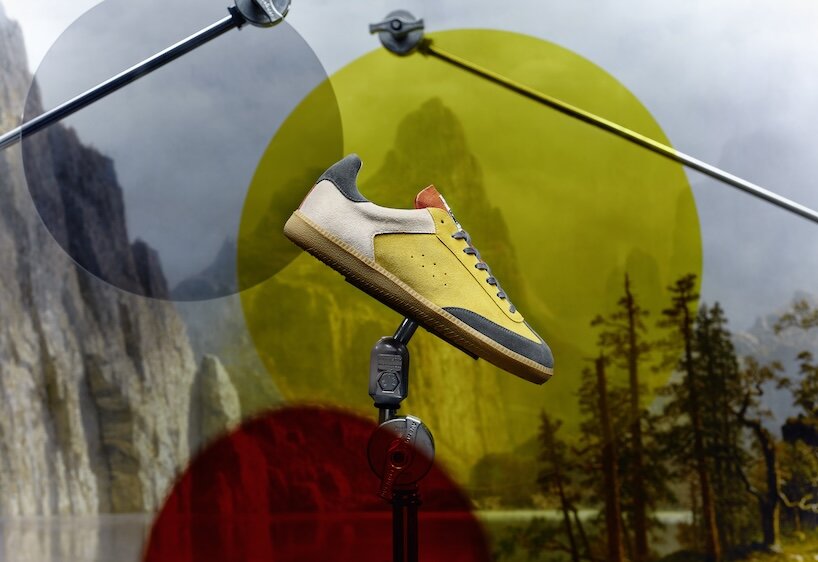
The first footwear model resulting from this partnership is titled Bring It On, a colorful suede sneaker designed to visualize the monumental global acceleration of renewable electricity generation between the years 1965 and 2022. The graphic composition incorporates a diverse array of green energy sources, including hydroelectricity, wind, solar, and other emerging renewables. As the historical output figures rise across the decades, they transform into a vibrant, abstract graphic pattern that flows seamlessly across the sneaker’s suede upper panels, while the underlying dataset is printed explicitly onto the footbed.
Klein-Reesink explains that with Bring It On, the structural shapes and colors were deliberately woven into the overarching architectural design of the sneaker, allowing the data to feel like an aesthetic choice rather than an overt chart. For Sagmeister, the subject matter holds profound contemporary significance, far outweighing transient technological trends. In an interview, the designer remarked that while global discourse remains heavily fixated on the rise of artificial intelligence, he finds the exponential improvements and cost reductions in renewable electricity generation to be far more consequential for the future of humanity. He points to the sweeping possibilities that cheaper, ubiquitous renewable energy could eventually unlock on a global scale, ranging from large-scale vertical farming and water desalination to direct air carbon capture.
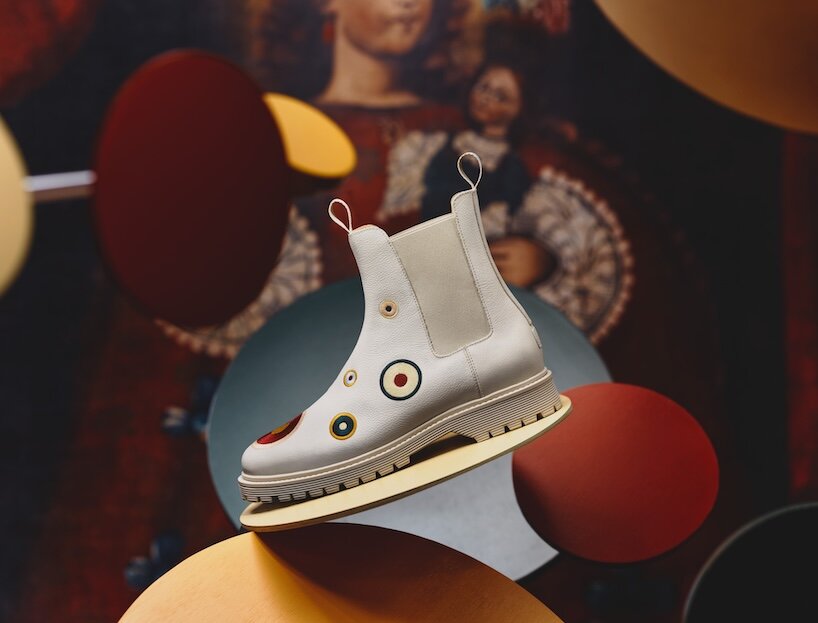
In stark contrast, the second footwear model, titled Like a Complete Unknown, tackles a much heavier and more uncomfortable subject, translating the grim reality of urban destitution into a cream-colored leather boot. The exterior of the boot features meticulous embroidered graphics that visualize reported street homelessness across six distinct nations, utilizing data sourced directly from the OECD Affordable Housing Database. The sobering statistics mapped onto the footwear reveal stark international disparities: reported homelessness ranges from 76 individuals living on the street or in public spaces per 100,000 inhabitants in the United States, down to 46 in Germany, 16 in the United Kingdom, eight in France, five in Mexico, and a mere two in Japan.
Klein-Reesink notes that unlike the sneaker’s printed elements, the graphic representation for Like a Complete Unknown is embroidered directly onto the smooth leather panels of the boot. Both creators, however, are entirely transparent regarding the inherent limitations of comparing such datasets internationally. Because different nations rely on varying legal definitions, administrative criteria, and data collection methodologies, the figures cannot be treated as an absolute, flawless measure of relative homelessness. Nevertheless, Sagmeister argues that imperfect statistics still possess immense value because they open up critical public discussions and force confrontations with systemic issues that might otherwise remain abstract and ignored.
EKN Footwear Bridges Graphic Language and Artisanal Manufacturing
Translating complex data visualizations into functional, wearable footwear demanded far more than simply selecting an appealing color palette or determining where to position a graphic motif. Both designs were built upon pre-existing EKN silhouettes, requiring the design teams to carefully adapt the original mathematical visualizations to fit the complex curves, individual panels, and structural engineering of each shoe model.
The Bring It On sneaker is constructed using premium, chrome-free tanned suede, providing a soft texture that complements its colorful composition. Meanwhile, the Like a Complete Unknown boot pairs chrome-free tanned smooth leather with intricate embroidery. According to Klein-Reesink, the development phase involved a meticulous, iterative process marked by ongoing exchanges with specialized embroidery experts and manufacturing partners located in Portugal. He describes it as an intensely practical and tactile endeavor—crafting an initial physical sample, examining the shoe in person, refining a minute detail, and then starting the cycle over again. The central challenge throughout this phase was preserving the distinct integrity of Sagmeister’s visual language without ever compromising the foundational requirement that the finished objects must remain comfortable, durable, and fully functional as everyday shoes.
This design process inevitably introduced a difficult paradox that neither partner sought to evade: the inherent tension of manufacturing and selling a luxury-priced boot that highlights the crisis of homelessness. Sagmeister readily acknowledges the contradiction, noting that there is something inherently awkward about a 350-euro boot bearing data on destitution, and he emphasizes that a financial donation alone does not magically erase that discomfort.
To address this ethical friction constructively, a portion of every sale will be directly funneled to organizations actively working within the respective fields. The leather boot retails for 350 euros, with 35 euros from each pair donated to the Coalition for the Homeless in New York. Similarly, the sneaker retails for 300 euros, with 30 euros from each pair directed to Future Cleantech Architects in Germany. Klein-Reesink confirms that exactly ten percent of the retail price from every pair sold is allocated to organizations operating in these critical areas. While these financial contributions do not completely resolve the inherent friction between a high-end commercial product and a heavy social message, they represent a concrete effort to bridge the gap between visualized information and real-world action.
EKN Footwear Implements a Made-to-Order Production Model
In alignment with their long-standing corporate ethos regarding sustainability and responsible consumption, both footwear models will be handmade at an artisanal workshop in Portugal and produced strictly through a limited pre-order system rather than being mass-manufactured in advance. Orders for the collaboration will be accepted globally from October 14 through November 15, 2026, with official delivery to customers anticipated in January 2027. Offered in European sizes 36 through 46, the footwear will enter the production line exclusively based on verified consumer demand, an intentional strategy designed to completely eliminate surplus inventory and unsold stock.
Klein-Reesink explains that the primary operational advantage of this model is straightforward: once the pre-order window closes, the brand knows precisely how many pairs consumers actually want and need. For the founder, who established EKN in 2015, this production framework reflects a much broader philosophy of responsible manufacturing that extends far beyond trendy materials. He stresses that true sustainability is not merely about choosing an organic or eco-friendly substitute material, but involves looking holistically at production methods, product durability, and responsible manufacturing quantities.
Ultimately, the collaborative project returns to a clear and uncomplicated proposition: abstract information becomes significantly more accessible and engaging when it is woven into the fabric of everyday life. Sagmeister’s upcoming exhibition, Finally, Something Good., investigates the psychological distance that exists between bleak public perceptions of the world and measurable, long-term human progress over time, using visual culture to challenge the overwhelmingly pessimistic narratives that frequently dominate contemporary media.
These two distinctive pairs of shoes carry that broader investigative mission out onto the street, where an observer might initially be drawn to a graphic simply because of its striking colors or unusual geometric composition, only to discover upon closer inspection what those visual elements truly represent. Klein-Reesink concludes that for EKN, good design inherently means building something properly and engineering it to last. Whether individuals who purchase the shoes ultimately spark conversations about renewable energy, systemic homelessness, or simply appreciate them as unique pieces of footwear remains entirely open. For Sagmeister, however, that human exchange is the ultimate objective, noting simply that the ensuing conversation itself is the piece.