Renowned Austrian graphic designer Stefan Sagmeister is taking his signature data visualizations far beyond the traditional boundaries of galleries and museums and onto people’s feet. In a striking and unexpected collaboration with Frankfurt-based sustainable footwear brand EKN, Sagmeister has developed a data-driven sneaker and a leather boot. These two distinct footwear designs translate complex statistical realities regarding renewable electricity and street homelessness into tangible, wearable everyday objects.
The launch of these innovative pieces coincides with Sagmeister’s upcoming solo exhibition, Finally, Something Good., which opens its doors to the public at La Gaîté Lyrique in Paris on October 15, 2026. Rather than simply taking pre-existing two-dimensional artworks and printing them onto the side of a shoe, this project represents a genuine synthesis of avant-garde graphic design and traditional, conscientious shoemaking. According to EKN founder Noel Klein-Reesink, the collaboration was born out of an artistic curiosity to see what happens when Sagmeister’s unique conceptual framework meets the physical constraints and craftsmanship of footwear manufacturing.
For Sagmeister, the primary appeal of the partnership lies in expanding his reach far beyond the predictable demographic of gallery-goers. In an exclusive interview, the designer points out that a painting hanging quietly inside a museum or gallery is exclusively viewed by individuals who have made a conscious decision to step inside and look. A shoe, by contrast, is encountered on the busy streets by people who made no such pre-arranged artistic pilgrimage.
This wearable project seamlessly extends Sagmeister’s ongoing body of work, which consistently explores long-term social progress through meticulously visualized data. Over the years, his investigations have manifested across historic paintings, large-scale public installations, and everyday consumer objects. Klein-Reesink sees an organic alignment between this philosophy and EKN’s brand ethos. He notes that what has always captivated the footwear team about Sagmeister’s practice is his rare ability to distill complex, abstract information into immediate, striking visuals. Through this collaboration, the artwork is liberated from waiting quietly for gallery visitors; instead, it actively engages passersby on their daily morning commute or walk to the grocery store.
Renewable Energy and Homelessness Shape Two Distinct Shoe Designs
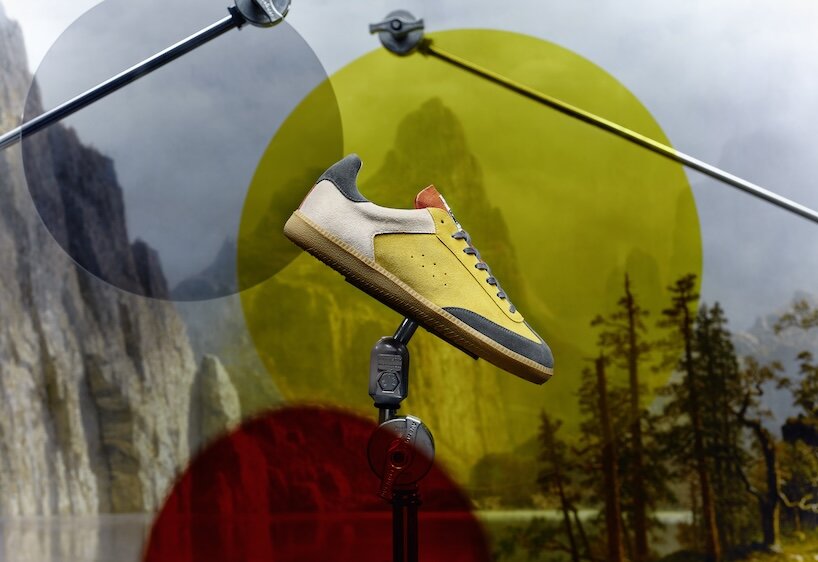
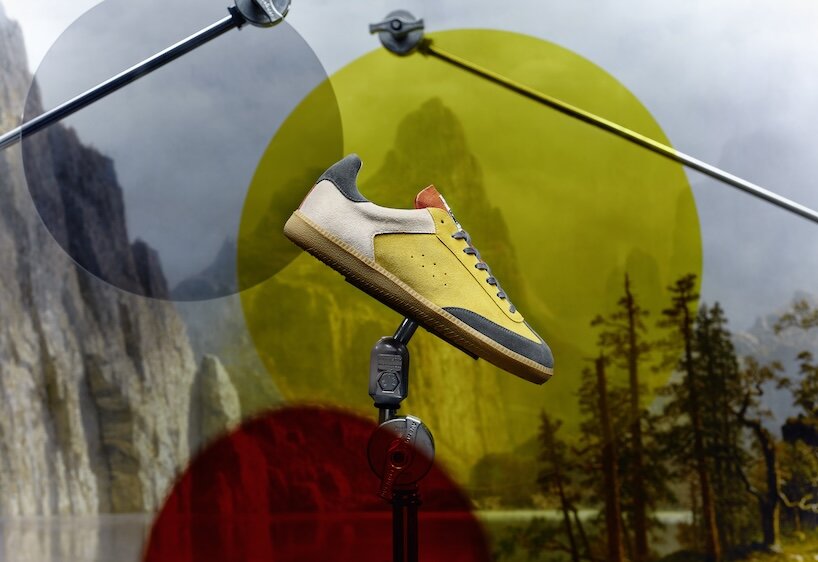
The first footwear model resulting from this collaboration is titled Bring It On. It is a colorful suede sneaker designed to visually encapsulate the staggering global rise in worldwide renewable electricity generation between the years 1965 and 2022. The graphic visualization charts a comprehensive range of green energy sources, including hydroelectric, wind, solar, and other sustainable generation methods. The rising statistical figures are ingeniously woven into a bold graphic composition across the shoe’s upper panels, while the complete, underlying dataset is printed directly onto the footbed.
Klein-Reesink explains that with Bring It On, the dynamic shapes and vibrant colors organically evolved into essential components of the sneaker’s overall aesthetic structure, while the hard data remains quietly tucked away on the interior. For Sagmeister, the subject matter holds immense contemporary relevance, far eclipsing many fleeting technological trends. He remarks that while nearly everyone is currently fixated on artificial intelligence, he finds the exponential, real-world improvements in renewable electricity generation to be far more consequential. He points to the profound global possibilities that cheaper, widely accessible renewable energy can unlock, ranging from large-scale vertical farming and seawater desalination to advanced carbon capture initiatives.
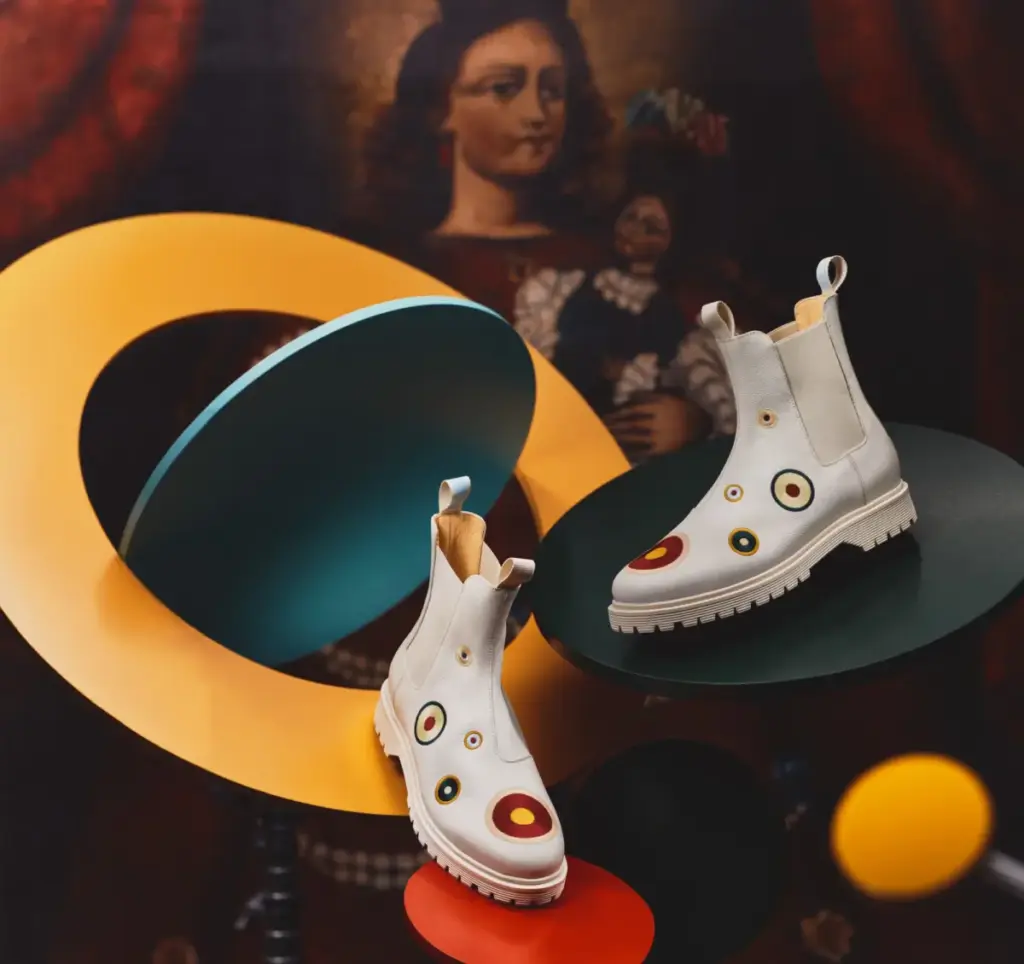
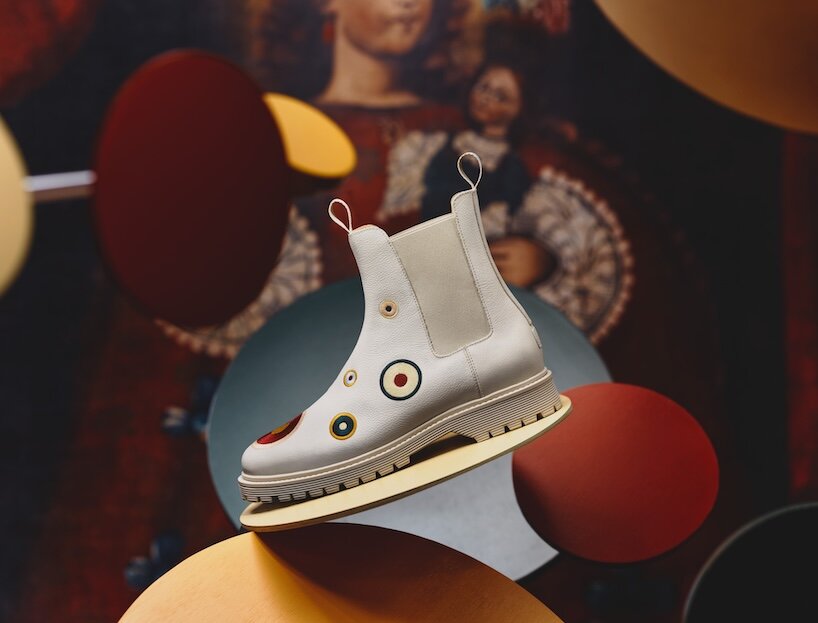
The second design, titled Like a Complete Unknown, tackles a much heavier, uncomfortable societal subject, translating it into a refined cream-colored leather boot. The upper of the boot features delicate, precise embroidery that visualizes reported street homelessness across six different countries, drawing its data directly from the OECD Affordable Housing Database. The statistics mapped onto the leather reveal a stark disparity, ranging from 76 individuals living rough on the street or in public spaces per 100,000 inhabitants in the United States, down to 46 in Germany, 16 in the United Kingdom, eight in France, five in Mexico, and a mere two in Japan.
Klein-Reesink notes that for this particular model, the intricate graphic is embroidered directly into the premium leather surface. Sagmeister is refreshingly candid about the inherent limitations of making such direct international comparisons, openly admitting that the numbers are not entirely perfect. Because different nations rely on varying definitions and data collection methodologies, the figures cannot be treated as an absolute, flawless measure of relative homelessness. Nevertheless, the designer maintains that imperfect statistics still possess immense value, serving as a vital catalyst for opening public discussions on critical issues that might otherwise remain hidden behind abstract numbers.
EKN Brings Sagmeister’s Complex Graphics to Functional Footwear
Successfully translating Sagmeister’s complex graphic visualizations into functional, durable footwear demanded far more than simply selecting where to place a bright color motif or an embroidery pattern. Both shoe models are built upon pre-existing EKN silhouettes, requiring meticulous adaptation to fit the natural curves, overlapping panels, and structural requirements of each shoe type. The Bring It On sneaker is crafted using premium chrome-free tanned suede, while the Like a Complete Unknown boot pairs chrome-free tanned smooth leather with detailed custom embroidery.
According to Klein-Reesink, the development phase involved a deeply hands-on, iterative process with embroidery specialists and manufacturing partners located in Portugal. The production journey required making a physical sample, critically evaluating the actual shoe, modifying a specific detail, and repeating the cycle until perfection was achieved. The ultimate challenge lay in faithfully preserving Sagmeister’s uncompromising visual language without ever compromising the fundamental requirement that the finished objects must remain comfortable, wearable shoes.
This ambitious collaboration also raises an intentional question that neither partner is interested in sidestepping: what does it mean to retail a luxury-priced boot that carries data about homelessness? Sagmeister openly acknowledges the inherent contradiction, admitting that there is something undeniably awkward about a 350-euro boot bearing homelessness statistics, and noting that a simple financial donation does not magically erase that friction.
The leather boot retails for 350 euros, while the colorful suede sneaker is priced at 300 euros. To help bridge the gap between commercial product and social awareness, ten percent of the retail price from each sale will directly support organizations working in the respective fields. Specifically, 35 euros from every pair of boots sold will be donated to the Coalition for the Homeless in New York, while 30 euros from every sneaker purchase will go to Future Cleantech Architects in Germany. While Klein-Reesink emphasizes that these donations do not completely resolve the inherent tension between the luxury products and their sobering messages, they form a crucial part of an earnest attempt to connect visualized data with real-world action outside the confines of the exhibition space.
EKN Footwear Embraces a Sustainable Made-to-Order Production Model
In alignment with their shared commitment to environmental responsibility, both footwear models will be handmade at a specialized workshop in Portugal utilizing a limited pre-order system rather than traditional mass manufacturing. Customer orders will be accepted through a specific window from October 14 to November 15, 2026, with official delivery scheduled for January 2027. Offered in standard European sizes 36 through 46, the shoes will enter production strictly according to actual demand, a conscientious approach explicitly designed to eliminate excess inventory and reduce unsold stock.
Klein-Reesink highlights that the primary advantage of this model is straightforward and practical: once the pre-order period closes, the brand knows precisely how many pairs people actually want and need. For the founder, who originally established EKN in 2015, this production framework reflects a much broader philosophy of responsible manufacturing. He stresses that true sustainability extends far beyond simply selecting eco-friendly materials, requiring an equal focus on ethical production methods, product longevity, and responsible manufacturing quantities.
Ultimately, the project returns to a clear, foundational premise: complex information becomes significantly more accessible and engaging when it is integrated into the fabric of daily life. Sagmeister’s exhibition, Finally, Something Good., closely examines the widening gap between public perceptions of the world and measurable long-term developments, utilizing visual culture to challenge the overwhelmingly pessimistic narratives that frequently dominate contemporary life.
These two unique pairs of shoes carry that ongoing investigation directly out onto the pavement, where a bold graphic might initially capture someone’s attention through its striking colors or unusual composition, only to reveal a deeper story upon closer inspection. As Klein-Reesink observes, good design fundamentally means crafting something properly and building it to last. Whether individuals who purchase and wear the shoes ultimately find themselves engaged in deep conversations about renewable energy, systemic homelessness, or simply the craftsmanship of their footwear remains to be seen. For Stefan Sagmeister, however, that exchange is the entire point, summarizing the essence of the project with a simple conviction: that conversation is the piece itself.