Stefan Sagmeister is taking his signature data visualizations somewhere they rarely venture: onto the streets and onto people’s feet. In a striking new collaboration with Frankfurt-based sustainable footwear brand ekn, the renowned Austrian graphic designer has developed a colorful sneaker and a premium leather boot. These unique objects translate complex statistics regarding renewable electricity generation and urban homelessness into wearable pieces of design.
The two footwear designs serve as tangible extensions of Sagmeister’s upcoming solo exhibition, Finally, Something Good., which is slated to open at La Gaîté Lyrique in Paris on October 15, 2026. Rather than simply applying printed reproductions of existing canvases onto standard shoes, the partnership bridges graphic design with traditional shoemaking craft.
"It was about seeing what happens when Stefan’s way of thinking meets our way of making things," ekn founder Noel Klein-Reesink explained in an interview.
For Sagmeister, the fundamental appeal of the project lies in expanding his audience far beyond the traditional confines of a gallery or museum. While exhibition spaces attract visitors who have actively chosen to step inside, footwear operates in the public realm.
"A painting in a gallery or museum is seen by people who decided to come in and look. A shoe is seen on the street by people who decided nothing of the sort," Sagmeister noted.
This philosophy anchors his ongoing exploration of long-term social progress through visualized data. Previously, Sagmeister has expressed these concepts across historic oil paintings, large-scale public installations, and various everyday objects. Klein-Reesink saw a natural alignment between this investigative methodology and modern footwear design, noting that ekn has always been drawn to the designer’s unique capacity to render abstract information immediate and visual. Through this collaboration, the artwork no longer waits quietly for visitors to arrive; it engages passersby unexpectedly in daily urban life.
Renewable Energy and Homelessness Shape Two Distinct Shoe Designs
The collaboration manifests in two distinct footwear models, each tackling a vastly different global subject through bespoke graphical translations.
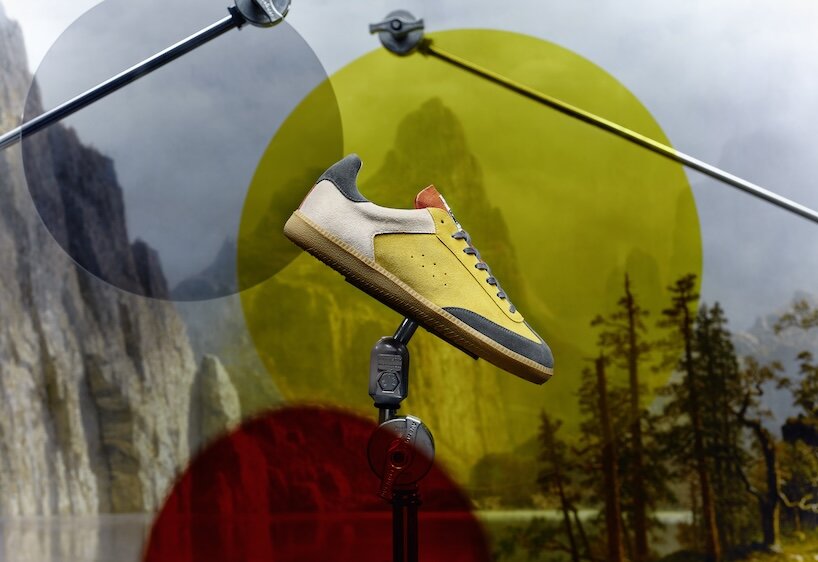
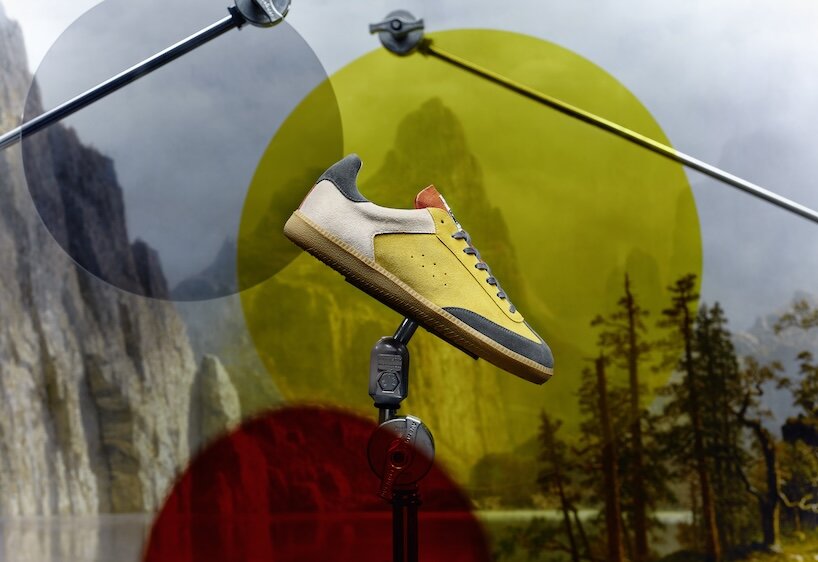
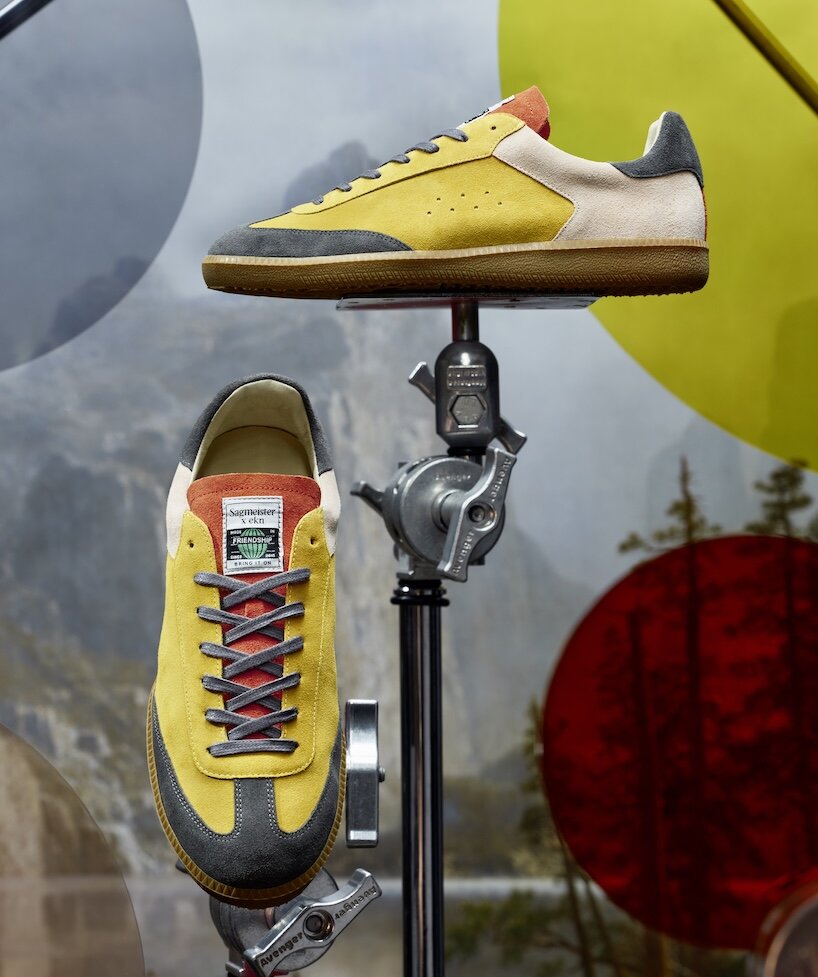
The first model, titled Bring It On, takes the form of a vibrant suede sneaker that visualizes worldwide renewable electricity generation between the years 1965 and 2022. The dataset encompasses hydroelectric, wind, solar, and various other green energy sources. As the historical figures climb upward over the decades, they transform into an energetic graphic composition that wraps dynamically across the shoe’s upper panels. Meanwhile, the complete, unedited dataset is printed directly onto the footbed.
"With Bring It On, the shapes and colours became part of the overall design of the sneaker, while the complete information sits on the footbed," Klein-Reesink explained.
For Sagmeister, the subject holds immense personal and cultural significance, particularly in an era dominated by technological hype.
"While everybody is talking about AI, I find the improvement in renewable electricity generation more consequential," he stated, pointing toward the massive practical possibilities cheaper clean energy could unlock globally, from advanced vertical farming and seawater desalination to large-scale carbon capture initiatives.
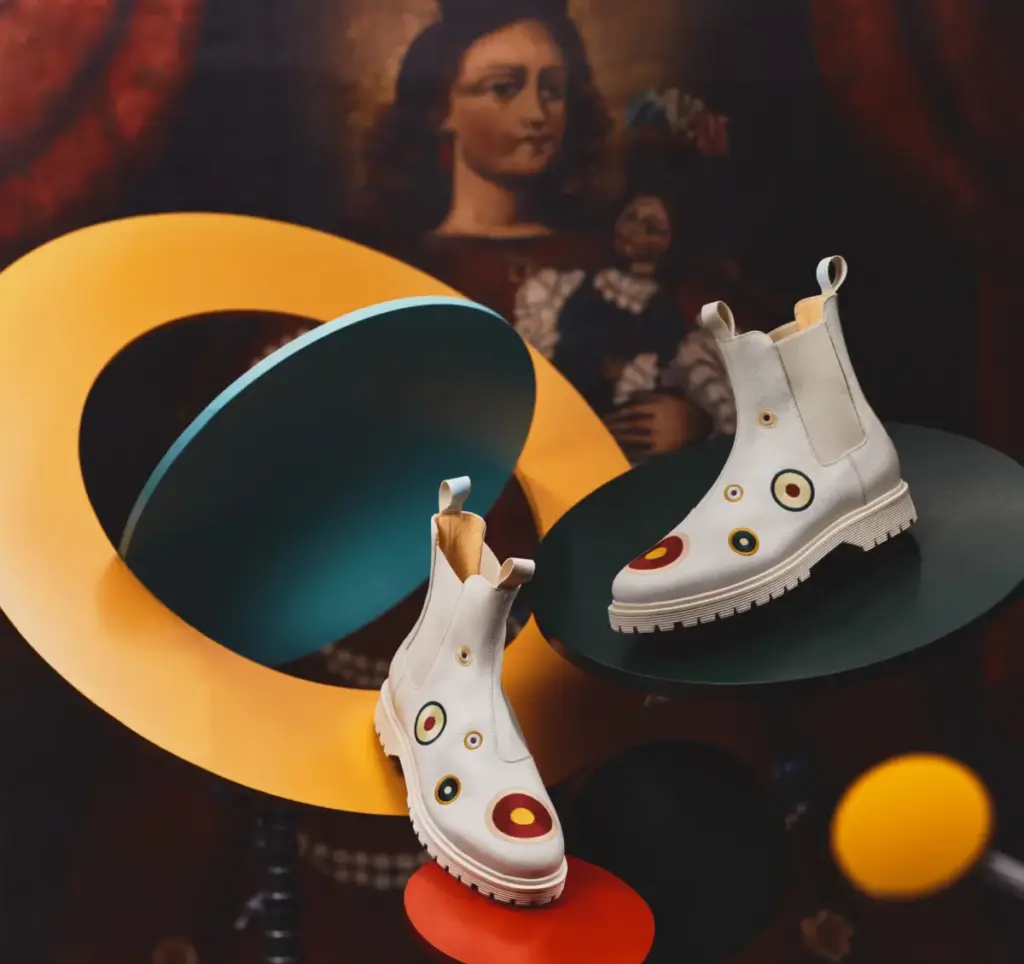
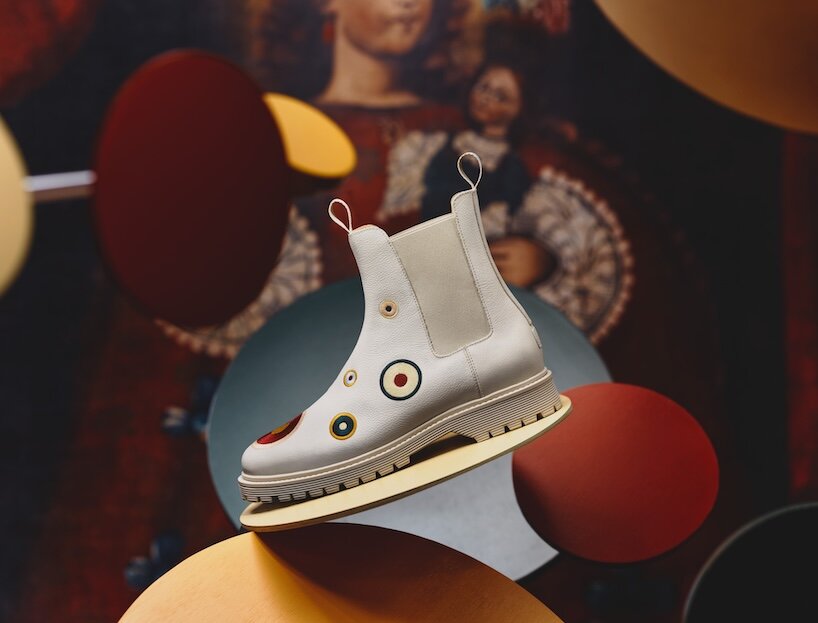
The second design, Like a Complete Unknown, shifts toward a more somber subject, translating global statistics into a cream-colored leather boot. Its intricate embroidered graphics visualize reported street homelessness across six distinct countries, drawing data from the OECD Affordable Housing Database. The stark figures reveal wide disparities, ranging from 76 individuals living on the street or in public spaces per 100,000 inhabitants in the United States, down to 46 in Germany, 16 in the United Kingdom, eight in France, five in Mexico, and just two in Japan.
"For Like a Complete Unknown, the graphic is embroidered directly onto the leather," Klein-Reesink said.
Sagmeister remains transparent about the inherent limitations of such international comparisons. Because different nations rely on varying legal definitions and data collection methodologies, the figures cannot be taken as an absolute measure of relative homelessness. Yet, the designer argues that imperfect statistics still perform a vital function by sparking public conversations about systemic issues that might otherwise remain abstract and ignored.
Ekn Brings Complex Graphics to Functional Footwear
Translating complex data visualizations into functional footwear demanded far more than simply selecting where to place a colorful pattern. Both designs are built upon pre-existing ekn silhouettes, requiring meticulous adjustments to adapt Sagmeister’s original graphics to the three-dimensional curves, overlapping panels, and structural seams of each shoe model.
The Bring It On sneaker utilizes premium chrome-free tanned suede, while the Like a Complete Unknown boot pairs chrome-free tanned smooth leather with precise, tonal embroidery. According to Klein-Reesink, the development phase involved a rigorous iterative process marked by repeated exchanges with embroidery specialists and manufacturing partners based in Portugal.
"It was a very practical process. You make a sample, look at the actual shoe, change a detail and try again," he explained.
The primary challenge lay in preserving Sagmeister’s distinct visual language without compromising the essential requirement that the finished objects must remain comfortable and durable footwear.
The partnership also confronts a profound contradiction that neither creator attempts to sidestep: the inherent irony of selling a luxury-priced boot that carries data concerning homelessness.
"There is something awkward about a 350 euro boot that carries homelessness data, and I don’t think a donation makes that go away," Sagmeister acknowledged openly.
The leather boots retail at 350 euros, while the suede sneakers are priced at 300 euros. To establish a tangible connection to the causes addressed, ten percent of the retail price from every sold pair will be directly allocated to relevant organizations. Specifically, 35 euros from each boot sale will go to the Coalition for the Homeless in New York, while 30 euros from each sneaker sale will support Future Cleantech Architects in Germany. While Klein-Reesink noted that these financial contributions do not completely erase the conceptual tension of the products, they form a deliberate effort to link visual awareness with real-world action.
Ekn Footwear Embraces Made-to-Order Production
Both models are entirely handmade within a specialized footwear workshop in Portugal. In a move that aligns with ekn’s broader environmental ethos, the shoes will not be mass-produced in advance. Instead, they will be manufactured through a limited pre-order system designed to eliminate excess inventory and reduce waste.
Orders for the collection will be accepted from October 14 through November 15, 2026, with global delivery scheduled for January 2027. Offered in European sizes 36 through 46, the footwear will enter production strictly according to actual consumer demand.
"The main advantage is very simple: after the pre-order period, we know how many pairs people actually want," Klein-Reesink explained.
For Klein-Reesink, who founded ekn in 2015, this production framework reflects a deeply held philosophy of responsible manufacturing that extends far beyond material choices.
"Sustainability is not only about choosing a better material," he emphasized, underscoring the equal importance of ethical production methods, product longevity, and restrained manufacturing quantities.
Ultimately, the collaboration circles back to a fundamental premise of Sagmeister’s broader artistic practice: complex information becomes infinitely more accessible when it integrates seamlessly into everyday human life. Sagmeister’s upcoming exhibition, Finally, Something Good., investigates the vast gulf between public perceptions of the world and measurable long-term developments, using visual culture to challenge the overwhelmingly negative narratives that often dominate contemporary media.
These two shoes carry that critical investigation out onto the pavement, where a striking graphic might first catch a pedestrian’s eye through its color or composition, only to reveal a deeper story upon closer inspection.
"For us, good design also means making something properly and making it to last," Klein-Reesink concluded.
Whether those who wear the shoes ultimately find themselves discussing renewable energy, housing crises, or simply the craft of their footwear remains entirely open. For Sagmeister, that ongoing exchange is the true substance of the work.