When David Hockney passed away on June 11, 2026, at the age of eighty-eight, the global art market responded with a posture of measured respect rather than the frenzied speculation that often follows the death of a titan. In the weeks that followed, the auction rooms provided a snapshot of the artist’s standing in the secondary market. At Phillips London on June 26, The Only One with Waves (1991) realized £2.42 million (approximately USD$3.24 million), a performance that sat comfortably within its pre-sale estimate of £1.8–£2.5 million. By September, the auction house’s dedicated single-artist sale, David Hockney, successfully moved seventy-five of its seventy-seven lots, totaling £2,038,071 (approximately USD$2.73 million) inclusive of fees.
These figures represent the high-water marks of the auction world—the data points that populate financial headlines and signal the fiscal temperature of an artist’s legacy. However, these numbers represent only the most visible, and often the most volatile, layer of the art ecosystem. Beneath this headline tier exists a more intimate and stable realm: the gallery sector. Here, the names that command millions on the block are accessible through the walls of dealers, with prices measured in hundreds and thousands rather than millions. It is within this sphere that collectors can engage in a more nuanced acquisition process, one defined by the ability to scrutinize edition, condition, and provenance long before a transaction occurs.
This current landscape reveals a compelling thread connecting three distinct masters: the etched line that established Hockney’s reputation as a serious printmaker decades before his celebrity; the rhythmic, meditative ballpoint marks that IL LEE has charted across New York canvases for forty years; and the rigid, mathematical units that defined Victor Vasarely’s contribution to Op art. These artists, represented by partner galleries from Mayfair to Tribeca and Braselton, Georgia, offer a reminder that the value of an artwork is not solely determined by a gavel.
The Legacy of the Etched Line
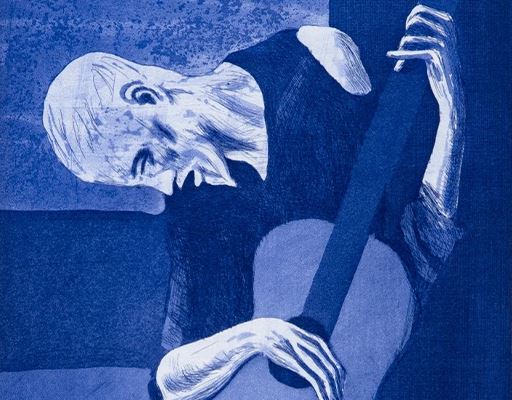
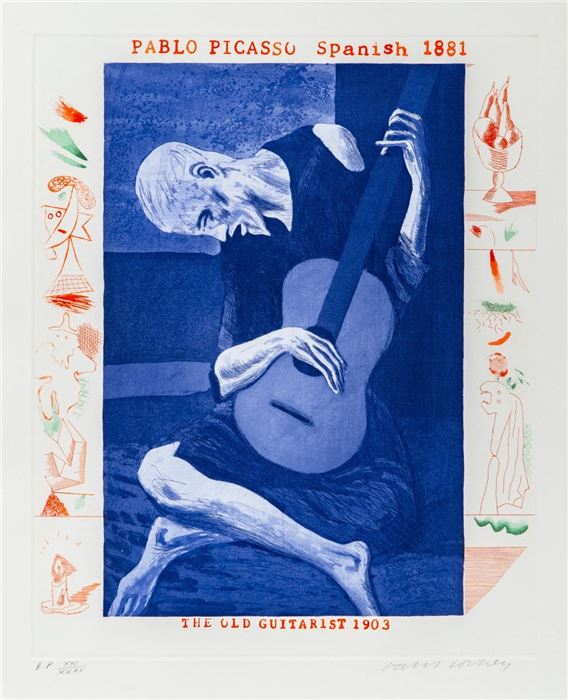
David Hockney’s The Old Guitarist (1976–77) serves as a profound bridge across seven decades of art history. In this work, Hockney revisited the somber, blue-toned musician of Pablo Picasso’s 1903 masterpiece, reinterpreting the figure for his own twenty-plate suite, The Blue Guitar. Inspired by Wallace Stevens’s poem, The Man with the Blue Guitar, the series was etched in Paris in collaboration with Aldo Crommelynck—the very printer who had worked alongside Picasso.
The print is a masterclass in artistic dialogue. It captures the melancholic weight of Picasso’s original—the bowed head and the heavy, folded limbs—while simultaneously showcasing Hockney’s own quick, self-aware draughtsmanship. Through his signature hatching and the use of aquatint to lay down flat fields of color, Hockney transforms a few bitten lines into a complete, atmospheric room of shadow. It is, in essence, a print about the architecture of image-making—an inquiry into how pictures are derived from other pictures, a question that remained central to Hockney’s creative practice until his final days.
Offered through the London-based dealership Gerrish Fine Art at £13,500 (approx. USD$18,100), the etching highlights the diverse range of works available in the gallery market. Hilary Gerrish, who began dealing in 1972 and established the firm in 1985, has built one of the trade’s most comprehensive inventories of Hockney etchings, currently listing around ninety works. The firm’s offerings demonstrate the “wide ladder” of the secondary market: on the lower rungs, collectors might find Ossie and Mo (1968) at £4,500 (approx. USD$6,000) or the Portrait of Richard Hamilton (1971) at £9,000 (approx. USD$12,100). Higher up the scale, one finds works like the 1969 etching The Lake at £12,500 (approx. USD$16,800), the early masterpiece Jungle Boy (1964) at £45,000 (approx. USD$60,300), and the vibrant 1980 lithograph Potted Daffodils at £55,000 (approx. USD$73,700).
The September results suggest that savvy buyers are already discerning between the various eras of Hockney’s vast output. While Autour de la maison, été (2019) led the editions sale at £193,500 (approx. USD$259,300), and major works like An Image of Gregory (1984–1985) and Tyler Dining Room (1984) set new records at £141,900 (approx. USD$190,100) each, the gallery sector provides a different kind of access. With the Tate planning a monumental seven-decade survey and a significant Turbine Hall installation at Tate Modern in 2027, the institutional narrative is only beginning. Alongside the Hockney stock, galleries like Gerrish also champion contemporary voices such as Harland Miller, whose own brand of printmaking continues to garner a devoted following, evidenced by the listing of his 2023 work XXX at £11,500 (approx. USD$15,400).
The Accumulation of Marks: IL LEE
While Hockney’s line is characterized by an economy of motion—a handful of strokes achieving the work of many—the Korean-born artist IL LEE takes a diametrically opposed approach. For Lee, the subject is not the economy of the line, but its sheer, relentless accumulation.
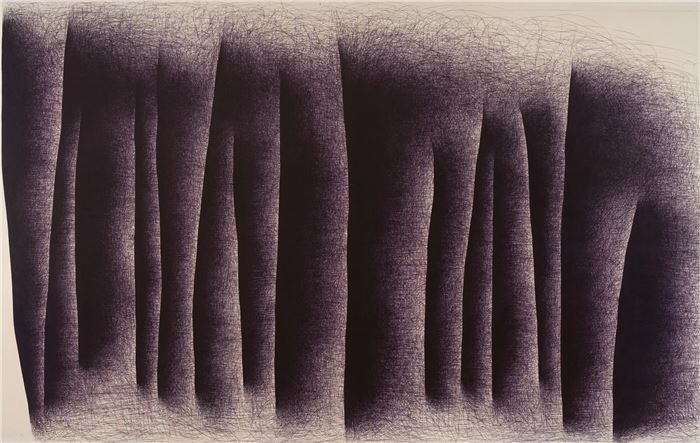
His work BK-002 (2006) offers an immediate visual experience that oscillates between landscape and pure drawing. Massed black ballpoint lines rise across the canvas like the dense trunks of a forest; at the edges, the lines tighten into solid, structural pillars, while toward the margins, they loosen and thin, allowing individual strokes to emerge before the grove dissolves into empty space. Though non-representational, the work evokes the landscape silhouettes for which the artist is best known, capturing the duality of his method: the way a single line can build form, and how it can simultaneously slip free of it.
Born in Seoul in 1952, Lee moved to New York in 1977, and by 1981, he had begun developing the ballpoint techniques that define his current practice. Using the humble office pen as his primary instrument across paper and canvas, Lee has created a body of work that exists in the liminal space between drawing and painting, marrying the traditions of East Asian ink work with the imposing scale of the New York School.
Represented by Art Projects International—the Tribeca gallery that hosted his first comprehensive survey of ballpoint drawings in 1997—Lee is currently the subject of the exhibition IL LEE: Works from the Collection. Running through November 21, 2026, the presentation sets recent examples of his mature style against seminal works from his early career, including BK-002. His work is held in the permanent collections of prestigious institutions such as the Metropolitan Museum of Art, LACMA, the Minneapolis Institute of Art, and the National Museum of Modern and Contemporary Art in Korea.
In a market season that has seen renewed interest in Korean modernism—highlighted by the high-profile sale of a 1971 canvas by Yoo Youngkuk at Frieze Seoul—Lee’s patient, rhythmic labor finds a natural, if idiosyncratic, home. While his work shares a certain spirit with the Dansaekhwa movement, influenced by figures like Lee Ufan and Park Seo-Bo, it stands apart as a singular, pioneer path forged in New York.
The System of the Line: Victor Vasarely
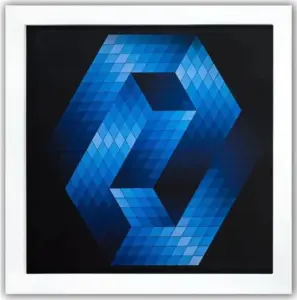
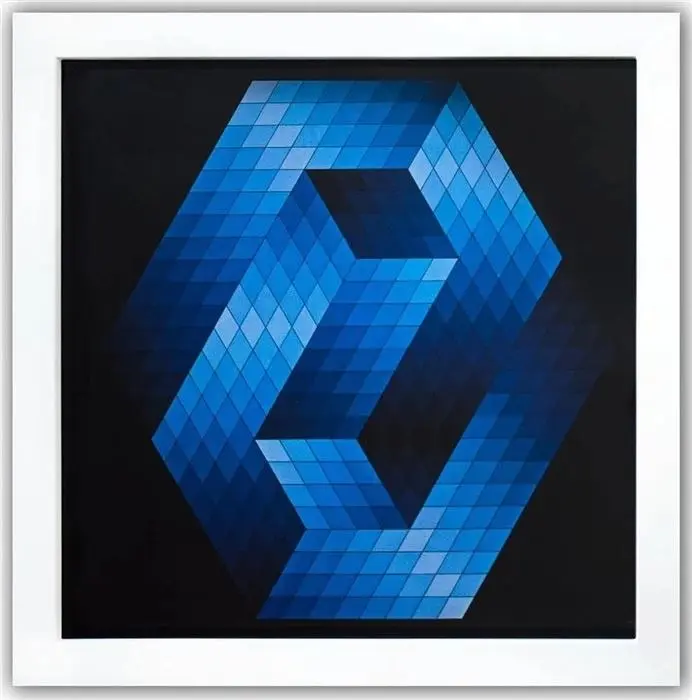
Where IL LEE’s repetition behaves with an organic, breathing irregularity, the work of Victor Vasarely is engineered to the millimeter. Vasarely’s Gestalt – Bleu (1971), a heliogravure, presents a blue cube twisting against a black ground. Its faces are constructed from bands that expand and compress with such precision that the viewer is forced into a state of perpetual indecision: is the cube receding, or is it projecting forward?
At 25.4 by 25.4 centimeters (10 by 10 inches), the work is small, yet it contains the distilled essence of Vasarely’s lifelong project. The Hungarian-born artist (1906–1997) utilized the systematic geometric unit as the building block of Op art, creating works that prioritized the reproducibility of visual language over the exclusivity of the unique canvas.
The Braselton Art Gallery in Georgia offers this piece at $635, a price point that underscores the vast chasm between the gallery wall and the auction house. In Paris this spring, for instance, Vasarely’s VEGA-ZETT-VA (1972) commanded €140,800 (approx. USD$166,400) at Sotheby’s—more than double its low estimate and a 36 percent increase over its 2020 price. Conversely, at a Christie’s sale the following day, Vonal-lum (1984) sold for €57,150 (approx. USD$67,300), an outcome that landed above its low estimate but represented a 19 percent decline from its 2022 performance.
These contrasting auction outcomes serve as a reminder that even for established names, the individual history, condition, and specific provenance of a work dictate its valuation. This principle holds true whether the work is a six-figure painting or a $635 heliogravure.
Ultimately, these three artists—Hockney, Lee, and Vasarely—describe an arc that moves from the line as narrative, to the line as accumulation, and finally to the line as a system. While the auction room remains the arena for high-stakes records, the gallery sector provides a vital alternative: a space where the conversation is direct, and the fundamental questions regarding an artwork’s life and legacy can be addressed with transparency. For those looking to engage with these works, galleries such as Gerrish Fine Art, Art Projects International, and Braselton Art Gallery provide the necessary depth of information that only a dealer’s expertise can offer.