Four years ago, while browsing through a local Goodwill in Wheaton, Illinois, then-college student Terrell Brown spotted an unusual, oversized ashtray. Priced at just $10, the ceramic piece featured a cartoon-like illustration of a fierce, cigarette-smoking young girl accompanied by the stark words “Too Young to Die.” While Brown recognized the striking visual style, he was entirely unfamiliar with the artist behind it. Seeking answers, he snapped a quick photo and uploaded it to Reddit, where a fellow user quickly enlightened him: “Yoshitomo Nara is a really cool and famous artist, this is an amazing find!”

That serendipitous discovery proved remarkably lucrative. Brown, who has since grown a massive following as a vintage reseller on TikTok with nearly 360,000 followers, eventually parted ways with the ashtray. Still preserved in its original packaging, the item sold on eBay for a staggering $2,860. The transaction highlights the profound cultural attraction and enduring afterlife of Yoshitomo Nara’s signature imagery. The Japanese artist’s instantly recognizable figures—typically round-headed children endowed with enormous, expressive eyes—oscillate dynamically between mischief, defiance, and deep melancholy. Deceptively simple in their execution, these characters are frequently paired with provocative slogans like “No nukes” and “Rock ’n’ roll is not dead.”

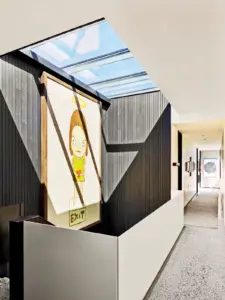
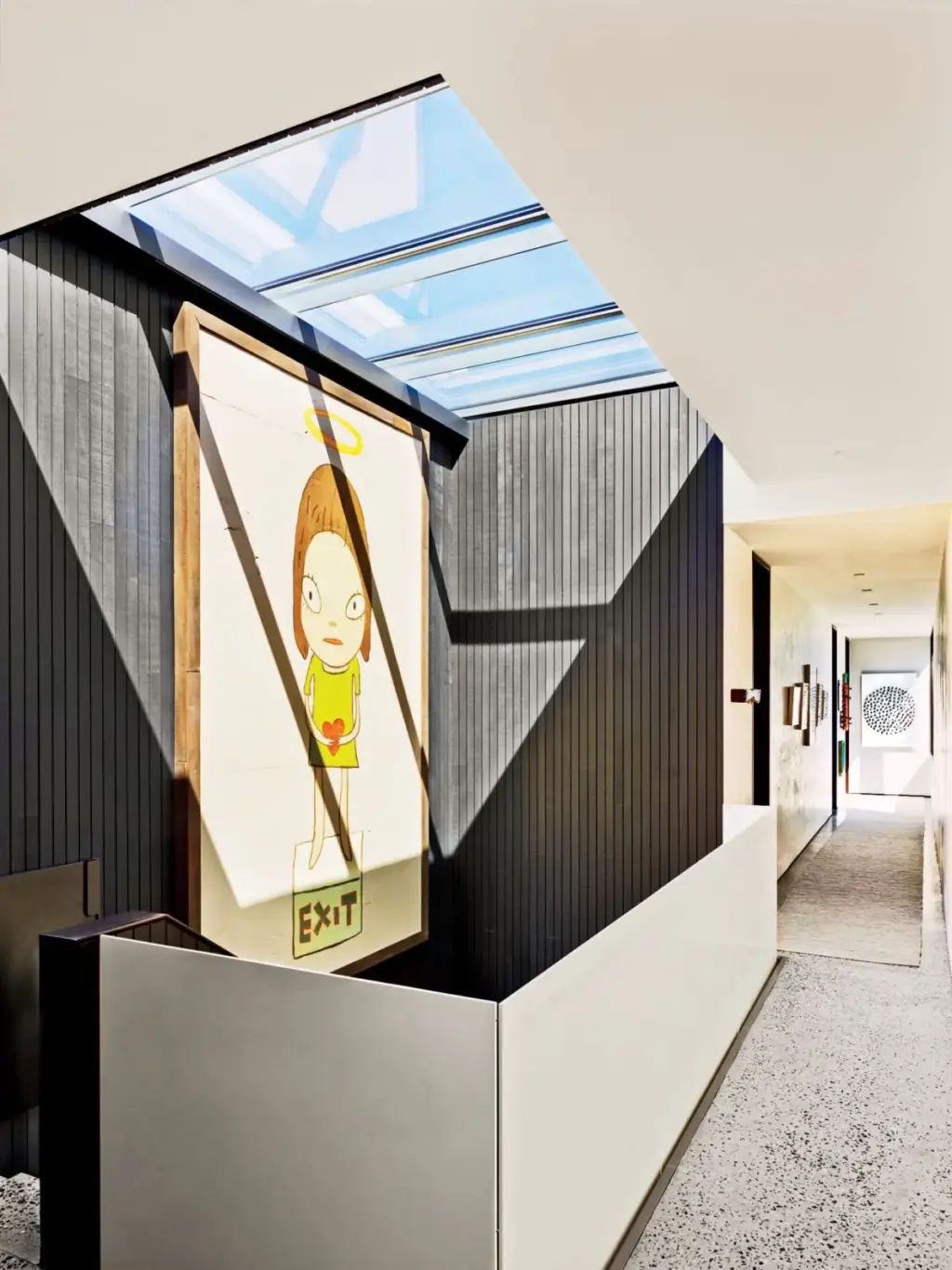
Today, Nara’s fan base spans an extraordinary socioeconomic spectrum. On one end sit some of the world’s wealthiest collectors and cultural figures, such as Salesforce founder Marc Benioff, a dedicated longtime collector of Nara’s work. Benioff notably supported a major retrospective of the artist’s work last year at London’s Hayward Gallery, an ambitious exhibition co-organized by the Guggenheim Museum Bilbao and the Museum Frieder Burda in Baden-Baden. Nara’s artwork has also cemented itself as a staple of elite interior design, frequently appearing in homes featured in publications like Architectural Design. High-profile examples include the whimsical Nara sculpture standing in Usher’s Atlanta backyard and the captivating painting prominently hung in Kris Jenner’s dining room.

On the other end of the spectrum, Nara enjoys immense popularity among Gen Z art lovers and everyday consumers who adore his illustrations without necessarily tracking the high-stakes fine art world. Nara’s creations have achieved a unique form of cult currency, circulating fluidly through college dorm rooms, digital marketplaces, thrift stores, and social media platforms. Over decades, these characters have grown so culturally ubiquitous that they almost seem to belong to the public at large.

This striking duality is brought into sharp focus as powerhouse art dealer David Zwirner unveils a major solo exhibition of Nara’s work in New York. Marking the artist’s first major solo presentation in the city in over a decade—and his inaugural exhibition with Zwirner after parting ways with Pace last year—the event promises to be a museum-quality showcase. Personally curated by Nara himself, the exhibition spans both of the gallery’s Chelsea locations, bringing together an extensive collection of paintings, drawings, and sculptures. Yet, true to form, the gallery will likely attract a diverse cross-section of admirers, ranging from elite institutional collectors to everyday fans who know his work as a vibrant decorative icon akin to Hello Kitty or Miffy.

Now in his 60s and based in Tochigi Prefecture, located roughly 100 miles north of Tokyo, Nara first emerged on the international contemporary art scene during the 1990s. The psychological complexity of his creations—balancing surface innocence with world-weary defiance—remains central to their universal appeal. Takako Nagasawa, deputy chairwoman at Phillips auction house, notes that the characters “look cute on the surface, but if you read into them, they’re not cute, like the girl who has a knife hidden behind her back.” Pointing out that many collectors proudly display his pieces in children’s bedrooms, Nagasawa suggests that this inherent two-sidedness explains the work’s potent relevance in modern culture. “I think that two-sidedness is the attraction, and very relevant now. We want to talk about what’s going on around the world, but we also don’t want to talk about it,” she observes.

Unlike many contemporary fine artists who strictly guard the boundary between high art and commercial merchandise, Nara actively embraces accessibility, extending his evocative imagery into thoughtfully designed everyday products. While other prominent artists have generated commercial characters—such as Kaws with his Companion and Jeff Koons with his balloon dog—none have achieved the widespread cultural endurance and deep emotional resonance of Nara’s figures, whose underlying rebelliousness continues to speak to disaffected youth across generations.

This philosophy of accessibility manifests in numerous creative partnerships. Yoshiki, the frontman of the legendary rock band X Japan, collaborated with Nara on the packaging for his Napa Valley wine collection, Y by Yoshiki, featuring the artist’s signature children. Similarly, fashion designer Stella McCartney, a close friend of Nara, has previewed her third limited-edition collaboration with the artist. The expansive collection ranges from accessible items like $100 shoelaces to luxury statements such as a $7,900 knit scarf. Furthermore, the merchandise directly overseen by Nara frequently mirrors the conceptual themes found in his fine art, encompassing $12 band-aids, $85 snow globes, and $1,200 table lamps sold through the MoMA Design Store. According to Chay Costello, associate director of merchandising and product development at MoMA, Nara remains one of the most frequently searched artists on the museum’s website.

Content creator Nick Lowry, who purchased a Nara ashtray on eBay two decades ago for $250, captured this dynamic in a recent viral TikTok video. Filming himself as he removed the object from its casual spot on his coffee table to proudly hang it on his living room wall—noting that the original acrylic painting inspiring the design resides in the permanent collection of the Rubell Museum in Miami—Lowry explained the rationale behind everyday curation. “Objects like this are one of the only ways to own work by a living artist whose paintings now sell for more than I could ever afford,” he told his audience, “so it deserved a better spot.”

Marc Benioff echoes this sentiment, describing Nara as “one of the most important artists of our time.” Benioff’s own collecting journey similarly began on eBay, where he purchased journals designed by the artist alongside his “little books” exploring the Zen Buddhist concept of Shoshin, or “beginner’s mind.” Having since befriended Nara through their mutual connection with Yoshiki, Benioff has built a substantial collection of the artist’s work, including a drawing of a grimacing girl inscribed with the phrase “I’m just alright,” a totemic fiberglass sculpture of two heads in a bowl, and a monumental bronze head. Reflecting on the shifting art market, Benioff acknowledges his fortunate timing: “It’s really almost impossible to get anything [on the primary market]. The best pieces all go to the museums.”

The opening of the Zwirner exhibition coincides with a wave of major secondary market offerings. Nara currently holds an auction record of $25 million, established in 2019 when his seven-and-a-half-foot canvas Knife Behind Back sold at Sotheby’s Hong Kong. Later this month, another massive canvas—the eight-and-a-half-foot painting Milky Lake / Thinking One, depicting a young girl with downcast eyes—is slated for sale on the online auction platform Fair Warning with an estimated value of $10 million.

Meanwhile, major auction houses are capitalizing on the heightened attention. Christie’s has slated an eight-foot-tall bronze version of Nara’s character Miss Forest for its upcoming 21st Century Evening Sale with an estimate of $1 million. Simultaneously, Sotheby’s is offering the 2001 painting Candy Blue Night at an estimated $5 million, alongside a 1999 edition of fiberglass sculptures titled The Little Pilgrims (Night Walking), carrying an estimate of $1.2 million. The sellers of the sculptural set, Theodore and Ruth Baum, originally acquired the pieces at auction two decades ago for a modest $360,000.

For the Zwirner gallery presentation, Nara has curated a retrospective dialogue by pairing early works from his student days in Düsseldorf during the 1980s and 1990s with his most recent creations, illustrating how drawing has continuously anchored his artistic evolution. The exhibition also features 13 oversized bronze heads, scaled up from palm-sized clay models that were directly inspired by the frozen snow “monsters” of Nara’s childhood winters in rural northern Japan. This New York showing directly aligns with the recent public reopening of the Hirshhorn Sculpture Garden in Washington, D.C., following a four-year renovation, where three larger aluminum iterations of the artist’s monumental heads are now permanently installed.

For most creators, maintaining a bridge between the exclusive world of multi-million-dollar museum masterpieces and mass-produced consumer products would present an insurmountable challenge. For Yoshitomo Nara, however, this very contradiction defines his enduring legacy. His art functions simultaneously as an elite market trophy and a teenager’s cherished trinket. While the Zwirner exhibition gathers the art world’s elite curators and top-tier collectors, the next generation of admirers will undoubtedly continue discovering his iconic, melancholic children somewhere else entirely—whether browsing online marketplaces, scrolling through social media, or wandering through a museum gift shop.