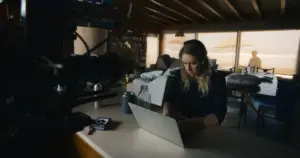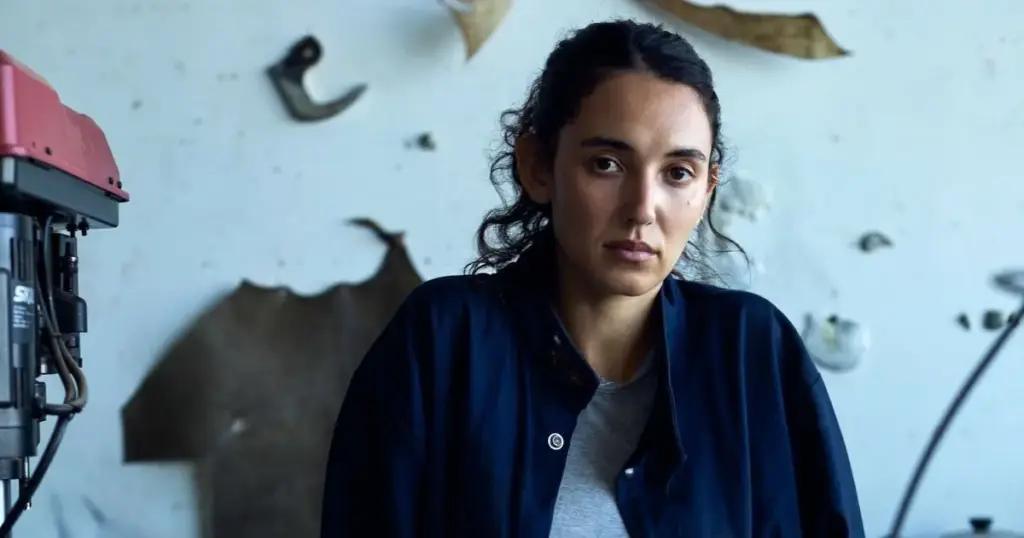
The Bushwick studio where Madeline Coven works is located on the hazy border between Queens and Brooklyn, tucked amid a gritty cluster of beef distributors and hydraulic repair shops, bustling gay nightclubs, and sprawling indoor adventure parks. Her shared workspace with a fellow artist is situated on the fourth floor of an industrial building that has been partially converted into a high-end members’ club. Visitors enter through a ground-floor lobby decked out in a curated suite of vintage furniture before taking the freight-style elevator up to Coven’s workspace. The atmosphere inside is consistently noisy with the distant, heavy clatter of street construction, and the room itself is neatly divided: one side is packed floor-to-ceiling with orderly cardboard storage boxes, while the other features the heavy drill presses, precision tools, and industrial ventilation hoses that form the standard vernacular of contemporary makers.
When I visited Coven in her studio last month, she was surrounded by metal-casting tests for an upcoming solo exhibition in Santa Fe, and our conversation quickly turned to the philosophical and physical limits of her design process. Using reference images she had uncovered in the paleontology archives of a New Mexico university, Coven had carefully carved the impressions of two prehistoric fossils into blocks of wood, then cast the resulting subterranean voids in molten aluminum.
"I’m always trying to recreate patterns or textures that occur naturally because they’re so unbelievable to me," Coven explains, gesturing toward the gleaming, textured metal pieces. "But the way they already exist is better than what I could ever make."
In this instance, the intense heat of the molten metal had inadvertently burned away some of the painstaking detail she had carved into the wood mold. Wasn’t that frustrating—even Sisyphean, I asked her—to constantly find oneself falling short of an impossible, organic benchmark?
"I’m not striving for perfection," Coven says without hesitation.
That is a remarkably refreshing perspective to hear from any creative professional. Coming from Coven, it reads not only as a healthy, grounded boundary set by a thoughtful Zillennial artist, but also as a succinct, accurate description of her entire studio practice. Before striking out on her own under her own name, she spent three formative years working within the studio of celebrated furniture designer Minjae Kim. She credits Kim with helping her develop a practical framework and operational mindset for running her own creative space, noting that "he does so much with so little and makes ideas work even without all the perfect tools and access." Before her time with Kim, she studied classical sculpture in college and subsequently worked as an artist’s assistant in Los Angeles.
Perhaps because she stems from a fine-art background rather than one strictly steeped in industrial design—where the primary focus is often on engineering the most functional way to produce a commercial object or selecting the optimal standardized material—Coven’s studio functions much more like a scientific laboratory. She creates finished work only after extended periods of rigorous experimentation, during which she carefully observes the myriad ways a material can act, bend, resist, or react under physical stress. It is a meticulous habit of observation she likely picked up from her father, an herbalist who frequently took Coven on long, meandering walks along the clearance ditches surrounding her childhood home in New Mexico.
"He’d stop and point out every single plant and take photos of it, and it would take forever just to go on a short walk," she recalls. "But I think that close observation of the world influenced me a lot."
The very first piece of design she ever created was built in collaboration with another alumnus from Minjae Kim’s studio, Jenna Graziano. Together, the two designers constructed a straight-backed seat featuring a heavy frame made from sand-cast recycled aluminum paired with a supportive sling crafted from raw cowhide. That initial collaborative effort happened three years ago, but nearly everything Coven has designed and produced in the years since has drawn from a remarkably similar materials palette, with occasional, deliberate detours into fiberglass and synthetic resin.
"I like materials that are forgiving, and I like for there to be room for error so unexpected things can happen," Coven notes.

That openness to serendipity has caught the attention of prominent curators and gallerists. For Tribeca gallerist Jacqueline Sullivan, Coven devised a striking series of wall sconces fashioned from animal hides accented with pewter embellishments. She later followed that with a collection of wall lights featuring flinty, lunar-like screens made by pouring sheets of pewter into shallow trays, manipulating the molten metal by hand as it cools and solidifies. For St Vincents in Antwerp, Coven designed a set of substantial mahogany tables edged in raw cowhide and pinned securely with square pewter fasteners that strongly resemble heavy belt buckles. In November, she is set to debut her next major body of work at Galerie Was on the Lower East Side: a series of nonfunctioning, sculptural vessels made from cow and goat hide, meticulously fastened together with custom pewter hardware.
Inside Coven’s studio, physical evidence of her ongoing experiments with these distinct materials is visible everywhere. The deep windowsill is lined with the various seeds and stones she frequently casts in metal; baking trays are piled high with globular, sculptural metal forms born from thermal tests; and a hot plate sits at her primary workstation, waiting to turn solid tin into a malleable, workable goo. Animal hides—which Coven first began sourcing years ago from a traditional leather-and-furs shop in her hometown of Albuquerque as a tactile alternative to fiberglass—are draped and gracefully wrapped around wooden bases, or rolled up in massive, heavy sheets on the floor like ancient scrolls, their natural scalloped edges flaring outward into the room.
"I’ve mostly been making tests so far," she says, speaking of the sculptural vessels bound for her upcoming exhibition at Galerie Was, while flipping through the pages of a sketchbook filled with hand-drawn sample vases featuring thick, robust bodies and pursed, expressive lips. As part of her rigorous research phase, she has also been deeply studying the historical evolution of ancient canteens, which were historically crafted from animal hides and meticulously sealed with beeswax to retain water.
During her material tests, Coven begins by thoroughly soaking the raw hides in water, then wrapping them tightly around welded steel armatures to dry, carefully observing how the organic material expands and contracts as moisture leaves the fibers. For anyone encountering animal hide at such close range within a contemporary design context, the material bears a distinct visual resemblance to fiberglass or stiffened canvas, yet it never lets the viewer forget its biological origins. When an entire hide is rolled out across the studio floor, distinct natural follicles and darker patches become immediately visible—evidence of where the animal once held more fat or muscle. When draped over sharp metal frames, the hides naturally form deep, organic folds that read alternately as human skin or even spun candy.
"There’s something very alive about it," Coven observes, running a hand along a curved surface. "It has a mind of its own. I’ve had finished pieces even warp a bit over time, which shows how it’s still living and changing."
Her prominent use of animal skin naturally brings up a broader, more complex philosophical query regarding contemporary design: What are the ethical and psychological consequences of incorporating a once-living creature into domestic objects? The question can manifest in unexpected ways. During the installation of her tables at St Vincents earlier this year, a resident dog repeatedly sniffed the furniture with intense curiosity.
"I was like, Oh right, this is a chew toy," she recalls with a laugh.
"There’s an eeriness to it, for sure," Coven admits, discussing the profound weight of the material. "I mean, it’s dead, and that feels heavy. But I’m not trying to ignore that weightiness."
Perhaps these are precisely the sorts of existential questions that every serious designer wrestles with at the dawn of their professional practice: Who am I as a maker? What are the tangible ramifications and rewards of the objects I am putting out into the physical world? Is there any genuinely ethical way to manufacture physical goods as a designer today? The crucial difference with Coven is that, at a tender stage in her career, she is actively willing to grapple with these complicated issues aloud. The resulting work is thoughtfully considered, deeply poetic, and compellingly executed.