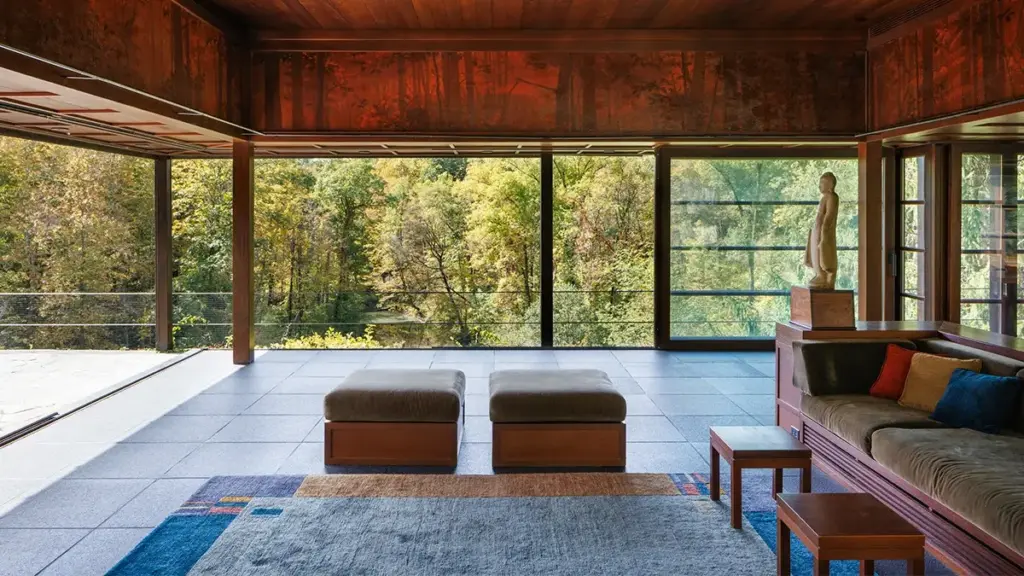
Nestled deep within the lush, rolling woodlands of upstate New York, an extraordinary architectural masterpiece known simply as the Waterfall House has officially hit the real estate market with an asking price of $8.5 million. Situated on a sprawling 21-acre parcel in Rhinebeck, the property is defined by a dramatic, 60-foot cascading waterfall that runs directly alongside the primary residence. The estate was conceived, designed, and meticulously shaped by the late architect Steve Mensch, whose life’s work on the land resulted in an intimate, seamless integration between modern structural design and the raw, natural beauty of the Hudson Valley.
Represented by Delyse Berry, founder of the Hudson Valley real estate and design firm Upstate Down, the multi-building compound is connected by a thoughtful network of stone paths and covered walkways. Berry’s history with the property spans more than a decade; she first approached Mensch roughly 13 years ago to manage rentals on the estate, back before she even held a real estate license. Over the years, the compound frequently functioned as a coveted high-end rental, attracting notable figures seeking privacy and inspiration in nature. Among its past tenants was acclaimed comedian, writer, and actress Amy Schumer, who resided on the estate while filming her 2020 docuseries, Expecting Amy. Today, the property stands ready for its next chapter as it transitions from a cherished family haven and private retreat into a luxury listing on the open market.

An Architectural Vision Rooted in the Landscape
The genesis of the Waterfall House dates back to 1995, when Steve Mensch first discovered the pristine, heavily wooded site along the Landsman Kill. Before drawing a single definitive blueprint, Mensch immersed himself completely in the environment. He spent significant stretches of time living simply on the property, setting up a cot and a drafting table inside an existing small cottage. For months, he observed how the changing seasons shifted the local light, how the wind moved through the tree canopy, and how the terrain responded to weather patterns.
This deep, patient observation culminated in a design philosophy that marries modernist architectural principles with distinct Japanese and Balinese influences. Rather than imposing a single, monolithic structure onto the delicate ecosystem—which would have severed the connection between the inhabitants and the outdoors—Mensch chose a decentralized approach. He divided the family compound into four separate copper-roofed buildings tucked organically into the woods. This layout was intentionally designed to accommodate his household, which included his wife, children, and a longtime life partner, while ensuring that moving between spaces became an immersive engagement with the surrounding forest and the constant, soothing sound of rushing water.

Inside the Main House and Independent Structures
The main residence serves as the anchor of the 21-acre compound, spanning 3,602 square feet and containing three bedrooms and two-and-a-half bathrooms. True to his innovative design ethos, Mensch deliberately flipped the traditional American floor plan. He elevated the main living areas and kitchen to the upper level, positioning them to take full advantage of the dramatic elevations and sweeping vistas of the waterfall below. Here, expansive floor-to-ceiling glass walls and warm wood ceilings create a luminous, organic gathering space. Retractable glass panels open outward, effectively dissolving the barrier between the interior and the exterior landscape, inviting the sights and sounds of the river directly inside.
Downstairs, the lower level houses the primary suite, two additional sleeping areas, and a dedicated media room, offering a more sheltered, intimate atmosphere rooted closer to the forest floor. Beyond the primary residence, the compound features two distinct guesthouses designed to host visitors with exceptional comfort and privacy. The larger guesthouse measures approximately 875 square feet and includes a cozy sleeping nook, a modern bathroom, and a covered porch that directly overlooks the river as it flows upstream. The second guesthouse, offering roughly 520 square feet, provides a self-contained living experience complete with a bedroom, a bathroom, a fully equipped kitchen, a comfortable living area, and a fireplace.

Adding to the property’s versatility is a separate 1,800-square-foot art and architecture studio. Tucked deeply among the mature trees and accessed via a charming private bridge leading to the front door, this standalone workspace includes its own bedroom, bathroom, and striking views of the cascading falls, making it an ideal sanctuary for creatives, writers, or artists.
A Storied Career and a Strategic Hudson Valley Location
The Waterfall House stands as one of Steve Mensch’s most defining and personal achievements, but it was far from his only notable contribution to architecture. After completing his architectural studies at Cornell University, Mensch earned early recognition by renovating an historic Egyptian Revival building perched dramatically above a gorge in Ithaca, New York. That specific project later caught the eye of renowned astronomer and science communicator Carl Sagan, who purchased the unique structure to serve as his home. Over the course of his distinguished career, Mensch went on to design and meticulously renovate residential properties throughout New York City and Pennsylvania before ultimately planting permanent roots in Rhinebeck, where he lived and worked until his passing in 2021 at the age of 78.

Despite offering an extraordinary level of seclusion, natural wilderness, and architectural privacy, the estate is exceptionally well-located. The property sits a mere five-minute drive from the vibrant heart of Rhinebeck’s historic village, known for its high-end boutiques, local dining, and cultural attractions. Furthermore, commuters and weekend travelers can reach the Amtrak train station in nearby Rhinecliff in under ten minutes, providing direct, seamless rail service into the heart of New York City and reinforcing the enduring appeal of the Hudson Valley luxury real estate market.