Over the past decade, a quiet revolution has been unfolding in laboratories around the globe as scientists make major, methodical progress in creating and manipulating two-dimensional materials. These ultra-thin substances exhibit unusual quantum properties that researchers believe could eventually support an entirely new generation of advanced technologies, fundamentally transforming computing, energy transmission, and data storage.
Some of these remarkable materials possess the capacity to become superconductors, allowing electrical current to flow without any energy loss whatsoever. Others develop complex charge orders, phenomena in which electrons settle into rigid, organized spatial patterns instead of moving freely and chaotically through a lattice.
Now, a team of researchers at the University of Chicago Pritzker School of Molecular Engineering (UChicago PME) has uncovered a profoundly unexpected form of behavior in one such advanced material known as $textFe_5textGeTe_2$. According to their findings, the material can enter a unique charge-ordered state where vast numbers of electrons move together extremely slowly while simultaneously maintaining strict quantum coherence.
The breakthrough findings, which have been published in the journal Science Advances, originated from the laboratory of Assistant Professor Shuolong Yang. This unexpected discovery directly challenges existing theoretical ideas regarding how the material behaves under specific physical conditions and points directly toward exciting, novel technological applications that could redefine how engineers approach memory devices.
"This is a fundamental discovery that deviates from theoretical predictions," Yang said regarding the team’s observations. "We now have to go back and think about the magnetic interactions of this material from scratch, but it also leads to new possibilities in using this material for new kinds of memory devices."
Millions of Electrons Moving Together
Discovered seven years ago, $textFe_5textGeTe_2$ belongs to a rapidly growing and intensely studied family of materials known as van der Waals magnets. Because these layered substances can be cleaved or grown into atomically thin sheets, researchers worldwide are actively exploring whether they might enable memory technologies that are vastly superior, faster, and more energy-efficient than those built with conventional magnetic materials currently dominating the electronics industry.
To unravel the inner workings of $textFe_5textGeTe_2$, Yang and his colleagues—including postdoctoral scholars Gabriele Berruto and Qiang Gao—examined samples of the material using a specialized technique called angle-resolved photoemission spectroscopy, commonly known as ARPES. This sophisticated experimental approach involves shining high-intensity photons onto a material, which cleanly ejects electrons from its surface. By measuring the angles and kinetic energies of these escaping particles, researchers can accurately map the material’s underlying electronic structure and its complex magnetic states.
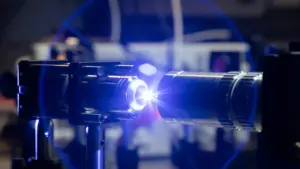
During their experiments, the team focused an ultraviolet laser onto a microscopic area just 10 micrometers across. What they observed through the ARPES measurements was entirely unexpected. The material displayed what physicists call a flat electronic band. In practical terms, this means that the range of electron energies associated with electrical conduction changed very little across the momentum space of the material.
In a normal conductor, electrons zip through the atomic lattice with varying speeds and trajectories. However, when a material exhibits a flat electronic band, electrons do not move through the substance as quickly as they normally would. Instead, their velocity drops dramatically, and they begin to behave collectively, bound by quantum mechanical rules.
"We’re not measuring one electron," Yang explained, emphasizing the collective nature of the quantum state. "We’re measuring the interaction of thousands or millions of electrons, and they are all moving together in a coherent way. That’s a quantum many-body phenomenon, and it’s actually a very weird thing."
A Quantum Version of Slow Motion
To help conceptualize this unusual physical phenomenon, Yang compares the collective electron behavior to water flowing through a natural landscape. A steep slope, he notes, makes water move quickly and turbulently, whereas a shallow, level slope produces a much slower, more uniform flow. In a remarkably similar physical analogy, the flat electronic band corresponds to electrons moving in a coordinated, sluggish manner, heavily influenced by their mutual interactions rather than just the background atomic potential.
This discovery fundamentally changes how researchers understand $textFe_5textGeTe_2$, a versatile material that is already known to exist in several different atomic arrangements and structural phases.
"From a scientific perspective, it suggests that the magnetic interactions within the material are totally different from what theory predicts," noted Gabriele Berruto, highlighting the gap between current theoretical models and experimental reality.
Beyond its fundamental scientific implications, this unusual behavior could carry profound practical consequences for device engineering. Because $textFe_5textGeTe_2$ can occupy multiple distinct magnetic states, those stable states could potentially be utilized to represent, process, and store digital information in future computing architectures.
Building on these insights, Yang and his colleagues are now actively investigating whether a tightly focused laser pulse can be used to dynamically switch the material between this newly discovered quantum many-body phase and other competing phases. Their preliminary work indicates that such precise optical switching is indeed possible, raising the tantalizing possibility that the effect could eventually be incorporated directly into an ultrafast, non-volatile memory device.
Pushing Quantum Behavior Toward Room Temperature
One of the most persistent hurdles in quantum materials research is that many of the most fascinating and exotic quantum effects are notoriously fragile. Typically, they only survive at extreme cryogenic temperatures very close to absolute zero, requiring expensive and bulky cooling equipment that prevents commercial adoption.
In this case, however, the UChicago researchers made an encouraging discovery: the coherent collective behavior persisted up to 100 degrees above absolute zero. While 100 Kelvin is still far below everyday room temperature, it is relatively high compared to many similar quantum materials studied in laboratories today, making the result especially promising for future technological applications.
"If we eventually want to use it in a memory device, it needs to work at room temperature," said Qiang Gao, who contributed to the research as a postdoctoral scholar and is now a research scientist at Lawrence Berkeley National Laboratory.
With the baseline behavior established, the team’s next scientific goal is to determine whether these exact same remarkable properties remain intact when $textFe_5textGeTe_2$ is exfoliated down until it is only a single atomic layer thick, realizing the true two-dimensional potential of the van der Waals magnet.
Remembering Physicist Peter Littlewood
The publication of these findings marks a poignant moment for the research group, as the study was one of the final research publications involving Peter Littlewood, a distinguished and deeply respected UChicago physicist who passed away on June 15.
"He was a great theoretical physicist and a leader of quantum materials research at UChicago," Yang said, honoring his late colleague’s immense contributions to the field. "We dedicate this paper to him."
In addition to Yang, Berruto, and Gao, the collaborative study’s authors include Khanh Duy Nguyen, Chaowei Hu, Paul Malinowski, Haoran Lin, Beomjoon Goh, Bo Gyu Jang, Xiaodong Xu, and Jiun-Haw Chu.
The research conducted at the University of Chicago was supported by the U.S. Department of Energy under Grant No. DE-SC0022960, and received partial support from the Gordon and Betty Moore Foundation under Grant No. GBMF12763.