Scientists have identified a critical hidden factor that can determine whether a chemical reaction succeeds or fails, paving the way for significantly cleaner and more efficient manufacturing methods. By precisely controlling tiny, microscopic changes in acidity near electrodes, researchers at Seoul National University dramatically improved the production of valuable chemical ingredients, raising the proportion of the desired product from approximately 16% to 97%.
The breakthrough, spearheaded by Professor Jaeyune Ryu of the Department of Chemical and Biological Engineering at the Seoul National University College of Engineering, could fundamentally alter how industries approach chemical manufacturing. By using oxygen and electricity to produce essential compounds, the newly developed method eliminates the need for the separate addition of hazardous peroxide oxidants, offering a pathway toward safer, more sustainable industrial processes. These compounds are vital for creating everyday materials, including plastics, medicines, and adhesives.
At the heart of the team’s discovery is a surprisingly overlooked phenomenon known as "local pH"—the specific acidity or alkalinity in the immediate microscopic surroundings of an electrode. By redesigning a chemical reactor to optimize the distance between electrodes and regulate the flow of liquid through the system, the research team successfully managed these local conditions, yielding a massive improvement in overall reaction performance.
The implications of the work extend across two major families of industrially significant chemicals: lactones and epoxides. Lactones serve as essential starting materials for the creation of biodegradable plastics and polyurethanes, while epoxides are heavily utilized in the manufacture of adhesives, protective coatings, and the epoxy resins integral to electronic materials. Furthermore, both chemical families play foundational roles in the synthesis of pharmaceuticals and other specialized fine chemicals.
Details of the breakthrough have been published in the Journal of the American Chemical Society (JACS), a leading peer-reviewed publication of the American Chemical Society (ACS).
The Hidden Chemistry That Can Make or Break a Reaction
The research is rooted in organic electrosynthesis, a technique that leverages electrical energy to drive chemical reactions and synthesize carbon-based compounds. This technological approach has attracted intense scientific and industrial interest because it offers a viable path to reduce or eliminate the hazardous chemical oxidizing and reducing agents traditionally required in manufacturing. While these traditional agents facilitate reactions by accepting or donating electrons, many are dangerous to handle and generate significant quantities of unwanted chemical waste.
Historically, efforts to refine organic electrosynthesis have concentrated on familiar parameters, such as electrical voltage, the composition of the liquid electrolyte solution, and the materials chosen for the electrodes. However, Professor Ryu and his colleagues suspected that a vital element was being missed entirely: the microscopic chemical environment situated immediately adjacent to each electrode.
This boundary layer is the exact spatial zone where molecules exchange electrons and undergo transformative chemical changes. Although the bulk solution filling a reactor may appear entirely uniform, conditions within this microscopic region can diverge drastically.
A primary driver of this divergence is pH. During standard electrochemical reactions, hydrogen ions—commonly referred to as protons—are continuously produced or consumed directly at the surface of the electrodes. When these ions are generated or removed faster than they can physically diffuse through the surrounding liquid, the local pH near the electrode shifts dramatically, creating an environment entirely distinct from the pH measured in the broader solution.
The research team discovered that these localized pH disparities can critically impact a reaction in multiple ways. They can alter the generation of reactive oxygen species, shift the chemical behavior of starting materials, and even destabilize newly formed products, causing them to break down prematurely. Consequently, a chemical reaction can easily fail even when macroscopic measurements indicate that the overall solution possesses ideal conditions.
An Overlooked Problem May Affect Many Chemical Reactions
To gauge whether this hidden phenomenon was an isolated incident or a widespread issue, the researchers conducted a comprehensive review of more than 600 scientific papers on organic electrosynthesis published over the preceding decade, starting from 2010.
Their analysis revealed that approximately 89% of those studies involved reactions occurring at one or more electrodes where both electrons and protons were actively transferred. Because proton movement directly alters local acidity, this high percentage suggests that overlooked pH variations near electrodes likely influence a broad spectrum of electrochemical reactions far beyond the team’s specific test cases.
The research team also measured the extreme boundaries these local environments could reach. Even when the bulk solution remained strictly neutral, calculations and measurements indicated that conditions near the cathode—the electrode where reduction reactions occur—could spike to roughly pH 11, generating a strongly alkaline microenvironment. Conversely, the region surrounding the anode, where oxidation takes place, could plunge to approximately pH 2.5, creating a strongly acidic zone.
These steep gradients carry major consequences. Under such extreme local conditions, the reactive oxygen species required to drive target reactions may be depleted, starting materials can undergo unwanted chemical alterations, and delicate products can rapidly degrade. Adjusting the pH of the entire bulk solution therefore proves ineffective; the true battleground for the chemistry is the microscopic layer directly adjacent to the electrode surfaces.
Making Valuable Chemicals With Oxygen and Electricity
To demonstrate the practical utility of their insights, the scientists focused on a well-known chemical process called Baeyer-Villiger oxidation. This classic reaction introduces an oxygen atom into an organic ketone molecule, converting it into an ester or a cyclic lactone. Lactones are critical ring-shaped chemical building blocks utilized in biodegradable plastics and polyurethanes.
Traditional industrial applications of Baeyer-Villiger oxidation frequently rely on hazardous oxidizing chemicals, such as peroxyacids. While effective, these substances introduce severe challenges concerning safe handling, chemical waste management, and the neutralization of unwanted byproducts.
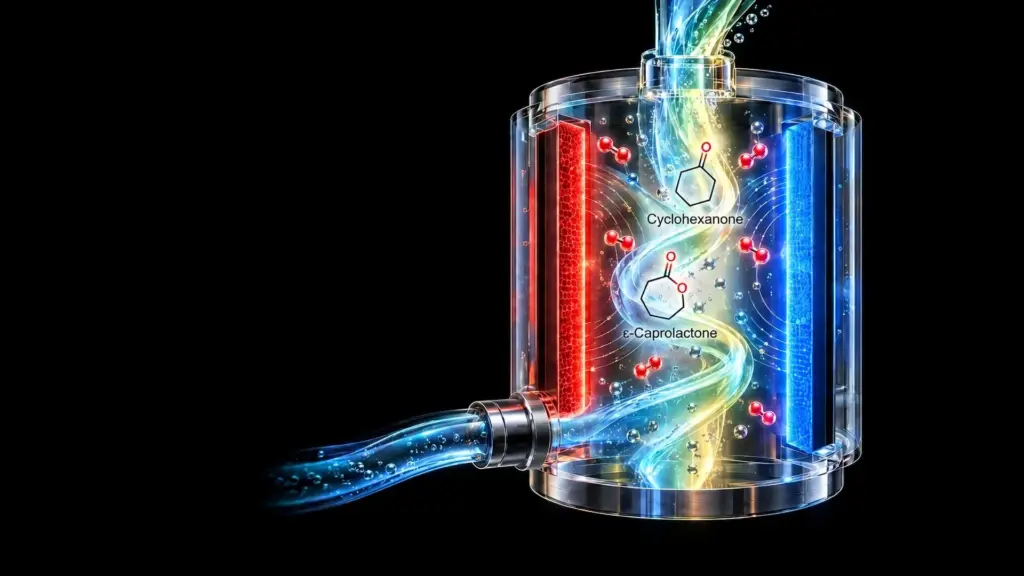
The Seoul National University team bypassed these traditional oxidants by developing an electrochemical alternative. Rather than supplying oxidants from external sources, they utilized electrical energy to activate oxygen gas directly at an electrode, generating reactive oxygen species capable of inserting oxygen atoms straight into organic molecules.
Isotope-tracing experiments verified that the oxygen incorporated into the final products originated directly from the oxygen gas rather than from the water in the solution. Furthermore, the team uncovered an important cooperative mechanism between the two electrodes. At the cathode, the reduction of oxygen generates reactive species that initiate the oxygen-transfer reaction. Hydrogen peroxide produced during this phase can then be recycled and converted back into reactive oxygen species at the anode, helping to sustain a steady supply of the chemical agents necessary for the reaction to proceed.
However, this entire cascade remains highly sensitive to local electrode acidity. If the local pH drifts into extreme territory, the efficiency of the chemistry drops precipitously.
A Simple Reactor Redesign Boosts Selectivity From 16% to 97%
Armed with an understanding of local pH dynamics, the researchers investigated ways to actively control them. Utilizing advanced computer simulations alongside precise electrochemical measurements, they engineered a novel reactor design that positions the electrodes in close physical proximity while forcing the liquid electrolyte—the conductive fluid carrying the reactants—to flow continuously between them.
The underlying strategy was to prevent extreme acidity differences from accumulating. Because the anode zone naturally trends acidic while the cathode zone trends alkaline, placing these regions close together and circulating the liquid effectively neutralizes and balances their opposing effects.
The resulting performance leap was striking. Under baseline conditions where local pH variations were left unchecked, roughly 16% of the resulting products consisted of the desired target compound. With the optimized reactor design in place, that selectivity soared to approximately 97%. This high degree of selectivity means the reaction successfully produced the intended substance while avoiding the creation of unwanted byproducts.
Further experimentation demonstrated that manipulating the flow rate of the electrolyte exerted a profound influence on production metrics. Across the tested flow rates, the volume of product generated per unit time increased by roughly 14 times from the lowest flow rate to the highest. Shortening the distance between the electrodes from 20 millimeters to 4 millimeters produced an additional 2.2-fold increase in the production rate.
Perhaps the most telling trial occurred when liquid flow was entirely halted. Even though the applied voltage and the overall chemical composition of the solution remained unchanged, the system yielded virtually none of the desired product. This stark contrast underscored that the success of an electrochemical reaction depends just as heavily on the physical reactor design and microscopic environmental control as it does on the primary ingredients, voltage, and electrode materials.
Applications for Biodegradable Plastics, Medicines, and Electronics
Having validated their reactor design, the researchers expanded their investigation to determine whether the strategy could be adapted to manufacture a wider variety of useful chemical compounds.
Under their optimized conditions, the team successfully synthesized lactones derived from 18 different ketone starting materials. A notable highlight was the successful synthesis of ε-caprolactone with an 82% yield. This specific compound serves as a vital precursor for polycaprolactone, a biodegradable polymer widely utilized in medical fields for applications such as surgical sutures and advanced drug-delivery systems.
In addition to lactones, the researchers applied their local pH control methodology to the production of epoxides, successfully obtaining target compounds from six distinct alkene starting materials. Epoxides are crucial ingredients utilized in industrial adhesives, surface coatings, and the epoxy resins essential for electronics manufacturing, as well as serving as valuable intermediates in the synthesis of pharmaceuticals.
These cumulative experiments demonstrated that managing the microscopic environment surrounding electrodes is not restricted to a single chemical pathway. Instead, the approach points toward a versatile, broadly applicable strategy for enhancing the synthesis of numerous commercially important chemicals.
Toward Cleaner and More Sustainable Chemical Manufacturing
One of the most compelling advantages of the newly developed technique is its reliance on clean inputs—oxygen and electricity—while entirely eliminating the need for externally introduced peroxide oxidants. Furthermore, the reactions occur under mild ambient conditions at room temperature and normal atmospheric pressure, removing the requirement for energy-intensive industrial heating or pressurization equipment.
These operational characteristics promise to simplify chemical processing while enhancing workplace safety. Because electricity serves as the primary energy source, the method holds long-term potential for integration with renewable energy infrastructure, supporting the transition toward sustainable chemical manufacturing.
The researchers note that the production of high-value specialty chemicals and pharmaceutical ingredients represents a particularly promising avenue for the technology. Such sectors demand rigorous control over reaction parameters alongside stringent safety protocols, fields where electrochemical methods can provide distinct advantages by limiting the handling of hazardous reagents and enabling production within compact apparatuses.
Nevertheless, the technology requires further refinement before achieving widespread commercial viability. Additional engineering optimization and rigorous testing at larger scales will be required to establish whether these laboratory breakthroughs can be reliably and economically reproduced in full-scale industrial manufacturing environments.
A New Way to Think About Chemical Reactions
Beyond its immediate practical applications, the discovery offers a paradigm shift in how electrochemical systems are conceptualized and engineered. Traditionally, chemical research has focused heavily on optimizing starting materials, catalysts, electrode surfaces, applied voltages, and bulk solution compositions.
The findings from Seoul National University suggest that governing the microscopic environment where molecules actually react is equally paramount, shifting the industry’s focus toward designing the local habitat in which chemical transformations take place.
"This study transforms ‘local pH’ near the electrode from a hidden variable into a controllable design principle," Professor Ryu stated. "To improve the efficiency of organic electrosynthesis, we need to design not only the reaction substrates and catalysts, but also the environment in which the molecules actually react."
The research team anticipates that this principle will unlock opportunities to optimize other complex electrochemical processes, particularly those governed by the simultaneous transfer of electrons and protons. Rather than treating local acidity as an unavoidable nuisance, future chemical reactors can be intentionally engineered to maintain micro-conditions tailored to favor target reactions.
The study was co-authored by Seonghyeon Min and Junghoon Lee, both master’s degree students in the Department of Chemical and Biological Engineering at Seoul National University, alongside integrated master’s and doctoral student Hanju Kim. Min and Lee intend to build upon these findings, exploring how local reaction environments impact a broader array of organic electrosynthesis pathways and manufacturing workflows.
Support for the research was provided by Seoul National University, the National Research Foundation of Korea, and the Institute for Basic Science (IBS).