Architects are rarely afforded the opportunity to truly spread their artistic wings and cross disciplinary boundaries to join forces with professionals in the performing arts. For most designers, the canvas remains fixed in steel, glass, concrete, and stone—bound by structural integrity, zoning laws, and the permanence of the built environment. So when the rare and exciting opportunity to work directly with modern dance legend Merce Cunningham presented itself to Benedetta Tagliabue, the principal of the renowned Barcelona-based architectural studio Miralles Tagliabue, she did not hesitate for a second and eagerly jumped at the chance.
For his part, over the course of an illustrious career spanning six decades, Cunningham has become just as famous for his unique, highly unexpected, and boundary-pushing collaborations as he is for his own groundbreaking choreography. Throughout his legendary trajectory, he has partnered with towering figures in the visual arts, famously working alongside iconic painters such as Robert Rauschenberg and Jasper Johns. More recently, he has brought his avant-garde vision into the realm of modern music, collaborating with acclaimed rock bands like Radiohead and Sigur Rós. For Cunningham, this cross-pollination of disciplines is not merely a novelty; it is a fundamental driving force of his creative life.
"I’m interested in artists that explore new ways of working, certainly in music, but in design also," Cunningham explains, highlighting an ethos that has defined his approach to performance art for more than half a century.
This distinguished and unexpected pairing between the avant-garde choreographer and the celebrated architect came about at the direct suggestion of Trevor Carlson, the executive director of the Merce Cunningham Dance Company in New York City. The artistic team was planning a special, high-profile performance at the prestigious Brooklyn Academy of Music (BAM) to celebrate Cunningham’s momentous 90th birthday, scheduled for April 16. In developing the concept for the landmark event, the company made the bold decision to physically alter the traditional dynamic of the performance space by bringing the musicians out of the shadows of the orchestra pit and right onto the main stage alongside the dancers.

"It seemed clear that if we were taking the musicians out of the orchestra pit and putting them on stage, it would be best to work with an architect," Carlson says, detailing the conceptual leap that led him to reach out to the design world. "I was introduced to Benedetta in Barcelona. What struck me about her architecture is the dialogue her buildings have with the community around them," he adds, pointing to prominent, praised projects such as Barcelona’s vibrant and undulating Santa Caterina market, completed in 2005.
Drawing a parallel between urban design and the performing arts, Carlson notes that the transition is remarkably natural. "It’s no different working on a stage with a group of dancers and musicians—you’re simply agreeing to occupy the same space at the same time."
For Tagliabue, accepting the commission meant stepping well outside the traditional boundaries of architectural practice, though it was not her absolute first brush with the performing arts. Prior to her collaboration with Cunningham, she had only designed for the stage on one single occasion—creating the visual environment for an opera production at Barcelona’s historic Liceu theatre.
"I had no real experience doing this," she recalls candidly. "Like Merce, though, I enjoy taking risks."
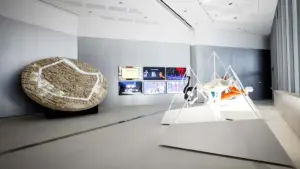
Yet, while Cunningham has famously built his entire career on leaving things to chance—adopting chance operations as a core compositional tool, quite literally through the simple toss of a coin—Tagliabue has naturally maintained a deeply architectural and structured approach to her design process. The complex geometries, crystalline formations, and brilliant reflective qualities of crystal served as the primary inspiration for the initial design concept. This initial spark has since been carefully developed and refined through a series of intricate, highly angular physical models. The inherent dynamism of these models, which has long stood as a celebrated trademark of her studio’s architectural work, will undoubtedly be heightened and intensified on the stage by the physical interaction of the musicians and dancers moving through the space.

Despite the complexity of merging spatial design with live, unpredictable choreography, meetings between the key collaborators in the months leading up to the performance have been surprisingly limited. Distance, demanding international schedules, and the nature of their respective creative practices meant that face-to-face planning sessions were kept to a minimum.
"Working this way, there has to be some form of good faith," Cunningham admits, acknowledging the high-wire act of trusting an external collaborator with the visual framework of a major milestone performance. "That moment when we all can see it come together usually isn’t until the dress rehearsal. On occasion, there hasn’t even been a dress rehearsal."
For a master artist who has spent a lifetime embracing spontaneity and deeply enjoys the thrill of artistic surprises, all bets are certainly on this unique architectural and dance collaboration proving to be a very special birthday surprise for both the creator and his audiences.
Merce Cunningham at 90 will run at the Brooklyn Academy of Music in Brooklyn, New York, from April 16 through April 19, 2009.