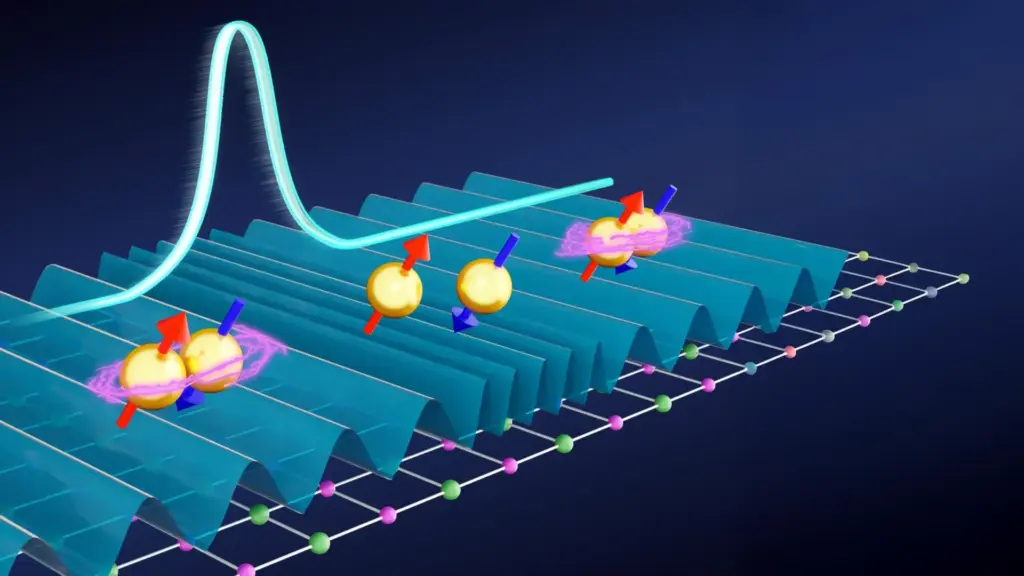
Superconductors remain among the most fascinating and remarkable materials studied in modern quantum physics. When certain specialized materials are cooled below a specific, critical transition temperature, a profound transformation occurs: their electrical resistance completely vanishes. Under these ideal conditions, electrical current can flow through the material indefinitely without losing a single fraction of its energy as heat. This zero-resistance state is made possible by the formation of correlated electron pairs known as Cooper pairs. Instead of navigating the atomic lattice independently, these paired electrons act collectively, moving in a synchronized wave-like manner through the material’s structure.
This extraordinary property endows superconductors with immense practical and theoretical promise. They are foundational to the development of powerful electromagnets used in particle accelerators and medical imaging, highly sensitive magnetic detectors, and the complex quantum circuits required for advanced quantum computing. However, the superconducting state is not an invincible fortress; it cannot withstand unlimited electrical current. Once the applied current exceeds a certain threshold, the superconducting state begins to fail, marking the boundary of what physicists refer to as the critical current—the maximum load a material can carry before electrical resistance and thermal energy loss reappear.
Why Superconductors Usually Break Down Early
In conventional type-II superconductors, the critical current measured during standard laboratory experiments rarely reflects the true, microscopic limit of superconductivity itself. Instead, experimental failure is almost always triggered prematurely by the movement of vortices. These are microscopic regions within the material where magnetic flux is allowed to pass through. As the operational electrical current increases, these magnetic vortices experience a Lorentz force that causes them to begin moving across the sample.
The motion of these vortices creates localized electrical resistance and generates destructive heat, which can quickly avalanche and completely destroy the superconducting state long before the material reaches its theoretical capacity. In reality, superconductors possess a much higher fundamental limit known as the depairing current.
"One way to picture it is that the current ‘twists’ the phase of the coherent quantum state of the superconductor, rather like winding a spring," explains Eryin Wang, the lead author of the study.
If this delicate quantum state is twisted too far by an overwhelming current, it rapidly becomes unstable. At that critical juncture, the Cooper pairs responsible for carrying the lossless current begin to break apart entirely. Conventional direct-current transport measurements almost never reach this intrinsic limit because the moving vortices and the accompanying thermal dissipation invariably disrupt the superconductivity first, masking the true underlying physics.
Outrunning the Vortices
To solve this long-standing experimental bottleneck, a team of researchers developed an ingenious way to bypass the disruptive effects of vortex motion by delivering extremely short, targeted bursts of electrical current.
"Our strategy was to outrun the vortex dynamics," says Eryin Wang.
While magnetic vortices can travel at remarkable speeds reaching tens of kilometers per second, distance is ultimately constrained by time. Over the span of a single picosecond—a trillionth of a second—these vortices can only move a distance of tens of nanometers. By applying an electrical current for an unimaginably brief period, researchers can successfully drive the current density to extraordinarily high levels before the vortices have enough physical time to move significantly or generate enough heat to ruin the sample.
This precise temporal control sharply reduces the energy loss typically caused by vortex motion. More importantly, it allows scientists to push the superconducting state far closer to its fundamental current limit than ever achieved before in standard configurations.
Electrical Pulses Lasting Just Picoseconds
To produce these exceptionally short and powerful currents, the research team utilized an advanced ultrafast electrical-transport platform that has been under development at the Max Planck Institute for the Structure and Dynamics of Matter (MPSD).
"To apply current to superconductors for only a few picoseconds, we used the ultrafast electrical-transport platform that we have been developing at our institute," explains Guido Meier, a co-author of the study.
The sophisticated system relies on specialized photoconductive switches that are precisely triggered by 300-femtosecond green laser pulses operating at a wavelength of 515 nanometers. Once activated by the laser, these switches generate ultra-short electrical pulses lasting only a few picoseconds. These high-speed pulses then travel along a coplanar waveguide before passing directly through superconducting samples that measure only micrometers in size, ensuring that the entire event occurs under tightly controlled laboratory conditions.
Two Superconductors Respond Very Differently
To test the capabilities of this new picosecond transport platform, the researchers deliberately selected two distinct materials: niobium nitride (NbN) and yttrium barium copper oxide (YBCO). These materials were chosen because they represent fundamentally different forms of superconductivity found in nature. NbN features a relatively uniform superconducting energy gap, classified as an s-wave symmetry. In stark contrast, YBCO possesses a complex energy gap that changes strongly and continuously depending on the crystallographic direction, known as a d-wave symmetry.
Studying both materials side by side allowed the research team to investigate how the microscopic internal structure of the superconducting state directly influences what happens when extremely strong, ultrafast currents are applied.
The experiments revealed striking differences in material behavior. NbN remained strongly and steadily superconducting until the applied current reached a distinct, sharp threshold that was far higher than its conventional direct-current critical limit. Once the current surpassed this exact point, the material’s electrical response changed abruptly, serving as a clear signature that its Cooper pairs were finally beginning to break apart.
YBCO, however, behaved in a remarkably different manner. Instead of remaining stable up to a sharp cliff and then failing abruptly, its superconducting state weakened progressively and smoothly as the current increased.
The researchers attribute this stark divergence to the distinct internal microscopic structures of the two compounds. In NbN, the superconducting energy gap is almost uniform in every direction, creating a unified threshold for pair-breaking. In YBCO, the energy gap varies considerably with direction and even disappears entirely along certain crystallographic axes. This unique structural geometry allows superconductivity in YBCO to weaken gradually rather than collapsing all at once at a single sharply defined threshold.
Revealing Hidden Superconducting Physics
The implications of these experiments extend far beyond measuring higher currents, opening a new window into quantum materials that were previously obscured by experimental limitations.
"Our results suggest that picosecond transport can provide access to microscopic properties of superconductors, including their gap symmetry, that are not directly available from conventional DC transport," notes Andrea Cavalleri, who leads the research group at MPSD.
Moving forward, researchers will need to examine a much wider range of superconducting materials to determine how broadly this relationship applies across different classes of quantum compounds.
More generally, the findings demonstrate that deploying extremely short electrical pulses can successfully expose forms of superconducting transport that are normally concealed by slower, secondary effects such as vortex movement and thermal dissipation. By working on temporal timescales that are directly comparable to the intrinsic dynamics of the superconducting state itself, scientists may soon gain powerful new ways to investigate, manipulate, and ultimately control these complex quantum materials. This newly accessible regime of ultra-high current superconductivity could also eventually yield practical implications for advanced optoelectronics and high-performance magnetic devices.